Southern California Heat Advisory: Record-Threatening March Temperatures to Bake 16.8 Million Residents Through Friday

Southern California is about to experience what forecasters are calling an extraordinary and historically anomalous heat event — temperatures more typical of mid-July arriving in the second week of March, with all-time records within reach across a region that covers tens of millions of people.
What the NWS Is Warning
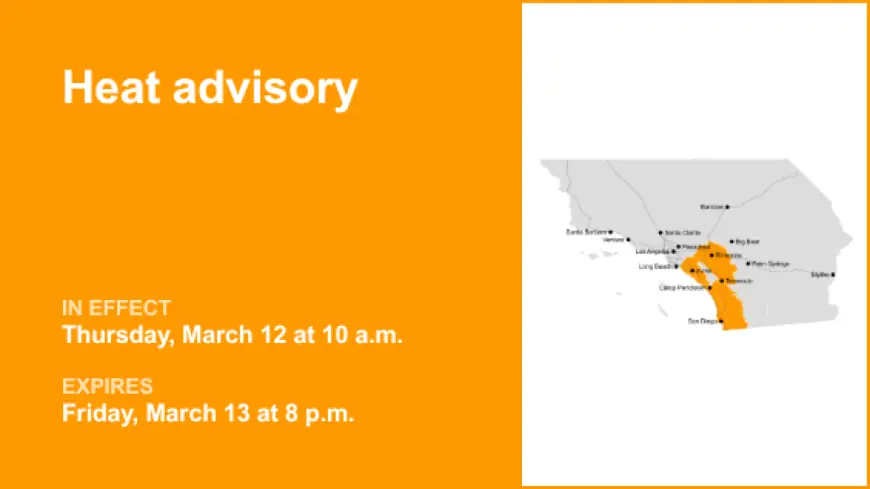
The National Weather Service has issued a 34-hour advisory covering San Diego, Orange, Riverside, San Bernardino, Los Angeles, and Ventura counties, warning that heat-related illnesses are a serious risk — particularly for people without air conditioning or those who must spend time outside.
For the coasts and coastal valleys of Ventura and Los Angeles counties, the advisory runs from 10 a.m. Thursday to 8 p.m. Friday PT, with widespread temperatures expected to hit 90 to 100 degrees. Inland, it gets worse. Orange County and San Bernardino and Riverside County valleys are forecast to reach 93 to 98 degrees, with coastal areas hitting 86 to 92.
The NWS has also issued a "High Risk for Heat Illness" designation — a separate, more serious classification — warning that several calendar-day records will be shattered and that some areas could break all-time records for the month of March.
The Numbers Behind the Warning
This isn't a modest warm spell. NWS meteorologist Sebastian Westerink put it plainly: "We typically don't see upper 90s or 100s until June." The average high temperature for Southern California this time of year is 73 degrees.
Temperatures are running 20 to 30 degrees above normal through the weekend, driven by a powerful high-pressure system paired with strong offshore Santa Ana winds developing Wednesday and Thursday. That wind-heat combination accelerates surface warming and eliminates the marine layer that typically buffers coastal temperatures.
The record stakes are real. The earliest-ever recorded 100-degree day in Los Angeles fell on April 4 — meaning a triple-digit reading this week would arrive three full weeks ahead of that mark. The existing all-time March record for LA stands at 97 degrees.
Who Is Most at Risk
The NWS identifies vulnerable populations as young children, older adults, people without home cooling systems, and anyone working or exercising outdoors. Those groups face the highest probability of heat exhaustion or heat stroke during the peak Thursday-Friday window.
Saturday offers little relief. Coastal and valley areas will still see highs of 82 to 96 degrees — dangerous for anyone who spent consecutive days in the heat. Cumulative exposure compounds risk even as raw temperatures begin to ease.
What Comes Next
The NWS Los Angeles/Oxnard office warned that additional Heat Advisories or even Extreme Heat Warnings may be issued as above-normal temperatures are expected to persist well into next week.
The NWS is urging residents to drink plenty of fluids, stay in air-conditioned spaces, avoid direct sun during peak hours, and check on elderly neighbors and relatives. Strenuous outdoor activity should be moved to early morning or after sunset.
Sixteen point eight million people fall within the NWS high-risk zone — a figure that underscores the breadth of an event that has forecasters reaching for comparisons they would normally reserve for late summer.