Majority of Americans Oppose U.S. Attack on Iran, Surveys Reveal

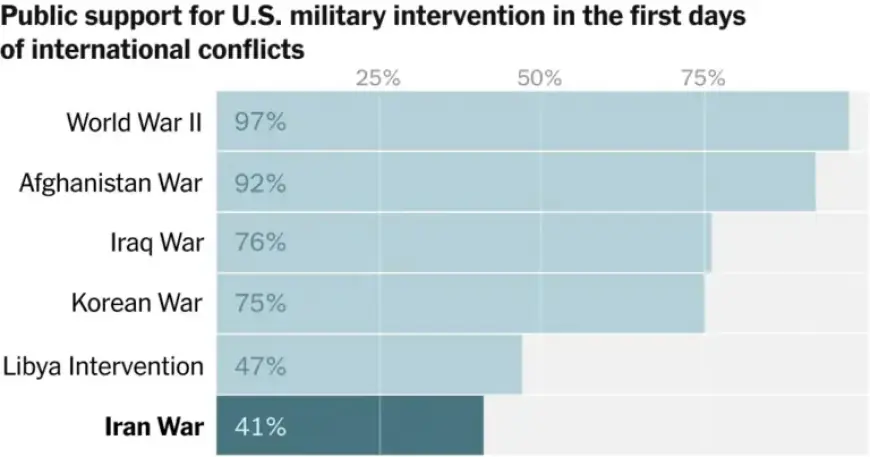
Recent surveys indicate that a significant majority of Americans oppose military action against Iran. Following President Trump’s decision to engage U.S. forces in this conflict, public support has notably lagged compared to previous wars.
Public Sentiment on U.S. Military Action Against Iran
Multiple polls illustrate that only 27% to 50% of Americans support the attacks on Iran. A Reuters/Ipsos poll recorded just 27% approval, while a Fox News poll indicated approximately 50% of respondents were in favor. This wide range implies that public opinion is still evolving as more details emerge about the situation.
Historical Context of War Support
In contrast to the ongoing response to the Iran conflict, historical data showcases much higher levels of support for prior military actions. For instance:
- After Pearl Harbor, support for the war against Japan soared to 97%, according to Gallup.
- Following the invasion of Afghanistan, 92% approval was recorded shortly after the military action began.
- Even during the initial stages of the Iraq War, support was at 76% the day after the invasion commenced.
Reasons for Current Opposition
Experts attribute the current low support levels to several factors. Sarah Maxey, an international relations professor at Loyola University of Chicago, highlights the lack of a communication strategy regarding the conflict. Unlike previous administrations, which effectively framed wars to the public, the Trump administration has faced challenges in garnering broad-based approval.
Matthew Baum, a Harvard University professor, points out another significant change in public perception. Traditionally, wars prompted a “rally around the flag” effect, where citizens united in support of military endeavors. However, increasing political polarization over the past 30 years has weakened this effect. According to Baum, support among opposing party members has diminished, particularly among Democrats regarding Trump’s presidency.
Trends Over Time
Support for military action tends to decline as the conflict unfolds and costs rise. Historical trends reveal a similar pattern. For instance, during the Vietnam War, initial majority approval dwindled as casualties mounted, leading to a growing perception that the war was a mistake.
The decline in support for the Iraq War was swift, with public backing dropping to just 43% by the end of the conflict. This trend transcended party lines, illustrating a broader wariness among the American populace.
The New Political Landscape
In today’s political climate, the idea of a unified national front during military ventures has diminished. Baum notes, “Politics used to stop at the water’s edge, that’s no longer the case.” As public opinion continues to evolve, the opposition to military action against Iran reflects both a shift in historical context and an increasingly divided electorate.