Mahmoud Khalil at Gracie Mansion: 3 Signals in a Ramadan Dinner That Underscore His Legal Limbo

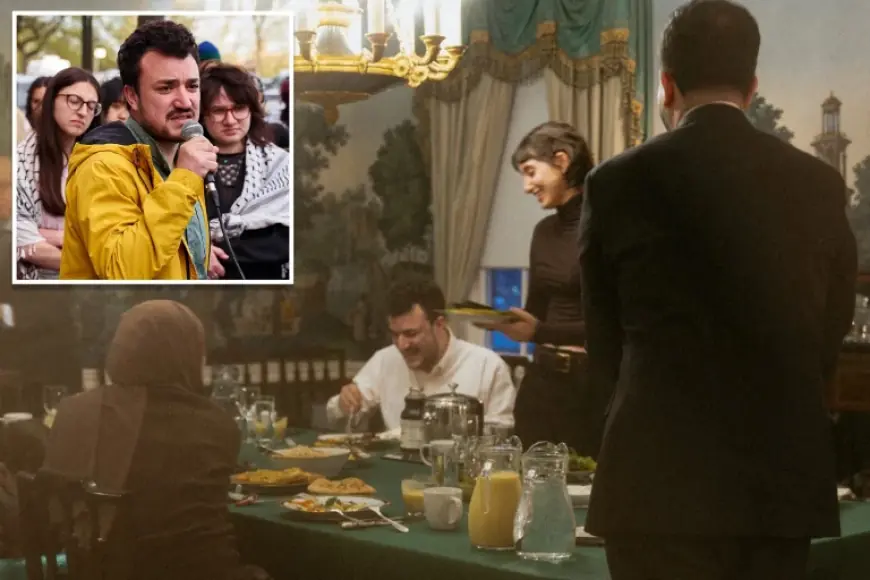
In an unusually personal display of City Hall politics, mahmoud khalil broke his Ramadan fast at Gracie Mansion alongside Mayor Zohran Mamdani, the mayor’s wife Rama Duwaji, and Khalil’s family—an encounter framed publicly as both a religious observance and a marker of the “one year anniversary” of his detention. The dinner, shared in a Monday Instagram post, re-centers a case that has shifted from immigration procedure into a high-stakes contest over identity, deportation authority, and how New York’s leaders choose to signal solidarity.
Gracie Mansion dinner turns a private ritual into a public message on Mahmoud Khalil
Mayor Zohran Mamdani hosted mahmoud khalil, Khalil’s wife Noor, and their young son Deen at Gracie Mansion on Sunday for Ramadan. In a Monday social media post, Mamdani wrote that he and his wife, Rama Duwaji, were “honored” to welcome the family to break the fast together. The post included a photo of the celebration showing Duwaji holding a plate of food beside a seated Khalil eating.
The mayor’s language added a clear political frame. He described the past year for Khalil as “profound hardship—and… profound courage, ” while also pointing to “New Yorkers raising their voices in solidarity” and “a city refusing to look away. ” Mamdani also asserted that “Mahmoud won his freedom, and a father was finally reunited with his child, ” and declared, “Mahmoud is a New Yorker, and he belongs in New York City. ”
That blend—religious commemoration paired with civic belonging—matters because it positions the case as a question of who gets counted as part of the city, not merely a question of paperwork. It also ties the mayor’s office to a specific individual whose immigration fate remains contested.
Why the case remains unresolved: deportation claims, a rarely used statute, and a panel decision
mahmoud khalil, described as a Syrian-born activist and former Columbia University graduate student, was arrested by ICE early last year. He faces deportation after the Trump administration accused him of committing fraud on his green card application. The same administration also claims Khalil is a Hamas supporter and is using a rarely deployed statute that allows noncitizens to be deported if their beliefs can pose a threat to US foreign policy interests.
Those elements create two overlapping tracks: an alleged application-fraud track and a beliefs-and-foreign-policy track. The second is especially consequential because it shifts the core question from conduct to viewpoint—an approach that, by design, broadens the government’s discretion while narrowing the space for a public defense rooted in expressive rights.
The case also has a procedural milestone. Khalil spent three months in a Louisiana federal lockup before a three-judge panel in New Jersey ruled in June that he should have been allowed to work through the immigration process. That decision did not end the broader legal dispute described around deportation exposure, but it provides an institutional reference point that the mayor can invoke as evidence that Khalil’s situation involved constraints that should not have applied.
Beyond the courtroom mechanics, the timeline has a personal dimension that has become inseparable from the public narrative. Mamdani noted that Khalil’s son—Noor and Khalil’s first child—was born while Khalil was in ICE custody several states away last year. The child, Deen, will turn one on April 21. The mayor’s emphasis on reunion effectively reframes detention as a family-separation story, not only an immigration enforcement story.
The political and civic stakes in New York: solidarity, speech, and the next flashpoint
New York’s mayor has been a vocal defender of Khalil, and his defense is explicitly tied to broader themes. At an unrelated press conference in January, Mamdani said: “I see this attack on him as part of a larger attack on the freedom of speech that is especially pronounced when it comes to the use of that speech to stand up for policy to human rights. ”
Within the facts available, that statement is the clearest articulation of what the mayor wants the public to understand: that the target is not solely mahmoud khalil as an individual, but speech—especially speech connected to human rights policy debates. Whether that framing persuades audiences depends on how they interpret the administration’s stated grounds for deportation and the statute described as rarely used. Still, the mayor’s choice to host Khalil at Gracie Mansion elevates his January argument from rhetoric to a governing posture.
Three signals emerge from the dinner itself:
- Normalization: Bringing Khalil into the city’s official residence implicitly casts him as part of civic life while his deportation exposure remains active.
- Personalization: Centering Noor and Deen—especially with the one-year detention marker—anchors the story in family impact rather than abstract legal categories.
- Confrontation by symbolism: A mayoral welcome functions as a visible rebuttal to the notion that Khalil’s presence is incompatible with the city’s identity.
What comes next is less about predicting outcomes and more about acknowledging tensions already visible in the record: a legal process described as ongoing, a statute tied to beliefs and foreign policy interests, and a mayor publicly positioning the case as a speech issue. In that environment, each public appearance becomes a political instrument, and each official statement sharpens the stakes for both local leadership and federal enforcement authority.
For New York, the open question is whether this becomes a template for how City Hall responds when immigration enforcement collides with claims about political belief—and whether the fight over mahmoud khalil remains a singular controversy or the first of several such tests.