Tucson Weather: 5 Signals Arizona’s Stormy Night Could Flip Fast Into Record Heat

Arizona’s forecast is sending mixed messages in the span of hours, and tucson weather is caught in the same statewide whiplash: scattered showers and thunderstorms tonight, then a rapid pivot toward much hotter conditions later this week. The immediate concern is the potential for a few storms to turn severe overnight, while the bigger strategic issue is what comes next—high pressure building back in and the prospect of record-challenging heat as soon as the weekend.
Tucson Weather and the storm setup: why Monday night is the hinge point
A storm system is moving into Arizona, bringing scattered showers and thunderstorms across the state. In the Phoenix area, a First Alert Weather Day has been declared for Monday, with the potential for a few storms to become severe. The Storm Prediction Center has also placed much of central and southern Arizona under a “Marginal Risk” for severe storms, a category that includes the possibility of damaging wind gusts over 60 mph and small hail.
Timing matters. The Phoenix outlook calls for the better chance of more widespread storms after 9: 00 pm ET to 10: 00 pm ET, continuing on and off overnight into the pre-dawn hours of Tuesday. Earlier activity was already observed in the region: parts of Phoenix and communities east of the Valley saw rain around 5: 30 pm ET, with more rain reaching the East Valley around 6: 00 pm ET.
For readers tracking tucson weather, the key takeaway is not a neighborhood-by-neighborhood promise—those specifics are not provided here—but the statewide pattern: storms this evening and overnight, followed by clearing and a quick warming trend once the system exits Tuesday afternoon.
From overnight storms to late-week heat: the rapid pattern reversal
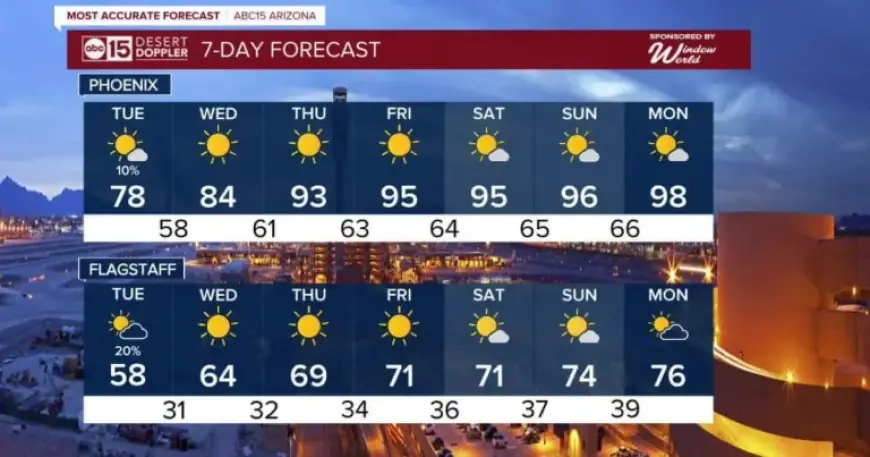
Once the storm moves out Tuesday afternoon, high pressure is expected to begin building again, drying out the forecast and “really heating things up. ” In the Phoenix outlook, temperatures are projected to rebound quickly: after a brief cooldown into the 70s on Tuesday and highs in the mid to upper 70s Tuesday afternoon with increasing sunshine, highs are expected in the low to mid-80s on Wednesday. The next step is more dramatic: low to mid-90s on Thursday, staying in the mid-90s from Friday through the weekend, with several daily high-temperature records potentially in jeopardy.
This is where the story becomes more than a routine storm update. The same forecast track also raises the possibility of the earliest triple-digit readings ever recorded in Phoenix toward the middle of next week. Confidence in “above 100 degrees by the middle of next week” is described as low in long-range guidance, but the signal is notable because it would challenge a specific benchmark: the current record for the earliest 100-degree day is March 26, set in 1988.
Even if triple digits do not verify, the forecast explicitly calls for end-of-week temperatures running 10 to 20 degrees above normal in the Valley. That speed of change—overnight storms to potential record heat—reshapes how residents and planners think about risk in a single workweek. It also frames tucson weather as part of a statewide transition rather than an isolated local event.
What the numbers say: wind, rainfall range, and a drying backdrop
Two sets of on-the-ground metrics illustrate both the immediacy of the storm threat and the longer-run dryness concerns.
Storm impacts already observed: Phoenix Sky Harbor Airport recorded wind speeds of more than 40 mph as storms moved in from the south at around 30 mph. In that scenario, communities saw quick bursts—rain lasting about 10 minutes in some places—highlighting how localized impacts can be even within the same metro area.
Rainfall expectations through Tuesday morning: Valley totals are projected to vary, with some spots near 0. 05 inches and others closer to 0. 25 inches. A broader estimate pegs totals through Tuesday morning at a tenth to a quarter inch in the Valley, with higher amounts possible in heavier downpours and over higher terrain.
A drying baseline: One data point underscores the wider context: 2026 Sky Harbor official rainfall to date is 0. 26 inches, listed as 1. 78 inches below average. Additional climate normals were also cited for Phoenix to show a shift toward lower rainfall averages: average monsoon rainfall for 1981–2010 is 2. 71 inches versus 2. 43 inches for 1991–2020, and average yearly rainfall for 1981–2010 is 8. 03 inches versus 7. 22 inches for 1991–2020.
These are Phoenix-area figures, not a statewide census. Still, they matter to the broader Arizona storyline because they pair short-lived storm bursts with an underlying trend toward less rainfall in the long-term averages cited. In practical terms, the near-term storm window may offer uneven relief, while the late-week heat pattern could quickly reintroduce dryness-driven concerns. That tension is central to understanding tucson weather within the current statewide setup.
Regional outlook: what changes Tuesday and what to watch beyond the weekend
As the system exits, the forecast turns toward sun and heat. A few showers may linger Tuesday morning mainly across higher terrain east of the Valley, followed by increasing sunshine Tuesday afternoon. Then comes the fast warmup into the weekend.
Five signals emerge from the current information:
- Overnight is the main storm window, with the better chance for widespread storms after 9: 00 pm ET.
- Severe potential is present but limited, framed as a “Marginal Risk, ” with threats including damaging winds and small hail.
- Rainfall will be uneven, with totals varying significantly across the Valley.
- High pressure returns quickly, drying conditions and boosting temperatures late week.
- Record heat is a live possibility, with long-range indications that triple digits could arrive unusually early, though confidence remains low.
For Arizona residents scanning forecasts city by city, the most actionable message is the sequencing: storms first, then a sharp trend toward heat. The forecast does not provide Tucson-specific hourly or neighborhood impacts in the supplied details, but the statewide storm-and-heat pattern offers a clear planning frame. If the warming trend holds, attention will shift from thunderstorm timing to the durability of the late-week heat and whether next week’s readings challenge historical benchmarks.
The open question for tucson weather watchers is whether the storm system’s patchy rainfall is enough to meaningfully dent dry conditions before the next surge of heat arrives.