Braxton Jones vs. Ozzy Trapilo: what the Bears’ pivot reveals

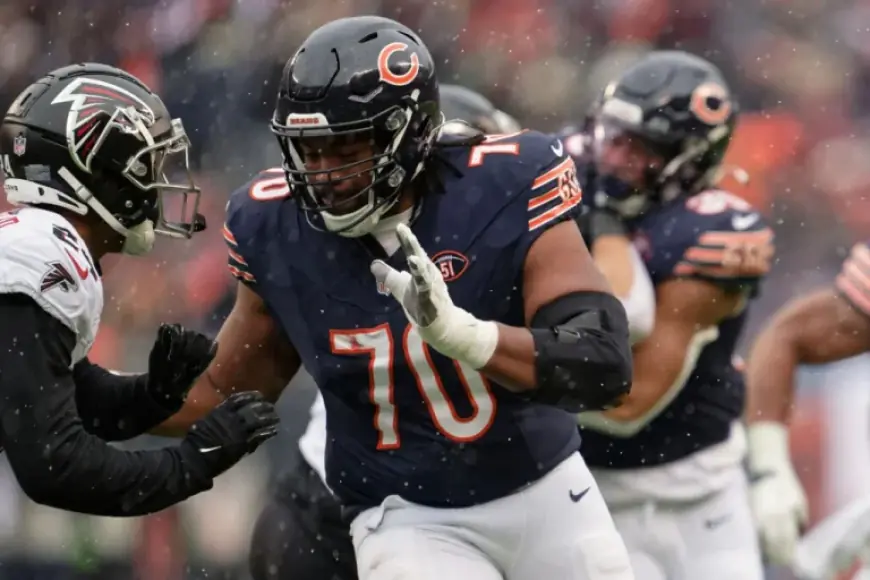
Bears left tackle braxton jones is staying in Chicago on a one-year deal worth up to $10MM, with the sides in agreement on terms. The move lands differently when placed next to Ozzy Trapilo’s situation, with Trapilo expected to miss much of the 2025 season. Put side by side, the question becomes whether this is a commitment to a long-term answer or a short-term bridge.
Braxton Jones and a one-year, up-to-$10MM return to Chicago
The Bears’ decision centers on continuity at a premium position, but under tightly defined terms. The agreement is for one year and can reach up to $10MM, a structure that limits the time horizon while still placing meaningful value on the 2025 season. In practical terms, it signals that the team wants a playable option in the mix immediately, rather than leaving the position exposed.
The context also frames the signing as a return to a familiar plan: Braxton Jones is described as a former starter, and the Bears are explicitly “pivoting” back to him. Yet, it is not presented as a simple restoration of the status quo. The same context notes that Jones lost his left tackle job in a contract year, which makes the one-year commitment read less like a full endorsement and more like another chance within a competitive setup.
Ozzy Trapilo’s 2025 absence forces the Bears’ timeline
The other half of the story is Ozzy Trapilo’s availability. With Trapilo expected to miss much of the 2025 season, the Bears face a timing problem: any plan built around him at left tackle would begin with a major gap. That constraint changes what “best option” means in the short run, because the team’s immediate need becomes less about upside and more about simply fielding a credible starter.
In that light, the pivot toward Jones functions as roster insurance. Trapilo’s expected absence is not described as a short, easily managed interruption; “much of the 2025 season” implies a prolonged period where the Bears would otherwise be forced into a thinner solution. The Jones deal, by contrast, provides a defined stopgap that can cover meaningful time without binding the organization beyond a single year.
Braxton Jones compared with the Trapilo situation: short-term cover vs. longer-term uncertainty
Placing Braxton Jones next to the Trapilo situation sharpens the logic of the Bears’ approach. One side of the comparison is a known player returning on a one-year structure; the other is a potential option who is not expected to be available for much of the upcoming season. The result is less a verdict on talent than a verdict on timelines.
| Comparison point | Braxton Jones | Ozzy Trapilo |
|---|---|---|
| Team action described | Bears pivoting to a former starter | Expected to miss much of 2025 season |
| Availability outlook | Available to “give it another go as a Bear” | Not expected to be available for much of 2025 |
| Contract/commitment | One-year deal worth up to $10MM | No contract details stated in the context |
| Role framing | Former starter; lost LT job in a contract year | Availability issue drives the pivot |
| Roster-building effect | Reduces urgency to “reach” for a tackle | Creates the need for a short-term answer |
Analysis: The comparison suggests the Bears are buying time rather than declaring the left tackle problem solved. Jones’ one-year pact and the note that he previously lost the job point to a decision built around coverage and optionality. Trapilo’s expected absence, meanwhile, acts as the forcing mechanism that makes a short-term bridge more valuable than a longer-term bet that cannot play early.
The context also ties the move to draft flexibility. With Jones in place, the Bears can still pursue a left tackle in the draft “if one falls, ” while avoiding the need to “reach. ” That framing reinforces the idea that the team is prioritizing a stable floor now, while leaving room to chase a different ceiling later.
Still, the same comparison leaves an open question: whether Jones returns as a placeholder or as a player who can reclaim and hold the job. The context acknowledges both possibilities by pairing “former starter” with “lost his LT job, ” then immediately positioning him to “give it another go. ” The next test of this plan will be whether the Bears’ pivot to braxton jones holds up well enough that the team can draft selectively rather than out of desperation.