Tomahawk Missile video near an Iranian girls’ school raises new questions

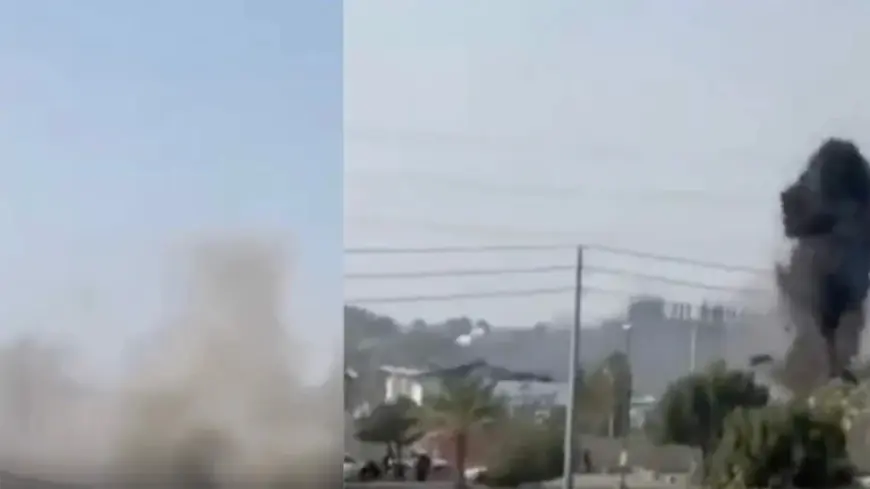
A newly surfaced video showing what one analyst described as a tomahawk missile hitting a building in Iran has focused attention on one specific place: a site adjacent to a girls’ school where local 168 people were killed. The footage is emerging as the United States, Israel and Iran trade strikes and world leaders talk about what the conflict could become next.
Mehr News footage and a girls’ school beside the strike site
The video, described as eyewitness footage, appears to show a U. S. -made missile slamming into a building in Iran next to a girls’ school. Local 168 people were killed at the school, a figure that places a human count beside a frame of grainy motion and impact.
The clip was first posted Sunday morning by the Iranian outlet Mehr News. It then spread further after Trevor Ball, a former U. S. Army Explosive Ordnance Disposal technician who now works as a researcher with the investigative group Bellingcat, shared it online. Ball wrote that the video showed a U. S. -made Tomahawk missile, a description that has driven intense attention to the location shown and the proximity to the school.
In the broader public argument over targets and intent, the video’s power lies in how narrow it is: one building, one neighboring school, one death toll cited by local officials. Whatever else is happening across the region, that adjacency has become its own focal point.
Trump’s Feb. 28 announcement and the expanding exchange of strikes
President Donald Trump announced “major combat operations” against Iran on Feb. 28, as officials described massive joint U. S. -Israel strikes targeting military and government sites. Iran, in turn, is responding with missile and drone attacks targeting Israel, regional U. S. bases and multiple Gulf nations. Israel is also intensifying its long-running strike campaign against the Iran-backed Hezbollah militia in Lebanon.
Iranian state television confirmed that Ayatollah Ali Khamenei was among those killed in Tehran on the first day of strikes. It also said his son, Mojtaba Khamenei, was chosen on Sunday to succeed him. Trump later told the New York Post that he was “nowhere near” a decision on potential ground operations in Iran, adding, “We haven’t made any decision on that. We’re nowhere near it. ”
Trump also reiterated in that interview that he was “not happy” with Mojtaba Khamenei. Asked what his plans were for Iran’s new leader, Trump said, “Not going to tell you. I’m not happy with him. ” He also dismissed concerns about spiking oil prices, saying, “I have a plan for everything, okay?” and, “I have a plan for everything. You’ll be very happy. ”
One line from Sen. Marco Rubio also landed sharply in the public record, as he described Iran by saying, “This is a terroristic regime. ”
Macron, the Strait of Hormuz, and the weight of oil and shipping
While the video near the girls’ school draws attention to what happened at a specific site, the conflict is also pushing officials to prepare for what it could do to sea lanes and energy markets. French President Emmanuel Macron said he is working with partners on a “purely defensive” mission to reopen the Strait of Hormuz by escorting ships, but only once the “most intense phase of the conflict” in the Middle East has passed.
France is deploying eight warships, two amphibious helicopter carriers and the Charles de Gaulle aircraft carrier to the eastern Mediterranean, the Red Sea and off the coast of Hormuz. Macron said a coalition of partners—coordinated by and headquartered in Greece—had already been formed.
Macron described the planned effort as “purely defensive” and “purely escort, ” aimed at enabling, as soon as possible after the most intense phase ends, the escort of container ships and tankers to gradually reopen the Strait of Hormuz. He called the strait essential to international trade and to the movement of gas and oil out of the region.
For now, the newly circulated video remains a single, stark data point in a conflict told mostly in large-scale announcements and retaliatory launches. Yet its details—an impact beside a girls’ school, and a local official death toll of 168—have pulled the story back down to one site on the ground, where the consequences are counted in people. In online posts, Ball identified the weapon as a tomahawk missile, keeping the focus on what exactly was seen, and what it suggests about the strike that hit next door.