Noah Fant and the Patriots tight end plan show a clear mismatch

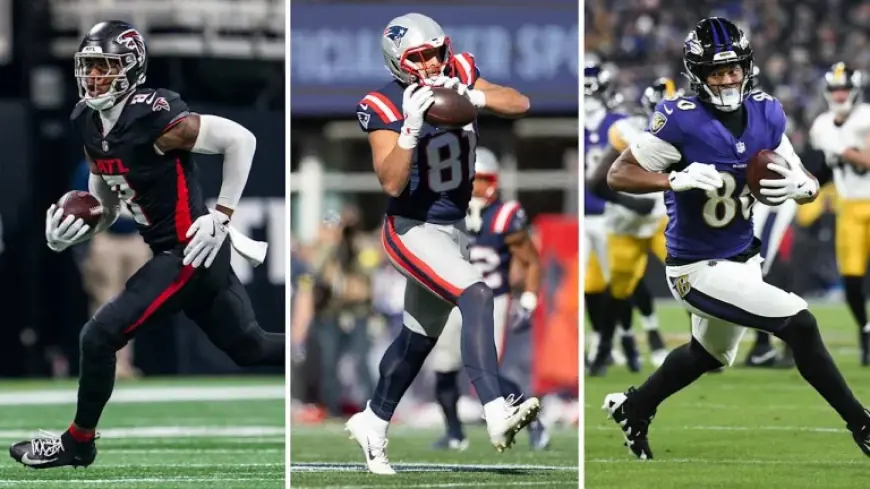
noah fant appears on a list of notable external tight end free agents as New England weighs its next steps at the position around third-year quarterback Drake Maye. Yet the documented case for change centers on a specific weakness: the Patriots struggled to run the ball out of multi-tight end groupings, even while their passing efficiency from those sets remained strong. That gap between the need described and the type of tight ends highlighted frames the central tension.
Drake Maye, Hunter Henry, and Austin Hooper set the immediate tight end baseline
New England’s own forecast of the 2026 tight end and fullback market opens with a clear roster snapshot: Patriots free agents include Austin Hooper and Jack Westover (ERFA). The same forecast describes the team as “possibly entering a transition phase” while it considers “the next wave of tight ends” around Drake Maye.
On the field, Hunter Henry is presented as the stabilizer. Heading into his 11th NFL season and his age-32 season, Henry is described as “one of Maye’s most reliable targets. ” The forecast ties that to production: Henry ranked seventh among tight ends with 768 receiving yards last season, and his 42 first-down receptions ranked fourth at the position. The record also includes efficiency and scoring benchmarks — top-10 in total EPA (+34. 3), receptions, and touchdowns (seven) — and states Henry built a “great rapport” with Maye.
Still, the tight end room’s age curve and contract status introduce a pressure point. Henry is described as “starting to get more seasoned, ” and Hooper is identified as an unrestricted free agent entering his age-32 season. The forecast explicitly links those facts to the logic of looking ahead: with the top two tight ends on the other side of age 30, “it would make sense” for New England to explore the next chapter at the position.
Noah Fant and other free agents are framed as pass-catchers, not in-line answers
The same forecast lists a group of “notable external free agents” at tight end, including Kyle Pitts (franchise tag), Dallas Goedert, Isaiah Likely, David Njoku, Chig Okonkwo, Charlie Kolar, Cade Otton, Mo Alie-Cox, Tyler Higbee, Noah Fant, Tyler Conklin, Foster Moreau, and Daniel Bellinger. That list signals options. It also sets up a potential mismatch between what the Patriots are said to need and what the market is said to provide.
New England’s forecast does not describe noah fant’s skill set directly, but it does draw a broader market conclusion: “the top options are mostly known for their pass-catching ability. ” It goes further, describing Kyle Pitts (franchise tag), Isaiah Likely, Cade Otton, and Chig Okonkwo as “essentially big wide receivers. ” The forecast also notes David Njoku “has something left in the tank as a seam runner, ” while adding that free agency and the draft do not look strong for “well-rounded tight ends. ”
That framing matters because the Patriots’ internal diagnosis focuses less on adding another receiving outlet and more on solving a style problem. The context does not confirm whether New England is prioritizing pass-catching or blocking in its personnel search. What is documented is that the area flagged for improvement is in-line blocking tied to heavy personnel effectiveness.
Josh McDaniels, Isaiah Likely, and the unresolved question of what New England is really buying
The forecast supplies the statistical hinge for the Patriots’ dilemma. Last season, New England “wasn’t as productive as it probably would’ve liked” running the football with multiple tight ends on the field. The passing side of the ledger looked very different: the Patriots were fourth in EPA per play out of multiple-tight end sets. The run side lagged: 27th in rush EPA out of tight end-heavy groupings (-0. 14). The forecast links that directly to a possible personnel fix, “suggesting a possible need to upgrade their in-line blocking ability at tight end. ”
The downstream effects are spelled out as a pattern. Because the Patriots were not a strong rushing team out of multi-tight end looks, defenses “mostly remained in nickel packages” against them. In turn, New England used 12-personnel on just over 19 percent of offensive plays and ranked 20th in 12-personnel usage. The forecast suggests a reason: the offense was “likely” not consistently creating mismatches in the passing game because of its run-game struggles, making it “more successful to put a third wideout on the field. ”
Run blocking grades for Henry and Hooper reinforce the same diagnosis. Henry (54. 2) and Hooper (57. 8) both ranked outside the top-50 among tight ends in Pro Football Focus run-blocking grades. The forecast states that “adding a more dynamic in-line blocker is a big part of the tight end equation” if the Patriots want to feature multiple tight ends more often.
Yet a separate prediction around Isaiah Likely pulls the discussion in a different direction: pass-catching weaponry. One analysis argues the Patriots “might be looking to make some moves to improve their pass-catching situation, ” and says a major addition could come at tight end even though “a majority of people” point to wide receiver upgrades. The prediction ties Likely to scheme, stating Josh McDaniels-run offenses “have heavily featured the tight end position, ” and notes Henry is set to play the final year of his contract in 2026. Likely is described as having “flashed the potential to be a dominating receiving threat, ” and his production is quantified: 1, 568 receiving yards and 15 touchdowns over 63 games across four seasons in Baltimore.
The tension across the two pieces is documented, not inferred: one side emphasizes in-line blocking as the reason tight end needs upgrading; the other frames the position primarily as a source of receiving help for Maye. The context does not confirm how New England will reconcile those priorities, or whether any name on the market — including noah fant — is being evaluated mainly as a blocker, a receiver, or a balance of both.
Resolution would require a concrete next step that the context does not provide: an actual signing, or a clear statement of whether New England is targeting an in-line blocker to change its heavy-personnel run efficiency. If a future move adds a tight end described primarily for in-line blocking, it would establish that the Patriots are acting on the run-game diagnosis embedded in their own forecast.