Kwity Paye trade chatter reflects how teams hunt value on the edge

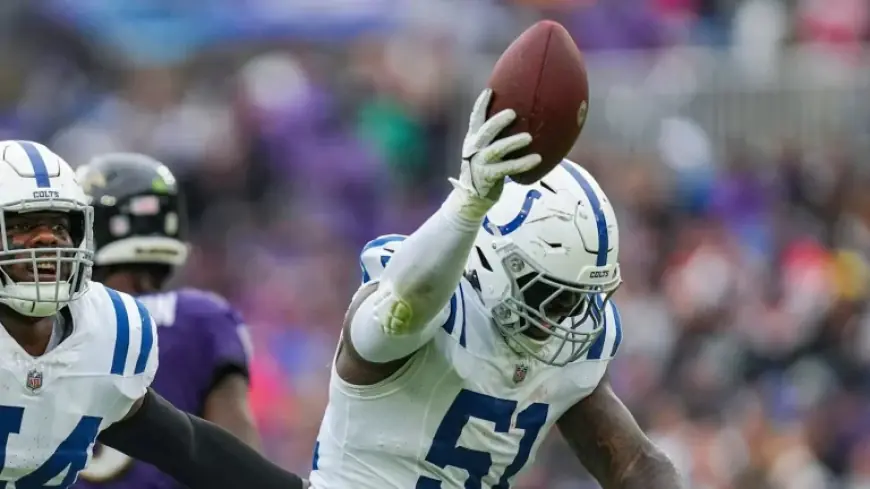
kwity paye is emerging in free-agency conversations as a possible low-risk pass-rush addition for the San Francisco 49ers, as signs point to the Indianapolis Colts moving on from him. The discussion reveals a broader roster-building pattern: when a team publicly admits it needs pass-rush help, it may prioritize scheme familiarity and recent production over chasing the biggest names.
San Francisco 49ers link Kwity Paye to a low-risk pass-rush plan
The immediate development is not a signing but a fit-based argument: a case is being made that San Francisco could view kwity paye as a “perfect free agency gamble” at defensive end. The 49ers have publicly admitted they need pass-rush help this offseason, even while banking on healthy 2026 versions of Nick Bosa and Mykel Williams. That combination—acknowledging a need while also counting on internal health—creates room for a cheaper, lower-commitment option rather than a premium pursuit.
The same framing also contrasts two approaches. On one end are “big-name pass-rushing defensive ends” such as the Las Vegas Raiders’ Maxx Crosby and the Cincinnati Bengals’ Trey Hendrickson. On the other is the idea of finding value: “plenty of low-budget options” exist, and Paye is positioned as one of them. The pattern points to a team trying to avoid getting “way too deep in the mix” for top-end talent, while still addressing a stated roster deficiency with a controllable bet.
One implication follows directly from the way the 49ers’ need is described: even if San Francisco expects healthier seasons from key defenders, it still sees a requirement for additional pressure. The data suggests that this kind of posture—plan for best-case internal outcomes, but shop for external support—encourages targets whose cost and role can be scaled up or down depending on what happens with health and depth.
Indianapolis Colts fifth-year option for Kwity Paye shapes his market
Paye’s current positioning stems from his arc in Indianapolis. The Colts selected Michigan defensive end Kwity Paye with the 21st overall pick in 2021, and he performed well enough for the team to exercise a fifth-year option. Yet the same context states he “never quite lived up to the expectation of being a game-changing pass-rusher, ” a key evaluation that helps explain why a move now feels plausible.
Production details underline that assessment. Paye recorded 30. 5 sacks over a five-year tenure, including just four over 17 games last season. That recent output is used as a central piece of evidence for why “all signs point to Indianapolis moving on from him. ” In analytical terms, the trigger is not one isolated data point but the combination of expectations attached to a first-round selection and a most-recent season that did not match the “game-changing” bar implied by his draft slot.
For the Colts, the implication is structural: choosing the fifth-year option signaled commitment, but the current tone suggests an inflection point where the team may reallocate snaps and spending elsewhere. For Paye, the same facts shape leverage. A player can be both “good enough” to warrant an option and still be evaluated as short of elite, and that gap often defines the tier of free-agency interest that follows—especially for a position as premium as edge rush.
Gus Bradley and Robert Saleh ties point to a scheme-based bet
The clearest single cause behind the 49ers fit argument is coaching and scheme familiarity. Paye’s career-best sack totals came in 2023 and 2024—8. 5 and eight sacks, respectively—under then-defensive coordinator Gus Bradley. Bradley later assisted with the 49ers defense last season under Robert Saleh, who is now the Tennessee Titans head coach. That chain is presented as the connective tissue: Paye produced best under Bradley, and Bradley’s recent work with San Francisco’s defensive environment makes the transition feel less speculative.
Still, there is a complicating factor built into the same set of facts. Saleh has been replaced by new coordinator Raheem Morris, and Morris is taking Bradley with him. That removes the most direct personnel-to-coach continuity the argument leans on. Yet the context insists there is “no doubt” Morris will adopt many of the 49ers’ previous defensive alignments, which keeps the scheme-translation case alive even without Bradley in the building.
The pattern points to a specific implication: if San Francisco expects to preserve much of its prior structure, it can prioritize players who have already shown they can produce within similar alignments. That is the heart of the “low-risk” framing. It does not claim Paye will become a different player; it argues the environment that coincided with his best two seasons could be approximated enough to justify the gamble.
The next confirmed milestone in this story is not a date on a calendar but a decision point embedded in the current language: Indianapolis appears positioned to move on, and San Francisco has stated its need for pass-rush help this offseason. If those two conditions hold, the data suggests kwity paye will be evaluated less as a former first-round centerpiece and more as a targeted, role-driven addition shaped by recent production and a scheme fit that can be defended on paper.