WiFi Signals Map Human Activities Through Walls by Detecting Body Keypoints

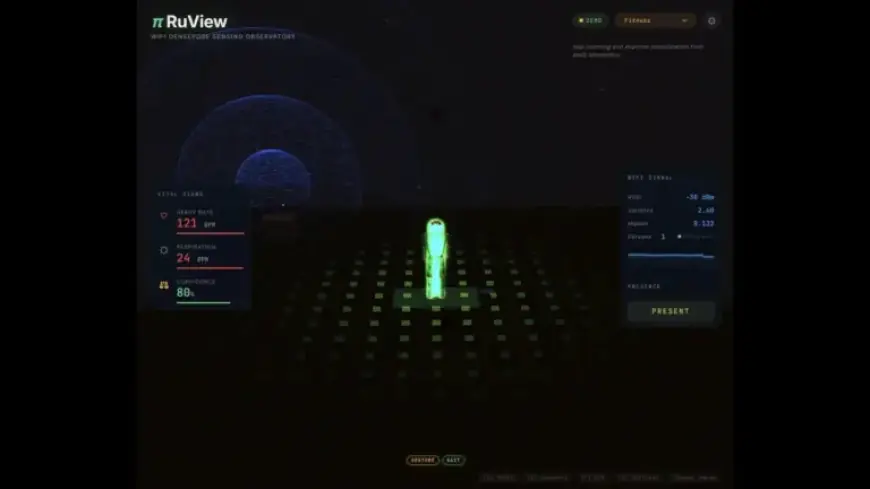
Recent advancements in WiFi technology have paved the way for a groundbreaking edge AI system known as π RuView. This innovative platform repurposes standard WiFi infrastructure into a through-wall sensing mechanism, capable of detecting human body poses, vital signs, and movements. Notably, this technology operates without the need for cameras, raising significant concerns about surveillance and privacy.
Understanding RuView Technology
Developed by Reuven Cohen, RuView is now accessible on GitHub as an open-source project. It utilizes a technique called WiFi DensePose, originally developed by Carnegie Mellon University. The system leverages Channel State Information (CSI) metadata, which is routinely gathered by WiFi hardware for signal optimization.
How It Works
RuView’s capabilities stem from its ability to interpret disturbances in WiFi signal paths caused by human movement. Operating at a rate of 54,000 frames per second, it processes these alterations in real time. It employs Rust programming to extract amplitude and phase information, employing a modified DensePose-RCNN architecture for deep learning. This allows RuView to reconstruct 24 human body surface areas, including arms, torso, and joints, using WiFi signals alone.
Real-Time Vital Sign Monitoring
In addition to body pose detection, RuView can also extract vital signs. It employs bandpass filtering with varying frequencies to monitor:
- Breathing rate: 6–30 BPM (0.1–0.5 Hz)
- Heart rate: 40–120 BPM (0.8–2.0 Hz)
Deployment and Security Implications
RuView can be installed on cost-effective ESP32 microcontroller nodes, which retail for about $1 each. By forming a multistatic sensor array, these nodes can generate more than 12 overlapping signal paths, providing precise detection up to 5 meters deep through walls.
One key advantage of RuView is its offline operation. This makes it impervious to cloud-related vulnerabilities, although it raises serious security issues. The system continuously learns the unique RF “fingerprint” of each room, allowing it to distinguish between static environments and human movement.
Regulatory and Ethical Concerns
The system’s passive operation raises significant legal and ethical questions. Unlike cameras which are subject to regulations like GDPR and CCPA, RuView’s WiFi-based sensing operates in a regulatory grey area. Legal experts highlight the difficulty in obtaining consent for such surveillance, as it occurs without physical intrusion.
Potential threats are evident. A malicious actor could place a low-cost ESP32 node near a WiFi access point and utilize RuView to monitor movements and biometric data undetected. As a response, security teams are urged to treat passive WiFi sensing as a new physical-layer threat vector, with recommendations for:
- RF shielding in sensitive areas
- Monitoring for unauthorized ESP32 devices
- Promoting updated regulatory frameworks to address WiFi-based human tracking
As this technology evolves, it is crucial for policymakers to establish controls that keep pace with advancements in surveillance capabilities. For ongoing updates on cybersecurity, follow Filmogaz.com on Google News, LinkedIn, and X.