Gorillaz SNL Debut Turns Nostalgia Into A Fresh Push For The Band’s New Era

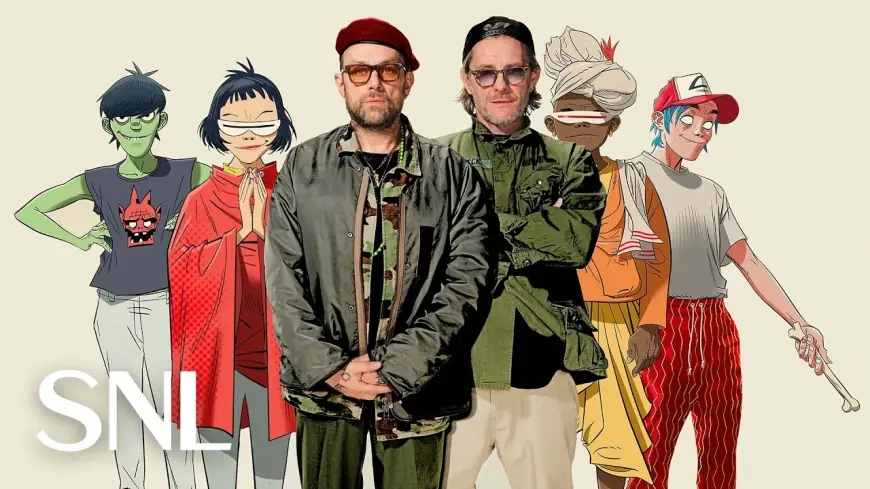
Gorillaz finally made their Saturday Night Live debut on March 7, and the performance landed like more than a long-delayed TV booking. It felt like a carefully timed reset. On a night hosted by Ryan Gosling, the band used its first SNL appearance to bridge two versions of itself at once: the early-era breakthrough that made Gorillaz a global force, and the darker, more expansive sound of its current album cycle. The set paired “Clint Eastwood” with “The Moon Cave,” giving viewers both the familiar hook that still defines the group’s mainstream identity and a newer, more cinematic track that signals where Damon Albarn and Jamie Hewlett want the project to go next.
That combination is what made Gorillaz SNL matter. Plenty of legacy acts use late-career television spots to replay old victories. Gorillaz used the stage to argue that the catalog and the present tense can still live together without one shrinking the other. “Clint Eastwood” arrived with Del the Funky Homosapien, restoring one of the band’s foundational collaborations and giving the performance a sense of lineage rather than simple nostalgia. “The Moon Cave,” by contrast, leaned into the larger-scale, guest-driven ambition that has come to define the band’s later work, with Asha Puthli, Black Thought, and Anoushka Shankar joining the performance.
Gorillaz SNL Moment Finally Arrives
The timing matters almost as much as the set list. Gorillaz has spent years existing slightly outside the normal machinery of pop promotion. The group can headline festivals, unveil elaborate visual worlds, and move between animation, guest features, and multimedia storytelling more easily than almost any act of its era. But Saturday Night Live still carries a specific kind of American mainstream signal. For a band that has always operated as both pop act and art project, finally appearing on that stage in 2026 was a way of reintroducing itself to a broad audience that may know the name and the cartoons but not the current chapter.
That is especially important now because the band is not selling a comeback in the traditional sense. Gorillaz never really left. The challenge is different: how to make a long-running, shape-shifting project feel urgent again in a media cycle that rewards short bursts of attention over deep world-building. An SNL performance helps because it compresses the pitch. One song tells casual viewers why the band mattered. The other tells them why it still should.
Clint Eastwood And The New Album
“Clint Eastwood” was the obvious anchor, but not the lazy one. Choosing that song for the Gorillaz SNL debut gave the show an instant point of entry while also reminding viewers how unusual the band sounded when it first broke through. Even now, the track still feels like a collision of moods rather than a clean genre fit: part hip-hop, part alt-pop, part haunted cartoon transmission. Bringing Del back sharpened that effect and gave the performance more than retro value. It turned the song into a statement about continuity.
Then came “The Moon Cave,” the more revealing selection of the two. That performance suggested Gorillaz is still leaning into scale, texture, and collaboration rather than chasing a simplified radio-ready version of itself. The newer material is denser, more atmospheric, and less eager to explain itself in one listen. On live television, that is a gamble. But it is also the more honest representation of what the band has become. Gorillaz is no longer trying to prove it can make a crossover hit. It is trying to prove that its universe can still expand.
What It Means For Gorillaz Now
The immediate effect of the performance is obvious: more visibility, more conversation, and a sharper spotlight on the current album cycle. But the larger significance is strategic. Gorillaz has always depended on tension between accessibility and mystery. Too much familiarity, and the project starts to feel like a museum piece. Too much experimentation, and it risks becoming self-contained. Saturday night’s set navigated that balance well. It gave casual fans something recognizable while telling more committed listeners that the band is still pushing outward.
That matters in 2026 because legacy acts are now competing on two fronts at once. They are competing with younger artists for present-day attention, and they are competing with their own back catalogs for cultural space. Gorillaz handled that challenge better than most. Instead of letting the past swallow the present, the band staged the past as an introduction to what comes next.
There are a few scenarios to watch from here. The first is the simplest: the SNL appearance drives a broader mainstream bump around the new album and upcoming live dates. The second is more interesting: the performance repositions Gorillaz not as a nostalgia brand but as a still-evolving project with room for another peak. A third possibility sits in between. The old songs may remain the mass-audience draw, while the newer work deepens the band’s standing with listeners who have followed its long arc closely. Even that would count as a win.
For Gorillaz, the best television performances have always done more than promote. They clarify the thesis. On SNL, the thesis was clear enough: this band is still most powerful when it makes its history feel unfinished.