Karl Anthony Towns’ late-season lock-in changes the Knicks’ title outlook

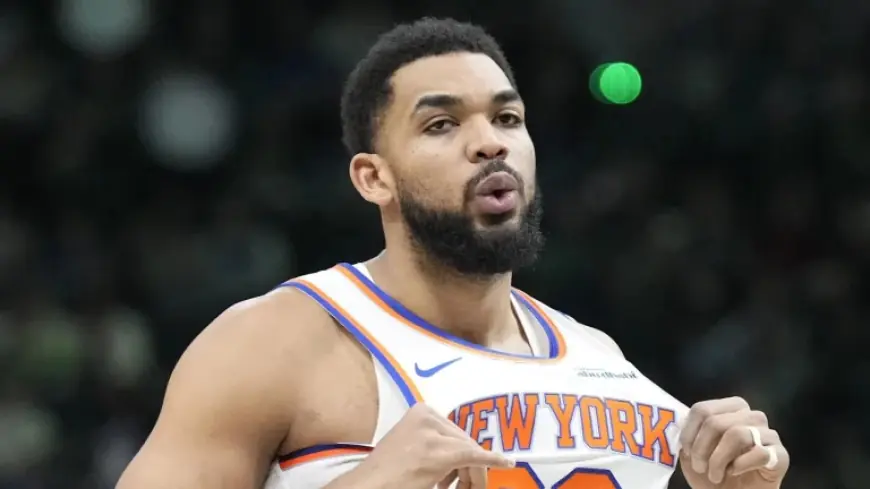
For the New York Knicks, the margin for error just got smaller: if Karl Anthony Towns stays engaged on both ends, New York’s ceiling rises fast—yet the same season-long inconsistency means the offense can still stall when he fades out of possessions. As of Sunday at 2: 30 p. m. ET, the shift is being framed around Towns’ recent two-way buy-in and how the Knicks can keep feeding him efficiently.
New York Knicks’ offense gets a clearer path when Karl Anthony Towns stays involved
The most immediate change is tactical: New York has a more obvious blueprint when Karl Anthony Towns is a constant factor rather than an occasional one. The Knicks are ranked third in offensive efficiency this season, a slight improvement on last year’s already top-five offense, and an “engaged” Towns is described as a significant talent boost for the roster.
Still, the same season has included long stretches where Towns’ lack of presence has stood out. Through 60 games played, Towns is averaging 19. 7 points—his lowest scoring numbers since his rookie season—while shooting a career-low 48. 5% from the field. He is also on pace for his lowest usage rate since the 2017-18 season, a sign that possessions are ending elsewhere more often than they used to.
That lower involvement has shown up in the shot counts. Towns attempted fewer than 10 shots just three times all of last season, but he’s already had 10 games under that threshold this season, with seven of those coming since early January. In a late February 109-94 loss to the Cleveland Cavaliers, he took just five shots; in a 126-111 home loss to the Detroit Pistons, he attempted one shot in the first half.
Jalen Brunson lineups reveal a split the Knicks can’t ignore
One consequence of Towns’ uneven role is that the Knicks now have a measurable lineup puzzle to solve with Jalen Brunson. In the two years as teammates, Towns has been more productive with Brunson on the floor. Yet this season, his scoring rate has diverged sharply depending on whether Brunson is sharing the court.
Towns is averaging 28. 0 points per 100 possessions with Brunson on the floor, based on PBP Stats. That number jumps to 35. 7 points per 100 possessions in 725 minutes without Brunson. The split doesn’t automatically point to a single fix, but it does raise the stakes for how New York staggers minutes and chooses which actions to prioritize when the two play together.
The intended fit was straightforward when the Knicks acquired Towns: his three-point threat could create space for Brunson to operate, and he could be an easy target for Brunson to dish. In practice, the results “generally worked, ” but the current numbers suggest the Knicks can still unlock more when both are on the floor—especially in possessions that don’t naturally flow to Towns.
One suggested adjustment is simplifying the pick-and-roll partnership. Towns can set better screens and be more decisive as a roller or a pop threat; the inconsistency comes when he veers into “no man’s land” after setting the pick, leading to less optimal scoring chances. On the other side of the connection, teammates—including Brunson—can look for Towns more often when he has a mismatch, particularly when defenses cross-match and place a smaller player on him.
Mike Brown’s system puts pressure on Towns’ defense and decision-making
The longer-term consequence is identity. The Knicks’ recent surge has been tied to defense, and that puts Towns—an 11-year pro in a new head coach Mike Brown’s system—under a brighter spotlight than simple box-score production. New York has gone 21-5 over its last 26 games, and during that stretch the Knicks have the top-ranked defense in the NBA, per NBA Stats.
Within that run, Towns’ defense is described as having become steadier alongside the team’s overall improvement. Another thread from the recent coverage is that Towns has emphasized defense-first habits as central to playoff success, pointing to how stops, rebounds, and key defensive plays swing postseason games. That framing matters because it moves the conversation from “How many points did he score?” to “Did he sustain the team’s standard possession after possession?”
Yet the offensive side still dictates how comfortable New York’s plan looks. Teams have consistently defended Towns with smaller players, including matchups where opposing centers guard Josh Hart while a wing takes Towns. New York has sometimes struggled to deliver quality entry passes in those situations, turning advantageous matchups into empty or late-clock possessions.
When the passing hasn’t arrived, Towns has still found ways to affect winning through rebounding. He remains one of the NBA’s top rebounders at 11. 9 boards per night, and the Oklahoma City game on Wednesday night offered a clear case study in consequence-driven adaptation: the Knicks struggled to deliver passes to him while he was guarded by smaller players, so he attacked the offensive glass instead. Towns collected a season-high nine offensive rebounds in that 103-100 loss, creating five different scoring opportunities through either a made basket or drawing a foul.
Discipline has also shifted. Earlier this season, Towns was frequently hooking a defender’s arm and flailing—habits that led to offensive fouls—but he has generally avoided that as of late. If that change holds, it directly supports the Knicks’ broader goal of turning defensive stops into clean offensive possessions rather than giving points back through avoidable turnovers.
For now, what changes next hinges on whether New York keeps leaning into actions that make Towns a clear read rather than a last option. The next inflection point arrives with the start of the playoffs; if the Knicks continue playing through Towns more consistently—while maintaining the defense that fueled their 21-5 run—then the “title hunt” framing hardens into a nightly standard instead of a brief stretch of form.