Unveiling ‘New Michelangelos’ with Dan Brown’s Art History Approach

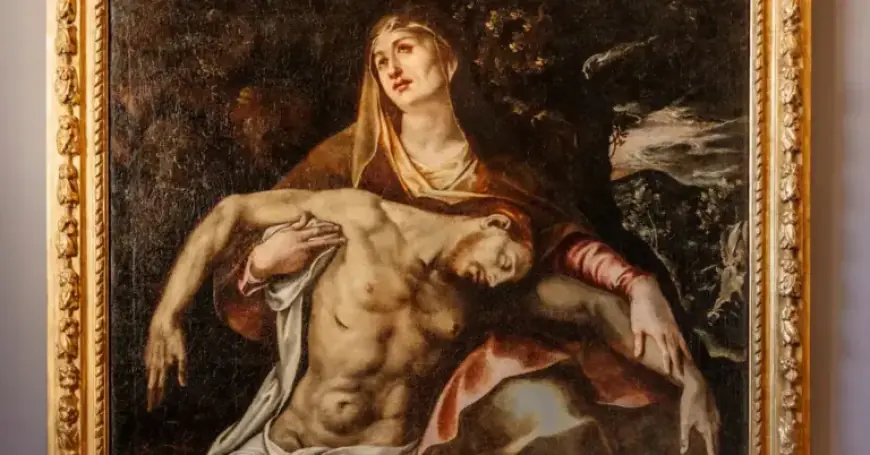
A recent auction held in Genoa, Italy, featured an intriguing artwork: a centuries-old depiction of the Virgin Mary and Christ. Initially estimated to sell for $2,300 to $3,500 in 2020, it ultimately didn’t find a buyer. Fast forward four years, two collectors from Brussels acquired the same piece for approximately $35,000, suspecting it might hold greater significance.
Potential Discoveries of ‘New Michelangelos’
Following technical analysis and extensive research, the collectors put forth an exciting claim. They believe the painting, now named “Spirituali Pietà,” may be an undiscovered oil on canvas by Michelangelo. Supporting this theory, Michel Draguet, a former director of the Royal Museums of Fine Arts of Belgium, published a 600-page report advocating this connection.
Recent Attributions and Investigations
Concurrently, independent researcher Valentina Salerno attributed a marble bust of Christ in the Basilica of St. Agnes Outside the Walls in Rome to Michelangelo. This raises questions about whether unknown creations from the renowned Renaissance artist could still emerge.
Controversy Among Experts
Since the claims surfaced, art historians have expressed skepticism. Francesco Caglioti, an art history professor in Pisa, likened this excitement to the “Dan Brown approach to art history,” which often reimagines discoveries. He emphasized that accurate attributions take years instead of days.
Another expert, Matthias Wivel, also dismissed the legitimacy of the Pietà, noting that while it may bear a resemblance to Michelangelo’s style, it lacks clear evidence of authenticity. He reminded that many artists adopted Michelangelo’s techniques after his influence in central Italy.
High Stakes in Art Attribution
New attributions can lead to significant financial rewards. For instance, a sketch attributed to Michelangelo recently sold for $27.2 million. The painting “Salvator Mundi,” credited to Leonardo da Vinci, fetched a staggering $450 million in 2017.
Examining ‘Spirituali Pietà’
Draguet’s study of “Spirituali Pietà” included advanced techniques such as infrared photography and macro X-ray fluorescence. Initially skeptical, he found the art compelling when identifying potential markings that resembled Michelangelo’s initials.
However, experts caution against hasty conclusions. They argue that the markings were likely added later, as Michelangelo rarely signed his works. The lack of provenance further complicates the painting’s history.
The Language of Art History
Questions retain their hold: Could the painting reflect Michelangelo’s radical beliefs during a time of religious upheaval? Draguet theorizes that it may have been concealed in England due to its presumed heretical content. But without broader consensus from art historians, the future of these attributions remains uncertain.
The desire to link new findings to celebrated artists often shapes interviews and discussions, as Van Druten of the Teylers Museum points out. This innate urge suggests a longing for connection to creative genius.
As the inquiry into these potential ‘New Michelangelos’ continues, the distinction between myth and reality in art history remains a critical focus.