Grand staircase in Pompeii confirmed; question remains how tall the towers were

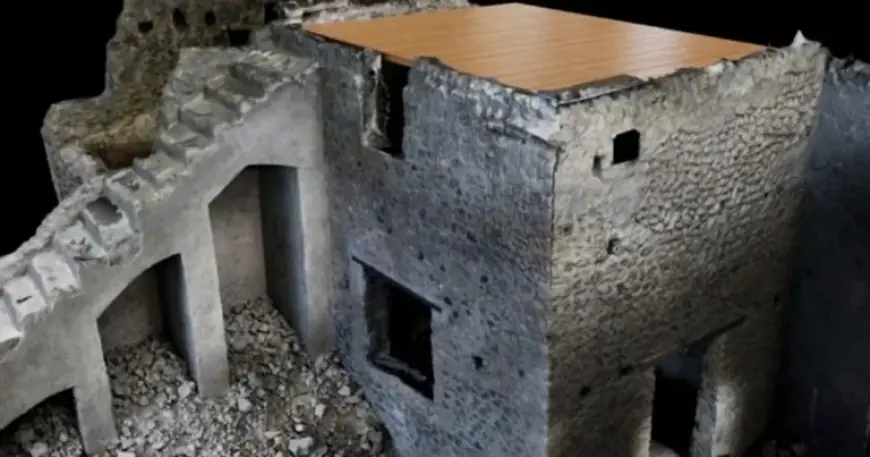
9: 00 a. m. ET — Archaeologists confirmed a grand external staircase inside the House of Thiasus at Pompeii, and Gabriel Zuchtriegel, director of the Archaeological Park of Pompeii, said the stair linked to upper floors now described as a “lost Pompeii” neighborhood. Unresolved: the exact height and structural completeness of the towers the staircase served.
House of Thiasus staircase: confirmed discovery and its implications for Pompeii
Fieldwork confirmed the presence of a monumental external staircase in the House of Thiasus, a finding that the research team interprets as an entrance to upper-level living spaces that formed part of what is called “lost Pompeii. ” Still, the excavation record in the lower levels shows simpler furnishings, which the researchers contrasted with the staircase’s monumental character.
Humboldt University reconstructions published in the E-journal Scavi di Pompei
Researchers from Berlin’s Humboldt University produced digital reconstructions of the House of Thiasus tower that were published in the E-journal Scavi di Pompei. Yet, the team described those outputs as hypothetical reconstructions built from non-invasive methods and 3D digital models rather than from preserved upper-floor remains.
Bay of Naples view, cut beams and stair clues that will determine tower form and height
Using clues such as unconnected staircases and cut-off support beams, the research team digitally designed a version of the site in which the staircase ascended to a tower allowing residents to overlook the city and the Bay of Naples. Still, the suggested tower height — scientists estimate it could have reached up to 40 feet — is unconfirmed as of 11: 00 a. m. ET and rests on interpretation of those physical clues and the digital model.
In addition to the physical clues, the team emphasized the role of digital archaeology in reconstructing parts of Pompeii that the volcanic deposit left incomplete. The researchers wrote that by assembling data in a 3D model, they can develop hypothetical reconstructions that help explain experience, spaces, and society before the Mount Vesuvius eruption of 79 C. E.
Still, several elements remain labeled unconfirmed as of 11: 00 a. m. ET: whether the upper floors functioned as multi-storey private towers housing the wealthy, the exact maximum height of those towers, and how much of the upper structures were destroyed by the eruption rather than preserved. The team noted that volcanic ash both buried and preserved ground floors while wiping out upper storeys, a pattern the researchers used in their reconstructions.
The published reconstructions in Scavi di Pompei are the confirmed release that underpins the tower interpretation. If the 3D models and the physical evidence they assemble are judged to show consistent structural supports for upper floors, then the interpretation that Pompeii featured multi-storey towers hosting elite households is expected to gain broader acceptance within the research literature.