Toto Wolff’s Mercedes pace hits rivals with a new 2026 qualifying puzzle

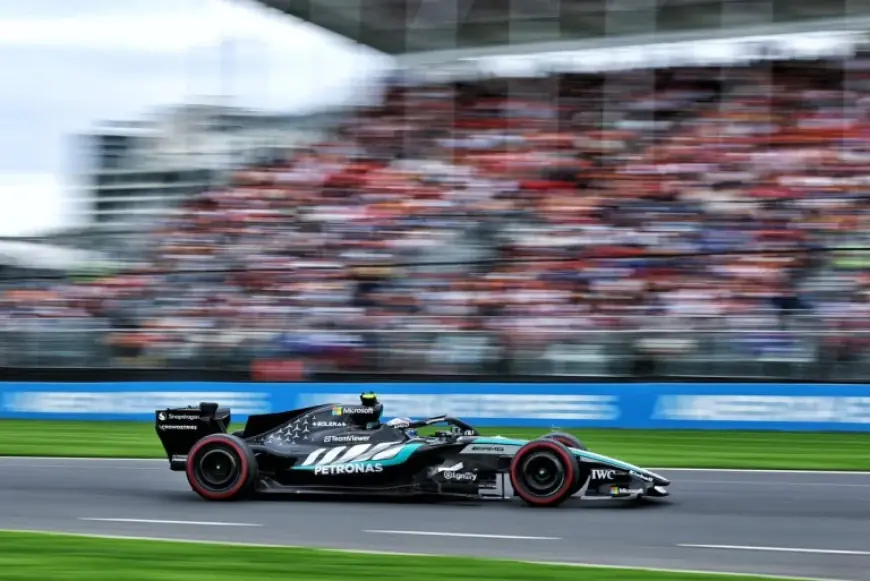
Teams chasing Mercedes face an immediate problem: in the new 2026 qualifying format, their laps can fall apart on the straights even when they arrive at full throttle at similar speeds. As of 9: 14 a. m. ET, Toto Wolff’s Mercedes operation sits at the center of that shift after qualifying revealed a gap that rivals struggled to explain through engine power alone.
Mercedes and Toto Wolff leave rivals paying the price on energy deployment
For Red Bull, Ferrari and McLaren, the impact is straightforward: they can reach key acceleration points close to Mercedes, then lose large chunks of lap time before the next braking zone. In the breakdown of George Russell’s pole lap, the decisive advantage showed up in how the Mercedes carried speed and, more importantly, how it gained speed on the straights through deployment superiority.
Data cited in the analysis highlighted a reference point at the exit of Turn 8 where multiple cars were at full throttle and traveling at near-identical speeds: Russell and Charles Leclerc at 290km/h, Isack Hadjar at 289km/h and Oscar Piastri at 291km/h. Yet even at that moment, Russell was already ahead, with Leclerc 0. 225 seconds down, Piastri 0. 252 seconds down, and Hadjar 0. 332 seconds down. From there, the gap widened on the back straight as speed traces diverged, with Mercedes reaching a higher peak and leveling off later.
The losses mounted quickly. On the run from the Turn 8 comparison point to Turn 9, Leclerc dropped another 0. 234 seconds, Hadjar another 0. 222 seconds, and Piastri a larger 0. 449 seconds. Over the longer stretch from that same Turn 8 point to Turn 11, an estimated 25-second segment of the lap, Leclerc lost 0. 650 seconds, Hadjar 0. 722 seconds, and Piastri 0. 628 seconds. That part of the lap represented about 32% of the lap time, yet accounted for 80% of Leclerc’s total loss, 92% of Hadjar’s loss, and 73% of Piastri’s loss.
George Russell’s pole lap frames Mercedes W17 as more than an engine story
The event that triggered the latest round of scrutiny was qualifying itself, where Russell secured pole position and Mercedes’ pace looked embedded across the lap. Russell described the advantage as broader than the power unit, stressing that the car’s feel and underlying quality mattered as well.
“We’ve got a really great engine beneath us, ” Russell said. “However, we’ve also got a really amazing car beneath us and that probably hasn’t been highlighted enough in the press these past few weeks. The car from the off, Kimi [Antonelli] and I both said it felt great to drive. ”
One reason that nuance matters is that Russell’s advantage was not limited to customer teams running the same power unit. The gap over the lead McLaren-Mercedes of Piastri was cited as 0. 862 seconds, a figure that pushed attention toward how Mercedes is using its package rather than simply what hardware sits in the back of the car.
There were also indicators that the Mercedes may be the superior chassis in addition to any power-unit strength. The analysis pointed to Russell’s minimum speed being “a little higher” than the McLarens through the majority of turns on his pole lap. Still, the deployment effect on the straights was described as the bigger component, and it overwhelmed smaller differences seen in cornering traces.
Andrea Stella and Lando Norris describe a “new language” rivals must learn
Beyond one qualifying result, the broader impact is that teams now have to rethink how they talk about and build a qualifying lap under the 2026 rules. McLaren team principal Andrea Stella characterized the new qualifying challenge as requiring “a new language and a new way of thinking, ” a framing that underlines how teams may be forced to re-evaluate old assumptions about where lap time comes from.
From the driver’s seat, McLaren’s struggles were described in energy-management terms rather than pure grip or downforce. Piastri said the team was “lifting and coasting three times a lap, ” and added: “We had two super clips through the lap. And in some corners we’ve got effectively 450 horsepower less. ”
In the other analysis, Lando Norris emphasized the tradeoffs between straight-line speed, lifting earlier, and how that feeds back into battery availability later in the lap. “The more speed you have on the straight, the sooner you can lift, ” Norris said. “The sooner you lift, the more power you have and the longer you can keep the throttle on. So it’s give and take. ” He added that the cycle also works through corner speed and time spent off the throttle, which can influence how much battery remains to deploy on exit.
Norris also offered a rough split for how such gaps can present, arguing that the difference is not simply a single measure of car performance: “So it’s not that the car is a second ahead; the car is probably three to four tenths better, and then the engine is also working three to four tenths better. ”
For Red Bull, the pressure point identified was the interaction between cornering performance and battery optimization. The assessment noted that data suggested Red Bull “lacks downforce and grip in the corners, ” reflected in Hadjar’s lower cornering speed, while also describing battery optimization as a key area where gains remain available. At the same time, it framed Red Bull’s challenge as more complex given it is “building its own PU for the first time, ” with the broader conclusion that Mercedes has, at least in this snapshot, optimized its entire package over a lap within battery limitations.
For now, the next shift that could change the outcome would come from car development, which was described as likely to be “particularly aggressive” over the season; if that development meaningfully improves corner speed and battery optimization for the closest challengers, the current qualifying gap could narrow.