F1 Results Leave Mercedes With Clear Qualifying Advantage After Melbourne

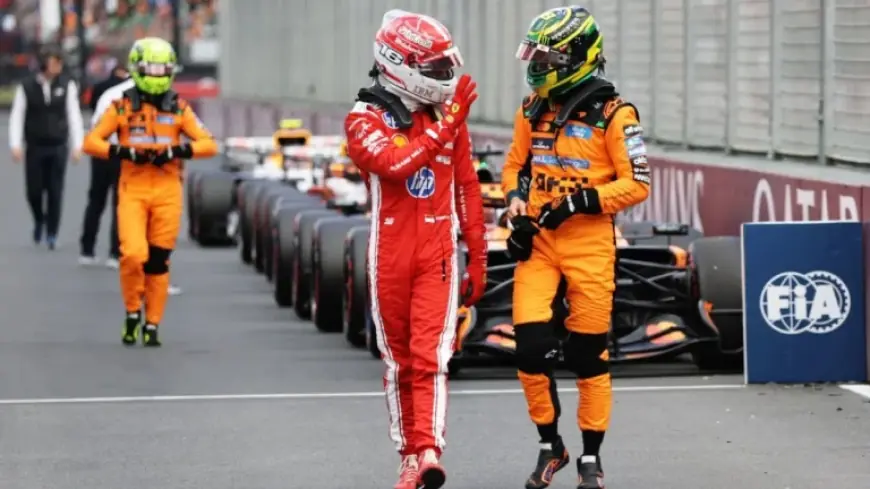
Teams now face a tighter race-day chess match: Mercedes will begin the Australian Grand Prix with a performance cushion that forces rivals to alter strategy and prioritize track time over setup experiments. Saturday at 4: 08 p. m. ET, qualifying produced the f1 results that set this new order when George Russell took pole amid a high-profile crash and widespread driver condemnation of the new cars.
F1 Results Give George Russell and Mercedes a One-Two Head Start
George Russell ended qualifying on pole and Mercedes completed a one-two with Kimi Antonelli, leaving their rivals under immediate pressure on race setup and tire plans. Russell finished 0. 785 seconds quicker than the first driver not in a Mercedes, Red Bull’s Isack Hadjar, a gap that hands Mercedes both track position and a clearer margin for race strategy.
Lando Norris, Max Verstappen and Lewis Hamilton Publicly Reject the New Car Formula
Lando Norris said teams had gone “from the best cars ever made” to “probably the worst, ” criticizing how drivers must manage battery charge across a lap under the new 50-50 internal combustion-to-electrical power split. He described constant lifting before corners and changing gear use as part of energy management, and warned that missing even a handful of laps leaves drivers and engines on the back foot.
Lewis Hamilton echoed dissatisfaction with the engine and chassis rules, calling them “completely against” Formula 1 principles, while Max Verstappen said he was “not having fun” driving the new machinery. Verstappen’s comments followed a qualifying crash that left him 20th on the grid and prompted immediate scrutiny of the hybrid systems that now dominate lap management.
Australian Grand Prix Qualifying: Verstappen Crash Prompts Red Bull Investigation
Max Verstappen spun into a barrier when the rear of his car locked up under braking into Turn One, an issue he described as the rear axle locking up “out of the blue” while applying the pedal. Red Bull opened an investigation into the cause of the incident, and Verstappen was later cleared by the race medical team after X-rays on his hands.
George Russell called the result a “perfect storm, ” citing Verstappen’s crash as one factor in Mercedes’ unexpectedly dominant qualifying performance. That description underscored how a single high-profile failure and the new, complex energy-management rules combined to reshape the starting grid.
Closing: The Australian Grand Prix race is next on the weekend agenda; Red Bull’s probe into Verstappen’s crash is the immediate follow-up. If Red Bull’s investigation confirms a fault in the energy-regeneration or rear-axle system, teams could be forced to change energy management settings by race day, changing how drivers approach every lap.