A23a Heads Toward Final Breakup Now as Fragments Melt in Weeks

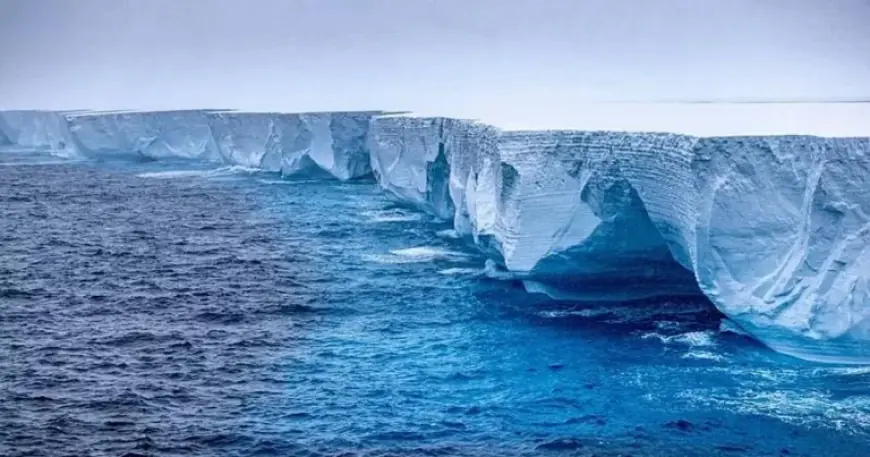
9: 00 a. m. ET — Iceberg A23a, once the largest iceberg on Earth, is in its final weeks, now reduced to scattered fragments that scientists say will disappear within weeks as warmer seas eat away the remaining ice. The timing matters because the berg’s rapid disintegration over the past year has produced visible ecological effects.
A23a’s Final Fragments Tracked as They Melt
Satellite and aerial observations show A23a fractured and disintegrating across the South Atlantic, with large pieces splitting away and smaller bergs and brash ice forming a debris field. Scientists described the iceberg’s condition as rapidly weakening after a year of accelerated melting far from Antarctica, and users of imagery noted chunks drifting northwestward before curling to the northeast.
Now: How Meltwater from A23a Fueled a Phytoplankton Surge
NASA satellite sensors detected plumes of chlorophyll-a around the remaining bergs and debris field, marking an extensive phytoplankton bloom tied to the iceberg’s meltwater. The VIIRS instrument on Suomi NPP captured imagery of the splintering tabular berg on January 25, 2026, and the OCI on the PACE satellite picked up elevated chlorophyll concentrations that drifted around the fragments.
Researchers connected the bloom to the iceberg because the pattern was large, persistent for weeks, and clearly spreading from the debris field; one emeritus oceanographer said the link strengthened his confidence that the iceberg and bloom were related. Oceanographers pointed to two mechanisms: meltwater creating a stable surface layer favorable to growth, and ice releasing iron and other nutrients—manganese and macronutrients such as nitrates and phosphates—that can stimulate phytoplankton.
Scientists Including Prof Mike Meredith Outline What Comes Next
Scientists tracking A23a emphasized the iceberg’s extraordinary longevity and its unusually eventful recent path. Prof Mike Meredith of the British Antarctic Survey called the iceberg’s journey “extraordinary, ” and Dr Christopher Shuman, a retired scientist formerly with the University of Maryland, Baltimore County, described following A23a’s path as like watching an unpredictable drama.
Researchers noted the disintegration offers an opportunity to study how large Antarctic ice structures behave when they drift into warmer seas and to observe downstream ecological effects such as the observed phytoplankton bloom. Oceanographers who examined satellite data highlighted that meltwater pooling on fragments was visible in Landsat 8 imagery from January 25, 2026, and that linear patterns on the ice align with long-ago striations.
In one key historical detail, the iceberg calved from the Filchner Ice Shelf in 1986 as a roughly 4, 000 square kilometer tabular berg, remained grounded in the Weddell Sea for more than 30 years, and only began moving again after scientists noticed signs of motion in 2020; at the start of 2025 it still measured roughly 3, 600 square kilometers before shrinking rapidly during the year.
Scientists highlighted episodes in A23a’s recent path that stressed the berg: it spent months trapped in a rotating Taylor Column vortex, became briefly grounded near South Georgia Island, and later resumed a long northward drift that ended with near-complete clockwise looping just before widespread fragmentation. Those interactions with ocean currents and seabed features contributed to its break-up pattern.
Grant Bigg, an emeritus oceanographer who has studied iceberg-driven blooms in the region, noted that while blooms unconnected to icebergs occur, the size and persistence of this bloom strongly point to the iceberg as the primary driver. Heidi Dierssen, an oceanographer, emphasized that light and nutrient availability normally limit phytoplankton here, and that iceberg melt can relieve those limits by supplying iron and stabilizing surface waters.
More details expected 11: 00 a. m. ET.