Hawaii’s uneven tourism rebound leaves households exposed to long-term stagnation

Middle-class families and working residents in hawaii face a widening affordability gap that the University of Hawaiʻi Economic Research Organization (UHERO) says is being driven by lagging productivity and wage growth, not just high prices. Sunday at 9: 00 a. m. ET, the latest UHERO analysis and forecast sharpened the stakes: near-term gains tied to high-spending visitors can lift totals, but they don’t resolve the longer-running underperformance UHERO describes as a “lost generation. ”
UHERO warns the gap for Hawaiʻi residents keeps widening
UHERO’s March 5 analysis argues that the gap between what Hawaiʻi residents can afford compared with elsewhere in the U. S. widens every year because productivity and wage growth lag, even as public debate often focuses on high prices. The authors say the state’s economic stagnation began in the early 1990s and “has never truly ended” for residents, particularly once the substantially higher cost of living is factored into the comparison.
Measured using standard approaches that adjust for national inflation, Hawaiʻi appeared to mostly keep pace with the broader U. S. economy and only recently slipped below the U. S. average. Yet the UHERO analysis says those measures can mask what residents experience day to day. By accounting for local prices, the analysis finds the 1990s “lost decade” looks different: prices grew more slowly in Hawaiʻi than in the U. S. overall, but the subsequent recovery looks muted as prices returned to a long-run relative level.
UHERO’s report frames the consequences as more than a statistical dispute. It links persistent underperformance to issues the state is already grappling with, including outmigration, housing stress, and the difficulty for middle-class families to sustain a standard of living. In that view, the core challenge is structural and long-running, not a short-term swing in inflation.
Steven Bond-Smith and Erich Schwartz trace a “lost decade” into a “lost generation”
In “The Lost Decade Never Ended in Hawaiʻi, ” UHERO researchers Steven Bond-Smith and Erich Schwartz describe how Hawaiʻi’s 1980s boom left the state vulnerable to the collapse of Japan’s asset bubble. The report says the shock’s impact was initially delayed, but the downturn exposed local weaknesses, including an overreliance on tourism and slow economic diversification.
Once cost-of-living adjustments are applied, UHERO says Hawaiʻi’s real per capita GDP has followed a “permanently lower, underperforming trajectory, ” even in periods when national metrics suggested recovery. The analysis puts a specific number on the long stretch: an average real per capita growth rate of 0. 7% per year since 2005, which it says essentially matches the slow growth rate of the lost decade and the recovery period from 1990 to 2005.
UHERO says the widening gap with the mainland U. S. is tied to a plateau in the dominant tourism industry, with other sectors failing to emerge in ways that offset the slowdown. The report’s phrase — “Hawaiʻi’s ‘lost decade’ has become a lost generation” — reflects that the effects have persisted long enough to reshape opportunities for people building careers and households across multiple decades.
The analysis also builds on a Feb. 1, 2026 UHERO report, “Beyond the Price of Paradise: Is Hawaiʻi Being Left Behind?” also authored by Bond-Smith and Schwartz. UHERO is housed in the University of Hawaiʻi at Mānoa’s College of Social Sciences.
Maui visitor spending lifts Hawaii totals, but UHERO flags concentration risks
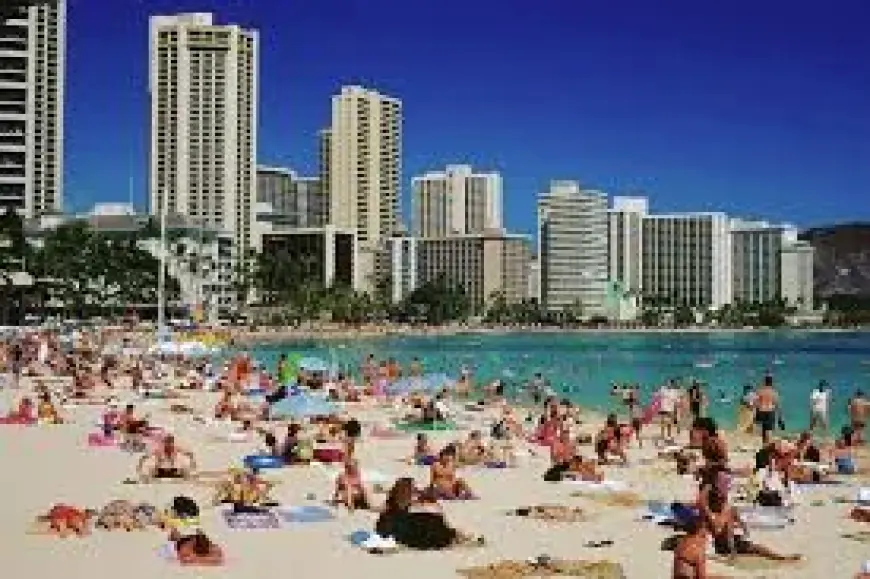
In its latest economic forecast, UHERO describes a near-term picture that looks “a bit brighter” as high-income tourists from the mainland continue to spend more, with a boost in visitor spending on Maui playing an outsized role. That matters because UHERO notes the overall tourism industry had been dragged down by a downturn on Maui following the Aug. 8, 2023 wildfires, but the forecast says a Maui resurgence is now driving the state overall.
UHERO’s forecast reported that visitor arrivals were off 1. 3% last year, while Kauai and Hawaii island saw visitor spending fall. Still, Oahu posted a 2. 5% increase in daily visitor spending, and Maui logged a 9% increase. Bond-Smith said the resulting increase in real spending statewide of roughly 3% was “very much dominated by Maui” and by “the higher-spending visitors. ”
Yet UHERO’s forecast also emphasizes how dependent the current spending mix is on a narrower slice of travelers. Bond-Smith said daily spending gains are coming from “high-end visitors” staying in luxury and upscale properties, but added that UHERO does not expect that increase in spending per person, per day to continue long term. Carl Bonham, UHERO’s executive director, warned that relying on the top 20% of income earners to drive tourism can be “risky when you’ve got all of your eggs in the high-consumer basket. ”
UHERO also described broader economic uncertainties tied to tariffs after the U. S. Supreme Court overturned President Donald Trump’s global tariffs last week, followed by questions about what policy steps might come next. In its forecast, UHERO wrote that in late 2024 and early 2025 imports surged as businesses tried to avoid looming trade levies, and that later in 2025 imports dropped sharply as tariff effects “began to bite. ” UHERO said at least 90% of tariff costs are being borne by the U. S., either by importers or consumers, and noted evidence that some major impacts — including on metals — have not fully fed through into prices.
For now, UHERO said construction, health care, and visitor accommodations and food service continue to drive Hawaii’s economy, even as it warns that tourism dependence and slow diversification remain central vulnerabilities. That leaves hawaii in a familiar bind: stronger spending numbers can offer near-term relief, but UHERO’s longer-running analysis says the underlying productivity and wage-growth problem continues to widen the affordability gap residents feel.
If UHERO’s view holds, the next inflection point for the outlook will come with its next scheduled forecast update, when new data on visitor spending, arrivals, and the direction of tariff policy are incorporated.