Weapons use in Iran strikes raises munitions and strategy questions

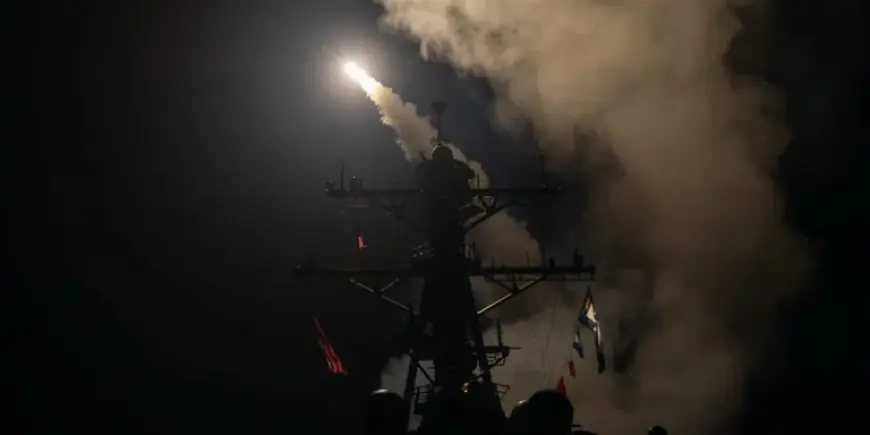
U. S. forces launched Tomahawk cruise missiles and the LUCAS one-way attack drone during strikes on Iran in Operation Epic Fury, a move that burned through limited Tomahawk stockpiles and marked the first combat use of the new drone. The mix of high-end and low-cost weapons in those strikes matters now because it has renewed questions about whether U. S. munitions supplies and production can sustain extended campaigns or larger wars.
Weapons stockpile strain after strikes
U. S. Navy warships fired Tomahawk missiles in the attack on Iran on Saturday, using a long-range, precision weapon that has been central to recent U. S. campaigns in the Middle East. The strikes further drained a limited Tomahawk inventory that analysts say could be needed in a war with a well-armed adversary. Tomahawks have been used repeatedly in operations targeting sites in multiple theaters, and officials have highlighted the importance of boosting production for such long-range munitions.
An analysis of the U. S. naval deployment in the region estimated that 13 destroyers, if all within striking range, could together launch roughly 150 to 250 Tomahawks, and the conversion of four Ohio-class submarines for cruise missiles could add about 154 more. It remains unclear whether a guided-missile submarine participated in the recent strikes. In response to concerns about supply, a multi-year agreement is in place to increase annual Tomahawk production to over 1, 000 missiles a year.
First combat use of LUCAS drone
U. S. Central Command confirmed that the strikes included the first combat employment of the LUCAS one-way attack drone. LUCAS is a low-cost, expendable munition modeled after an Iranian design and was launched as part of the same operation that targeted command-and-control facilities, air defenses, launch sites and airfields.
The platform can be launched by catapult, rocket-assisted takeoff and mobile ground systems, and it had been test-launched from a ship in the region prior to its combat debut. The design is a spinoff of a target model used to simulate Iranian drones; one variant cited has a range capability of around 500 miles, a maximum payload near 40 pounds, and a maximum takeoff weight of about 180 pounds. Unit cost for the LUCAS has been described at roughly $35, 000, making it far cheaper than advanced missiles.
Cheap Shahed-style drones change tactical calculus
Task Force Scorpion Strike, a squadron focused on one-way attack drones and led by Special Operations personnel, has been fielding these lower-cost systems. The use of inexpensive, Shahed-style drones alongside Tomahawk cruise missiles illustrates a deliberate mix of capabilities: affordable, scalable munitions for attrition and precision long-range weapons for high-value effects.
That mix has prompted analysts and former defense officials to highlight sustainment risks. For years the U. S. has drawn down inventories of strike weapons and interceptors while engaging in multiple theaters. Previous war games modeling a war with China have shown that supplies of certain weapons could be depleted within about a week, reinforcing calls for ramped production and logistics planning.
Key takeaways
- Tomahawk use in Operation Epic Fury further reduced a limited stockpile that planners view as important for high-end wars.
- The LUCAS one-way drone saw its first combat use and is significantly cheaper than traditional missiles, with an approximate unit cost of $35, 000.
- Officials are pursuing increased Tomahawk production and broader munitions planning to address sustainment concerns.
Looking ahead, the observable indicators to watch are production ramps for long-range munitions, the operational tempo of one-way drone deployments, and any formal disclosures about inventory levels. If production increases materialize and low-cost drones continue to be fielded at scale, planners may gain more flexibility; if stockpiles remain thin, future operations could face harder choices about how to allocate high-end strike weapons.