F1 Race Today: Drivers slam new rules as Australian GP pace stays unclear

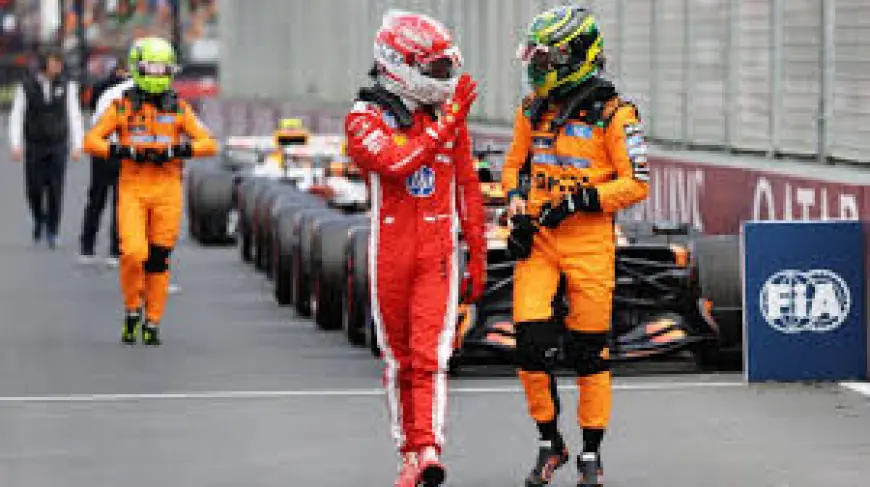
Sunday at 9: 00 a. m. ET in Melbourne (Saturday at 6: 00 p. m. ET), three world champions — Lewis Hamilton, Max Verstappen and Lando Norris — sharply criticized Formula One’s new regulations after a turbulent Australian Grand Prix qualifying session. With f1 race today set to follow that grid, what remains unresolved is how much the new energy-management demands and lingering reliability questions will alter race performance from what qualifying suggested.
George Russell’s pole is confirmed, but the qualifying gap has disputed causes
George Russell took pole position for the first race of the season in Melbourne with a dominant qualifying performance. Russell finished more than eight-tenths of a second quicker than McLaren’s Oscar Piastri, who qualified fifth, and he ended the day leading a Mercedes one-two from teammate Kimi Antonelli. Another confirmed marker of the gap: Russell was 0. 785 seconds quicker than the first driver not in a Mercedes, Red Bull’s Isack Hadjar.
Still, Russell said a “perfect storm” helped explain the scale of Mercedes’ advantage. One specific factor he pointed to was that Verstappen, whom Russell said Mercedes believed was their closest rival, crashed without setting a time. Russell also said Mercedes knew it had a fast car but did not anticipate it being “this fast, ” while adding that “Max wasn’t there. ”
What that means for f1 race today is not settled by qualifying alone. The grid is confirmed, but Russell’s framing leaves open whether Mercedes’ pace advantage reflects a sustainable edge or whether it was amplified by a qualifying session that featured major disruption for at least one top contender.
Lewis Hamilton, Max Verstappen and Lando Norris describe the new cars as ‘worst’
Norris, Hamilton and Verstappen delivered a coordinatedly bleak assessment of the regulations overhaul after qualifying for the Australian Grand Prix. Norris, described as McLaren’s defending champion, said the driving experience “sucks” and called the cars “probably the worst” ever made, adding that the sport had moved from “the best cars ever made” to “probably the worst. ” He directly tied that to the engines having a 50-50 split between combustion power and electrical energy.
Hamilton criticized the new engine and chassis rules as “completely against” Formula One’s principles, focusing on the requirement for drivers to manage energy recharge throughout a lap. He described a lap pattern in which drivers begin with partial throttle and only later reach full throttle, saying the system pushes “lifting and coasting” and is not something drivers “particularly like. ”
Verstappen said he was “definitely not having fun at all with these cars, ” and argued that the “formula is just not correct, ” adding that changing it would be “a bit harder. ” His criticism fit a broader set of complaints that, as confirmed in driver comments, had circulated through pre-season and intensified at Albert Park.
What remains unresolved is not whether the drivers dislike the new setup — that is confirmed by their statements — but whether the race will highlight the same issues in ways that materially affect results, including through energy management on long straights and the need to lift off the throttle to allow energy recovery.
The energy-management demands and Verstappen’s crash are the immediate variables
Multiple confirmed details point to why the competitive picture is unsettled heading into the race. The new regulations require complex energy management across a lap, and drivers described constantly managing battery charge through techniques that are not typically associated with the sport’s traditional “flat-out” approach. Norris said drivers have to “lift everywhere” to make sure the battery pack is in the right window, and that being too high can also be a problem. He also said that missing laps now carries a larger penalty than before because the driver has less time to learn the necessary techniques and the engine does not learn what it needs to learn.
Norris said reliability issues on Friday left him with fewer laps and put him “on the back foot, ” and he qualified sixth. Those reliability issues are confirmed only to the extent that Norris described them and tied them to limited running; the specific causes were not confirmed in the provided information.
Verstappen’s crash created another concrete uncertainty that affects how to read the grid. He spun into a barrier when the rear of his car locked up under braking into Turn One in qualifying. The lockup was described as part of the energy regeneration process that drivers are adapting to. Verstappen said the rear axle “completely locked up out of the blue” while he was on the brake pedal, calling it “very weird” and something he had “never experienced” in F1 before. He finished 20th, and Red Bull is investigating the cause.
One item is resolved on the health front: Verstappen was later cleared by F1’s medical team after X-rays on his hands following the crash.
For the race itself, the picture will clarify through a small set of observable developments during and immediately after the event:
- Whether Red Bull confirms the cause of Verstappen’s rear-axle lockup after its investigation
- Whether Russell’s qualifying margin translates into clear race control from the front row, or narrows once sustained energy management comes into play
- Whether Norris’ limited laps from Friday-related issues show up in race execution under the new battery-management demands
The next confirmed on-track event is the Australian Grand Prix itself in Melbourne, with the build-up to f1 race today centered on whether the new energy-management rules and unresolved technical questions — including the reason for Verstappen’s lockup — change the competitive order. If Red Bull confirms a specific fault tied to energy regeneration, further adjustments are expected on that car’s operation within the limits of the current rules.