Mongolia Marks 20th Eagle Festival as Prefabricated Volcano Hotel Debuts in Inner Mongolia Steppe

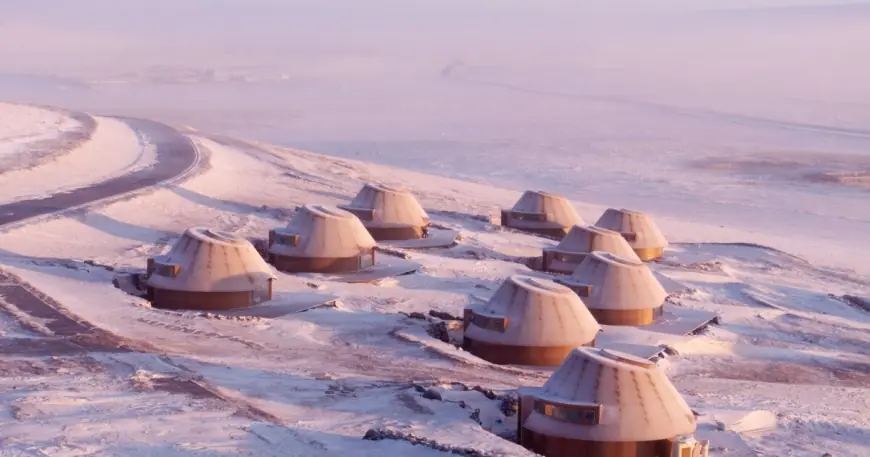
The annual Eagle Festival has returned to the Chinggis Khaan Khuree Tourist Complex for its 20th year, drawing more than 30 local eagle hunters and 16 international competitors to celebrate nomadic falconry. At the same time, architects have completed a prefabricated Volcano-In hotel in the Baiyinkulun Steppe of Inner Mongolia, a development that blends high-end accommodation with landscape rehabilitation.
Eagle Festival at Chinggis Khaan Khuree in Mongolia
Organizers staged the festival this weekend to promote traditions and pass them to younger generations, with the Ulaanbaatar Tourism Department, the Chinggis Khaan Khuree Tourist Complex and the Mongolian Eagle Hunters Association coordinating the program. More than 30 eagle hunters from Bayan-Ulgii, Tuv and Selenge aimags entered competitions alongside 16 visitors from Kazakhstan, Kyrgyzstan, Spain, Hungary and Russia. The Ministry of Culture, Sports, Tourism and Youth of Mongolia and the Bayan-Ulgii Aimag Department of Culture and Arts provided support for the event.
Contestants paraded in traditional dress carrying trained golden eagles and riding horses trained for eagle hunting. Judges evaluated how well participants preserved customs and assessed the colors and designs of clothing, with awards given for the finest eagle hunter, best traditional attire, and most authentic horse and eagle equipment. Visitors could attend Kazakh cultural performances, shop for crafts, taste local cuisine and enter a Kazakh ger to experience traditional lifestyles. The festival underscores a longer heritage: the practice of training birds of prey for hunting has roots stretching back millennia and was inscribed on the UNESCO Representative List of the Intangible Cultural Heritage of Humanity in 2010.
Volcano-In Hotel of Arrivals by PLAT ASIA
PLAT ASIA completed a 1, 634-square-meter hotel in the Baiyinkulun Steppe, part of the broader Baiyinkulun Steppe & Volcano Tourism Resort. The development sits southeast of a long-dormant volcanic crater formed roughly 150, 000 years ago and within a region that contains 108 volcanoes scattered across the steppe, lakes and wetlands. The hotel comprises compact spherical cabins clad in reddish metal panels with aluminum roofs, assembled from prefabricated components to reduce heavy groundwork and minimize disturbance to the fragile landscape.
Each cabin sits on elevated foundations above existing sand depressions; curving retaining walls double as snow screens and wind buffers. Architects deliberately positioned the units over these depressions to halt their spread and encourage soil recovery, while stone-paved walkways connect the cluster and a nearby prototype on a hilltop. Guest suites include a sleeping area, living zone, bathroom, private terrace, an oval skylight above the bed for stargazing and a narrow horizontal window framing the volcanic horizon.
PLAT ASIA Design Choices and Landscape Stabilization
The Volcano-In Visitor Center complements the hotel with a continuous 274-metre corridor that winds around a crater-like enclosure, three circular sections at varying heights and glass walls that frame views of the plain, lakes and distant volcanoes. Designers used weathering steel platforms and local volcanic stone for paths and squares so the buildings settle into the terrain over time. The project was engineered for extreme conditions: curved profiles and extended eaves reduce wind pressure and prevent snow buildup in an environment where winter temperatures can reach as low as -43 degrees.
By limiting groundwork through prefabrication and by siting structures on already disturbed ground or over sand depressions, the project aims to stabilize volcanic ash and soil and reduce ongoing erosion. That cause-and-effect — placing light-footprint architecture where the land is already compromised so it can be repaired rather than further scarred — is central to the resort’s stated conservation rationale. What makes this notable is the explicit pairing of high-end visitor amenities with deliberate measures to support ecological recovery in a highly exposed steppe environment.
Together, the Eagle Festival and the Volcano-In development demonstrate two distinct approaches to cultural and environmental stewardship in the region: one using ceremony and competition to sustain living traditions, the other employing prefabricated architecture and landscape management to repair and present a fragile volcanic landscape to visitors.