























Big 10 Wrestling Championships 2026: Penn State Hosts Deep Field as Huskers Bring Seven Top-Five Pre-Seeds

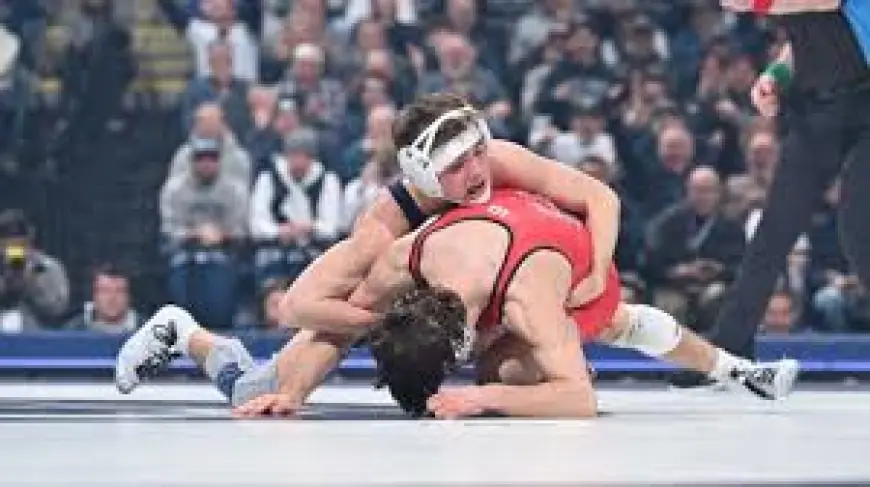
The Big 10 Wrestling Championships 2026 open this weekend in State College, Pa., with the conference entering the tournament deep across weights and Nebraska sending seven top-five pre-seeds after a 13-6 dual season. What happens over the two-day event will directly influence NCAA automatic qualifiers and seeding for the March national meet.
Bryce Jordan Center Hosts Big 10 Wrestling Championships 2026 Field
The 112th edition of the conference tournament will be staged at the Bryce Jordan Center and begins Saturday, March 7 at 9 a. m. Central Time for Session I. Semifinal action is scheduled to start at 6 p. m. CT that day, with championship coverage resuming Sunday at 11 a. m. CT and final bouts airing at 3: 30 p. m. CT. Broadcast plans include live linear and streaming windows on the Big Ten Network and additional mat streams on B1G+.
The schedule and session structure mean that wrestlers will need to navigate multiple rounds in a compressed timeline: first rounds and quarterfinals on Saturday morning, consolation brackets and semifinals Saturday evening, and medal matches on Sunday. The timing matters because quick turnarounds can favor deeper teams with multiple potential scorers and challenge those relying on a few top individuals to earn automatic NCAA berths.
Nebraska's Seven Top-Five Pre-Seeds and Team Stakes
Nebraska arrives with seven wrestlers seeded inside the top five in their respective weights following a regular season that concluded with a 13-6 dual record. Two Huskers, Antrell Taylor and Christopher Minto, enter the tournament seeded No. 1 at their weights. Three Cornhuskers are seeded No. 2: Brock Hardy, Camden McDanel and AJ Ferrari. Silas Allred sits at No. 3 while Jacob Van Dee is seeded sixth.
Four Nebraska competitors will make their Big Ten Tournament debuts: Ferrari, LJ Araujo at No. 5, Chance Lamer at No. 6 and Kael Lauridsen at No. 11. That mix of established scorers and first-time participants shapes expectations for team scoring; Nebraska has finished no lower than eighth in its 14 years in the conference, including 11 top-five finishes and three consecutive top-three placings prior to this year. Last season the Huskers recorded a program-high 137 team points and placed second, anchored by individual titles from Ridge Lovett and Brock Hardy.
The conference also set pre-allocated NCAA qualifying slots per weight, a concrete pathway from conference finish to national field: 125 (nine), 133 (eight), 141 (seven), 149 (nine), 157 (eight), 165 (nine), 174 (ten), 184 (eight), 197 (ten) and 285 (nine). Because these allocations determine how many automatic berths the Big Ten can provide at each weight, performances this weekend will have immediate consequences for wrestlers chasing NCAA qualification ahead of the March 19-21 national tournament in Cleveland.
Top-Ranked Individuals, Seedings and Matchups to Monitor
The Big Ten enters the tournament with national No. 1s concentrated across the lineup: nine of the 10 weights are led by top-ranked wrestlers, underscoring the conference's depth. Penn State's Luke Lilledahl is the conference No. 1 pre-seed after an 8-0 league season that included a fall and four tech-fall victories. His projected path could pit him against Iowa's Dean Peterson in an early round and then No. 17 Jacob Moran or No. 13 All-American Jore Volk in the semifinals before a possible rematch with Illinois' Nic Bouzakis in the final.
At other weights, Ohio State's Jesse Mendez carries the No. 1 pre-seed and a national top ranking into a bracket that includes Nebraska's Brock Hardy as the No. 2 seed; Mendez has multiple recent wins over Hardy. Illinois' Lucas Byrd and Penn State's Marcus Blaze each finished the regular season undefeated, with Blaze earning the conference No. 1 pre-seed at that weight. Wisconsin's Zan Fugitt, a 2025 All-American, sits at No. 4 in a bracket that features several contenders capable of altering expected outcomes.
What makes this notable is the combination of individual national leaders and deep mid-card talent: with nine weights featuring national No. 1s and a long list of high seeds, a handful of upsets could redraw the NCAA bracket picture and shift team-scoring dynamics dramatically over two days.
Live stats and brackets will be available through the tournament's official tracking platform, and teams will use the weekend results to finalize seeding and NCAA entries ahead of the national championships later in March.