
























Stock Futures Slip as Oil Soars After U.S. and Israeli Strikes on Iran — Higher Pump Prices Loom


The oil spike that followed U. S. and Israeli strikes on Iran — which killed its supreme leader — matters now because it immediately pressures both consumers at the pump and traders in stock futures. Retail gasoline prices face a near-term jump while markets pivot toward volatility: oil benchmarks climbed sharply, prompting a broad risk-off move that hit global equities and pushed investors into safe havens.
Stock Futures: who feels the impact first and how
Here’s the part that matters: traders pricing risk into stock futures will pass through faster than pump prices, but fueling costs bite households next. The immediate market reaction is visible in falling equity benchmarks and a flight to gold and the dollar, signaling that stock futures are reacting to geopolitical shock rather than routine supply shifts.
What happened to crude and how big the jump was
Oil surged after the strikes. U. S. crude rose more than 6. 5%, while Brent jumped 8% on Monday morning, with the U. S. benchmark moving nearly $5 per barrel higher in a single session. That rise followed an already-elevated market: prices had climbed 17% earlier this year amid ramped-up rhetoric from President Donald Trump and additional U. S. sanctions on Iran.
Immediate consumer math and analyst signals
Retail gasoline typically moves about 2. 5 cents for every $1 change in crude. By that rule, the recent crude move implies almost a 13-cent-per-gallon increase could be on the horizon for consumers. GasBuddy analyst Patrick De Haan said price hikes at gas stations could start as soon as Monday, adding that by Monday night it would be credible to say pump prices were being impacted. He warned it likely won’t look like a spike but expects stations to begin passing along increases this week.
Market reactions across assets and regions
Stocks opened sharply lower: the broad S&P 500 and the tech-heavy Nasdaq each slid nearly 1% at the open, while the Dow Jones Industrial Average dropped more than 400 points. The Russell 2000, which tracks smaller companies, declined 0. 8%.
Global equities also fell: the pan-European Stoxx 600 tumbled 1. 8%, Germany’s DAX plunged 2. 5%, France’s benchmark slid 2. 1%, Italy’s fell 2. 4%, and Japan’s Nikkei traded 1. 4% lower overnight. The U. S. Dollar Index rose 0. 8%, and precious metals climbed, with gold futures jumping about 2% — more than $115 — as investors moved toward safe-haven assets.
Supply-route risks, Iran’s oil footprint and shipping disruptions
Iran’s oil production is estimated at less than 5% of global output, and most of that output flows to China because of U. S. sanctions. The country wields outsize influence over the Strait of Hormuz, a chokepoint that carries more than 20% of the world’s daily oil demand; a closure or restriction there would quickly rock the global oil market and is considered a worst-case scenario by long-time industry observers.
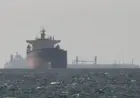
On the logistics front, at least six leading cargo shipping companies halted or diverted vessels that were set to transit the waterway on Saturday and Sunday, reflecting immediate commercial responses to the heightened risk.
- OPEC+ response: eight oil-rich OPEC+ nations plan to increase production by more than 200, 000 barrels per day starting next month in an effort to calm markets.
- Volatility hinge points: analysts point to four variables that will shape the trajectory of prices — how much supply is disrupted, how long any disruption lasts, whether other sources can be mobilized quickly, and what follows next.
The real question now is how persistent this episode becomes: historical geopolitical oil shocks often fade quickly, but if tensions endure, markets may see extended volatility.
Key takeaways:
- Oil benchmarks jumped sharply — U. S. crude >6. 5%, Brent ~8% — after strikes that killed Iran’s supreme leader.
- Stock futures and equity indexes opened lower, with major U. S. indexes down about 1% and the Dow off more than 400 points.
- Consumers could face nearly a 13-cent-per-gallon rise at the pump based on standard crude-to-retail math; station-level increases likely this week.
- Supply-side risk centers on the Strait of Hormuz (handles >20% of daily demand); Iran produces <5% of global oil and ships most output to China because of U. S. sanctions.
- At least six major shipping companies halted or diverted vessels; eight OPEC+ nations plan a >200, 000 bpd production boost next month to calm markets.
It's easy to overlook, but the market’s immediate reaction—stocks down, gold up, dollar firmer—reflects a rapid risk re-pricing that could reverse if tensions ease. The trajectory of both oil and stock futures will hinge on whether supply disruptions intensify or are quickly offset by additional output.