























iPhone 18 Pro Max Rumors Harden Into a Clearer Picture Ahead of Apple’s September Window

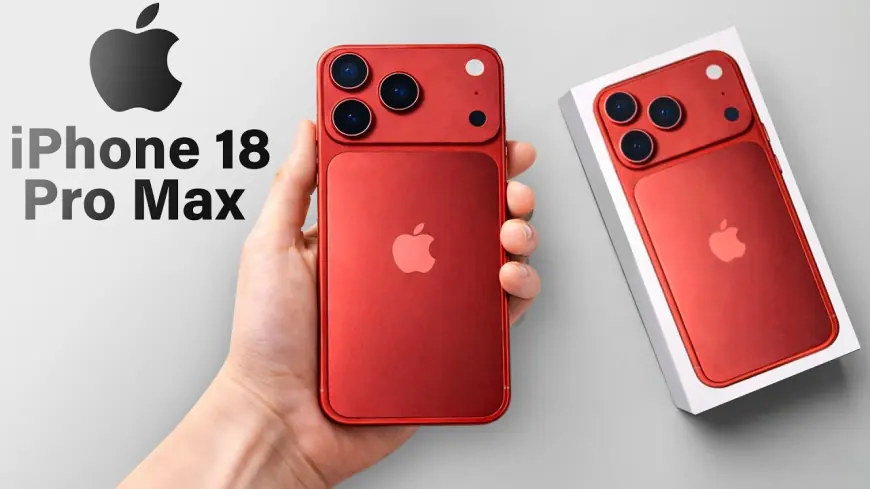
The iPhone 18 Pro Max is already taking shape in the rumor market as Apple’s next big “Pro” swing: a cleaner front display, a sharper selfie camera, and a new-generation A20 Pro chip that could push performance and efficiency—while Apple tries to keep pricing steady despite rising component costs. As of Monday, March 2, 2026, none of this is confirmed by Apple, but the pattern of leaks is becoming consistent enough that carriers, accessory makers, and investors are starting to treat the iPhone 18 Pro Max not as a speculative concept but as a product with a defined direction.
The timing chatter is also narrowing. Most industry watchers still expect the iPhone 18 Pro Max to arrive in September 2026, with a launch event likely in the first half of the month and retail availability following shortly after—Apple’s well-worn cadence when it doesn’t face supply shocks. In Eastern Time, Apple typically announces in the early afternoon, with preorders opening that same week and in-store availability about a week later. The important nuance: dates and “release time” are largely driven by Apple’s event schedule, not midnight unlocks like a game launch.
iPhone 18 Pro Max release date and release time
If you’re searching iPhone 18 Pro Max release date, the best working expectation remains September 2026, with many forecasts clustering around the September 3–10 event window and a retail release shortly after. The release time question tends to matter for two moments:
First is the announcement itself, which—based on Apple’s modern pattern—usually happens in the early afternoon ET on a weekday.
Second is preorder timing, which in recent years has commonly landed at 8:00 a.m. ET on the Friday after announcements. That’s the moment carrier systems and Apple’s storefronts typically go live, and it’s where demand spikes reveal early supply constraints.
If Apple does tweak the calendar in 2026, the most plausible reason wouldn’t be marketing—it would be manufacturing: tighter capacity for next-gen chips, camera modules, and display components can compress early inventory even when the device is ready to announce.
Resident-level changes: under-display Face ID, smaller Dynamic Island, and the screen bet
The biggest “headline feature” being floated for iPhone 18 Pro Max is under-display Face ID, often paired with talk of a smaller Dynamic Island rather than a fully uninterrupted screen. That distinction matters. Under-display Face ID is difficult because it asks Apple to do two conflicting things at once: hide sensors behind the panel while keeping reliability and speed at the level people expect.
Apple’s incentive is obvious: a more immersive display is instantly visible in marketing and helps justify “Pro” identity even when year-over-year internal changes get harder to feel. The risk is also obvious: Face ID is a trust feature. If performance slips—especially in low light, odd angles, or with accessories—consumer backlash would be swift.
That’s why the most believable version of the rumor is evolutionary, not radical: Apple moves Face ID components under the panel but keeps a small visible cutout for the front camera, shrinking the island rather than eliminating it. It’s the kind of compromise Apple historically prefers when a technology isn’t fully mature at massive scale.
A20 Pro, battery expectations, and what “Pro Max” is really selling
On paper, the iPhone 18 Pro Max will likely live or die by the A20 Pro story. The talk in the supply chain centers on a more advanced manufacturing process—often described as “2nm-class”—which could deliver better efficiency even when raw performance gains are modest. For a Pro Max model, efficiency is the quiet king: it translates into battery life, sustained performance, and cooler operation under camera, gaming, and on-device AI loads.
Battery rumors are already swirling about “record” endurance, which is the kind of claim that spreads fast and proves tricky later. The realistic upside is still meaningful, even without miracles. A more efficient chip, incremental display power improvements, and smarter modem behavior can produce real-world gains—especially for the heavy users who buy the Pro Max precisely because they’re tired of managing charge anxiety.
The strategic layer is that Apple is selling stability in a market that keeps getting noisier. Android rivals can spike impressive single-spec moments; Apple often wins by stacking many small improvements that compound: smoother thermals, steadier cameras, fewer “weird edge cases,” and battery life you notice every day.
Camera rumors: 24MP selfie talk and the “real” upgrade question
The iPhone 18 Pro Max camera chatter has one clear hook: an upgraded front-facing camera, commonly rumored at 24MP. If true, it would be a meaningful step up from Apple’s long-standing 12MP era and the more recent incremental bumps. But megapixels alone don’t decide camera quality—sensor size, lens characteristics, processing, and stabilization often matter more.
That’s why the more revealing part of the rumor isn’t the number; it’s the implication that Apple sees the selfie camera as a new battleground. Video calls, creator workflows, front-camera social video, and “always-on” communication have pushed the front camera from afterthought to primary camera for millions of people.
There’s also persistent talk of advanced camera control on the rear system—sometimes framed as variable-aperture ideas—though that remains less consistent than the selfie chatter. If Apple does bring more optical control to the Pro Max, expect it to be marketed as creative flexibility and better low-light handling, not as a spec-sheet flex.
Price pressure and the iPhone 18 Pro Max “no increase” narrative
The most consumer-relevant rumor is also the most strategic: Apple trying to hold iPhone 18 Pro Max pricing roughly flat versus the prior generation, even as chip, memory, and display costs creep upward. Whether Apple can do it depends on a few levers: component contracts, yield rates, mix (how many high-storage models sell), and how aggressively it bundles value into services rather than hardware margin.
If prices do hold, Apple buys itself a powerful message in a high-rate, cost-sensitive environment: “premium without a penalty.” If prices rise, Apple will likely justify it through visible hardware changes—exactly the kind of display and camera improvements that make an increase feel less like a tax.
Between now and September, watch for three triggers that will tell you whether the iPhone 18 Pro Max rumors are hardening into reality: repeated agreement on the front-display design, clearer signals about chip production capacity, and accessory leaks that reveal where the camera and sensor cutouts actually land. That’s when speculation stops being entertainment and starts becoming a roadmap.