

























Jim Carrey’s “New Face” Goes Viral After Rare Awards Appearance in Paris

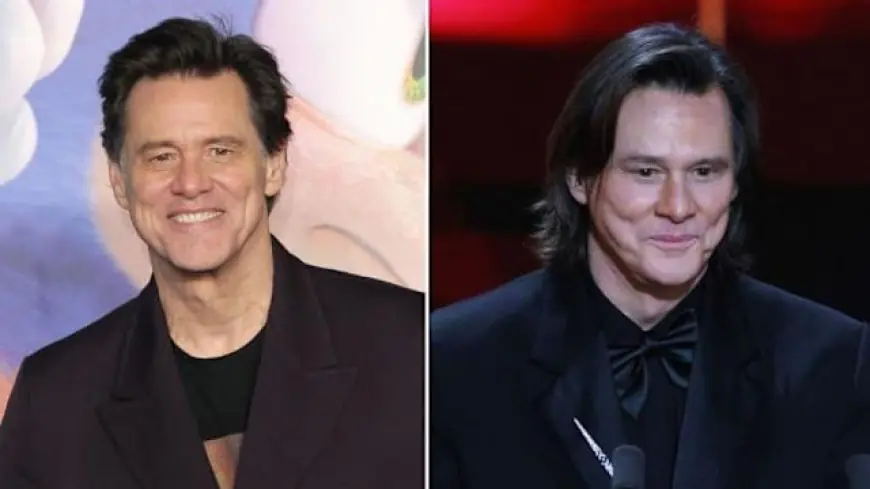
Jim Carrey set off a wave of online speculation about his “new face” after a rare public appearance at the César Awards in Paris on Friday, Feb. 27, 2026, where he was celebrated with an honorary career prize. Within hours, clips and stills spread across social media, with commenters arguing over everything from possible cosmetic work to lighting, camera lenses, and even far-fetched body-double claims—turning a routine red-carpet moment into a full-blown internet mystery.
In Eastern Time, the reaction cycle was almost instantaneous: late Friday afternoon into Friday night, the images hit peak virality, and by the weekend the conversation had expanded into a broader debate about celebrity aging, performance personas, and how quickly online audiences treat a single appearance as “evidence” of something deeper.
César Night, Instant Scrutiny
Carrey’s appearance was notable for its rarity. He has kept a lower public profile in recent years, so any return to a major stage was primed to draw attention. The César ceremony—France’s marquee film awards—gave that attention a global stage, and the cameras did what cameras always do at these events: caught him in a dozen angles, with shifting stage light, heavy contrast, and close-up framing designed to read on television.
That’s where the “new face” narrative took hold. Some viewers fixated on a smoother forehead, different cheek contour, or changes around the eyes and mouth. Others pointed to more mundane culprits: longer hair changing his silhouette, weight fluctuation, fatigue versus rest, and the simple reality that high-resolution video can make skin texture look radically different depending on makeup, harsh lighting, or compression artifacts.
The more interesting part wasn’t the initial shock—it was how quickly the story mutated. Within a day, online threads were no longer asking “did he change?” but “why is he changing?” and “who benefits?” That is the modern celebrity cycle: appearance becomes a plot, and the plot becomes a referendum on authenticity.
Plastic Surgery Rumors and the Internet’s “Explain It” Reflex
The cosmetic-surgery chatter followed a familiar path: side-by-side photos, amateur face-mapping, and confident diagnoses from people with no access to Carrey’s medical history. What’s striking is how the certainty travels faster than the evidence. A single still frame—especially one mid-expression—can make anyone look “unrecognizable.” Yet the internet often treats that as a before-and-after.
A parallel industry then kicks in: “expert” takes that range from responsible to reckless. The responsible version acknowledges the limits of inference: aging shifts facial fat, skin elasticity, and muscle tone; styling changes can exaggerate those shifts; and stress, sleep, and hydration affect appearance in ways that can’t be reverse-engineered from a screenshot. The reckless version offers procedure lists as if they were confirmed facts. The gap between those two approaches is where misinformation thrives.
Carrey himself has not provided a detailed explanation tied to the viral claims, and absent that, the only honest framing is uncertainty. You can’t confirm surgery from a red-carpet clip. But you can confirm something else: audiences now consume celebrity faces the way they consume storylines—searching for continuity, looking for clues, and punishing ambiguity.
Clone Conspiracies and the Alexis Stone Twist
The story’s strangest branch was the “replaced” narrative—an old internet trope that reappears whenever a famous person looks different, sounds different, or behaves outside a familiar pattern. It’s less a belief system than a viral language: a way of saying “this feels off” without doing the hard work of explaining why.
That’s where a separate claim poured gasoline on the speculation: the makeup artist and impersonator Alexis Stone posted content implying a transformation into Carrey, prompting some viewers to argue the César appearance could have been an elaborate stunt. There is no conclusive public proof that a hoax occurred, and the claim itself has been treated skeptically by many online observers. Still, it mattered because it gave the discourse a hook—an alternate explanation that sounded more entertaining than the boring truth that cameras, lighting, and aging can produce dramatic differences.
What’s happening here is a shift in how “celebrity reality” is negotiated. In an era of deepfakes, hyper-realistic prosthetics, and performance art designed for virality, even implausible ideas feel temporarily plausible. The internet doesn’t require a theory to be likely; it only requires it to be shareable.
What Happens Next
Four scenarios are now in play, and each has an obvious trigger:
First, if Carrey appears again soon—another event, an interview, a public outing—the “new face” conversation may collapse under normalcy. Familiar angles and consistent footage tend to deflate mystery fast.
Second, if he stays out of view, the speculation may harden into fan-lore, because absence invites narrative. The less data people have, the more confidently they fill in the blanks.
Third, if a film project or public-facing role arrives—especially something tied to performance or transformation—the moment could be reinterpreted as intentional branding rather than accidental virality.
Fourth, if the Alexis Stone claim is clarified one way or the other, the internet will treat the clarification as either a “reveal” or a “cover-up,” depending on what each corner of the audience already wants to believe.
For now, the cleanest explanation remains the least exciting: a rare appearance, captured under unforgiving lights, meeting an online culture that treats every pixel as a clue. The real story isn’t whether Jim Carrey has a “new face.” It’s how quickly the public decides a face must come with a conspiracy.