
























Chad Baker-Mazara exits USC basketball with two games left, deepening Trojans’ late-season slide

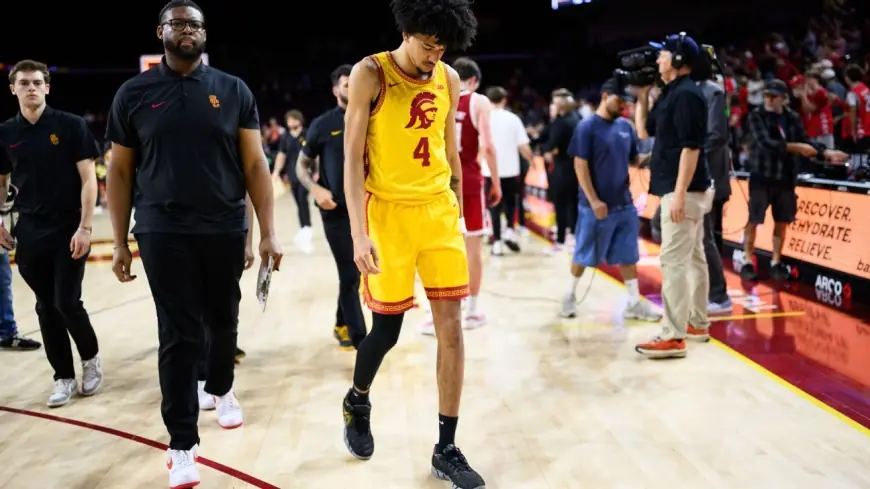
Chad Baker-Mazara is no longer a member of USC basketball, the program announced Sunday, March 1, 2026, a stunning break that lands with just two regular-season games remaining and the Trojans scrambling to keep their postseason hopes alive. The move comes immediately after USC’s 82–67 loss to Nebraska, a game in which Baker-Mazara left early in the second half following a hard fall and did not return. By Sunday evening ET, the separation had turned what was already a tense finish to the season into a full-blown crisis of stability and identity for a team that has leaned on him as a primary scorer and on-ball answer-maker.
USC did not provide details for why the split happened, and that vacuum is now shaping the story almost as much as the decision itself. What is clear is the timeline: an injury scare, a chaotic sideline sequence that drew attention inside the arena, a loss that extended a skid, and then a blunt roster reality set in motion less than a day later. For USC, the question isn’t just how to replace a high-usage wing in March. It’s how to keep a locker room together when the calendar is least forgiving.
USC basketball loses its leading scorer at the worst possible time
Baker-Mazara’s importance to USC wasn’t theoretical. He’s been the type of player who can create a shot late in the clock, absorb the toughest perimeter matchups, and turn a broken possession into points—skills that matter more in close games than they do in comfortable wins. With two games left, those possessions are no longer a footnote; they’re the entire margin between a season that extends and one that ends abruptly.
There’s also the roster-shape issue. A late-season departure doesn’t just subtract points. It changes roles overnight. Players who were complementary become primary. Lineups that were balanced become lopsided. Rotations tighten, then tighten again when foul trouble hits. When you lose a trusted option, coaches don’t merely replace minutes—they replace decisions. Who handles the ball when pressure arrives? Who takes the late-clock jumper? Who steadies the group when a run starts going the wrong way?
USC’s recent stretch has already been fragile, with the team searching for consistent offense as losses piled up. Removing Baker-Mazara now is like pulling a stabilizer off a plane mid-flight. It forces immediate simplification: fewer actions, fewer read-heavy sets, more emphasis on defensive stops and transition chances, and a heavier burden on whoever is left to manufacture half-court offense.
What happened in the Nebraska game, and why the optics mattered
The Nebraska loss became the inflection point. Baker-Mazara took a hard fall early in the second half after a defensive play near the rim, and he exited soon after. The episode didn’t read like a routine “shake it off and return” moment. He never re-entered, and attention shifted to where he was—and where he wasn’t—during the remainder of the game.
In college basketball, optics aren’t everything, but they can be accelerant. A player leaving the bench area, whether due to injury management, frustration, or miscommunication, instantly becomes a story because it looks like separation. Even when a situation has an ordinary explanation, the visual can create its own narrative inside an arena and then online within minutes.
That matters here because USC followed the game with a statement that offered no explanation for the parting. Without details, people will connect dots that might not belong together: the fall, the exit, the seating, the loss, then the announcement. Some of those connections will be wrong. But the team now has to deal with the consequences either way—because uncertainty can travel through a locker room faster than clarity.
Chad Baker-Mazara’s winding path made him valuable and complicated to replace
Baker-Mazara’s college journey has been unusually nomadic by major-program standards, moving through multiple stops before landing at USC for what was meant to be his final season. That kind of path can produce a rare kind of player: older, battle-tested, comfortable in new systems, and less shaken by hostile road environments. In March, that maturity is currency.
It also means he arrived with a defined sense of what he is as a player. USC didn’t bring him in to be a long-term project. The fit was supposed to be immediate: score on the wing, defend with edge, and provide an experienced backbone for a team trying to win now. When a player with that profile exits in-season, the void isn’t just talent—it’s certainty. You can’t replicate years of physical and emotional reps with a week of practice.
That reality will force USC into a choice: either spread Baker-Mazara’s usage across multiple players—accepting some inefficiency as the price of stability—or concentrate responsibility in one or two hands and live with the consequences if opponents load up defensively.
What comes next for USC basketball and Baker-Mazara: five scenarios to watch
The immediate USC basketball challenge is functional: win games without him. But the next steps will quickly turn into a bigger set of questions around program culture, roster management, and what “buy-in” means in an era where movement is constant and timelines are short.
Here are the scenarios that will define the next two weeks:
First, USC stabilizes quickly. The trigger would be a simplified rotation, a defense-first identity, and one player stepping into a clear primary scoring role without the offense collapsing.
Second, USC’s offense stalls. The trigger would be late-clock droughts, a spike in turnovers as ballhandlers face pressure, and an inability to generate free throws—often the first casualty when a creator leaves.
Third, the locker room tightens into an “us against the world” posture. The trigger would be sharper defensive effort, improved rebounding, and a visible uptick in energy from role players who suddenly have permission to be aggressive.
Fourth, distractions linger. The trigger would be consistent questions after games, visible frustration in huddles, and small breakdowns—missed rotations, poor shot selection—that often signal a group playing with one eye on the noise.
Fifth, Baker-Mazara’s next step becomes the story. Whether that’s pursuing professional opportunities, evaluating options elsewhere, or addressing what happened publicly, the trigger would be any direct statement that clarifies the nature of the separation. Until then, the silence will continue to invite speculation.
For USC, the season isn’t over yet, but it has unquestionably changed. Chad Baker-Mazara’s departure removes a key piece at the exact moment teams normally lean harder into experience, not less. The next games will show whether the Trojans can turn the shock into cohesion—or whether the loss of one central figure becomes the moment the entire season finally tips.