

























Iran news today: Khamenei confirmed dead as strikes widen and Gulf cities absorb fallout

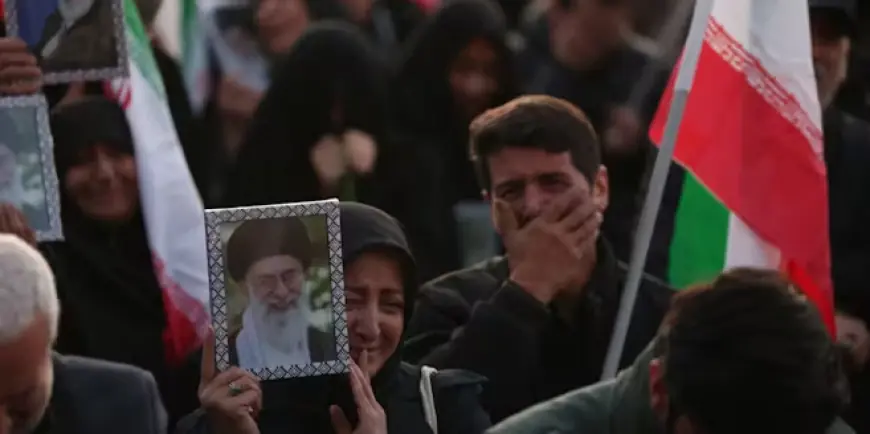
Iran is in its most volatile political moment in decades after state authorities confirmed the death of Supreme Leader Ayatollah Ali Khamenei, killed amid joint U.S.-Israeli strikes that began over the weekend. Iran has answered with waves of missiles and drones aimed at U.S. military assets across the Gulf, with knock-on effects that reached the United Arab Emirates, including Dubai. If you’re asking, “are we at war with Iran,” the reality is that large-scale hostilities are underway—even if the United States has not issued a formal congressional declaration of war—while lawmakers argue over presidential war powers and what an endgame would look like.
The leadership question is now immediate: Iran’s constitutional process shifts power temporarily to a three-person leadership council until a new supreme leader is selected, and that transition is unfolding while bombs are still falling.
Is Khamenei alive? Iran says no—and the succession clock has started
The most searched question—“is Khamenei alive” or “is Iran’s supreme leader dead”—now has a definitive answer from Iranian authorities: Ayatollah Ali Khamenei is dead. The timing matters. The strikes began Saturday, February 28, and confirmation of Khamenei’s death followed shortly after, as Iran moved into an official mourning period and the state tried to project continuity under fire.
The interim power arrangement is not a rumor mill detail; it’s the mechanism that keeps the system functioning. President Masoud Pezeshkian is part of the temporary leadership council, alongside the head of the judiciary and senior cleric Alireza Arafi, who was appointed as the jurist member. That trio is tasked with exercising the supreme leader’s duties until the Assembly of Experts selects a successor—an opaque process even in peacetime, now complicated by war, casualties, and fears of infiltration.
This is also where search confusion around “ayatollah khomeini” spikes. Ayatollah Ruhollah Khomeini—the founding leader of the Islamic Republic—has been dead since 1989. Khamenei was his successor, and it is Khamenei’s death that is reshaping Iran today.
Why is Iran attacking Dubai, and what actually happened in the UAE?
“Why did Iran attack Dubai” is, in practical terms, a question about geography and deterrence. Iran’s retaliation has been framed as a response to U.S.-Israeli strikes on Iranian territory, and the Gulf is dense with U.S. military presence, logistics nodes, and air corridors. In that environment, even when the declared aim is “U.S. assets,” the blast radius of fear and disruption spreads quickly to commercial hubs.
In the UAE, authorities reported intercepting multiple incoming missiles. Even so, the shock was real: residents reported debris, sirens, and a sudden shift from normal weekend life to emergency instincts—fuel lines, hurried shopping, and a nervous quiet on roads that are usually loud with tourism and commerce. Financial authorities in the UAE also took the unusual step of pausing major stock exchange activity for two days, a signal that officials were preparing for volatility, damage assessment, and the possibility of additional attacks.
The wider pattern is that Iran’s retaliation has not been limited to one point on the map. Missiles and drones have been reported across multiple Gulf countries hosting U.S. forces, which is why the phrase “iran war update” is now less about speculation and more about daily operational tempo.
Did the US bomb Iran, and why did Trump attack Iran?
Yes—the U.S. joined Israel in a large-scale strike campaign on Iran that began February 28. The stated rationale from Washington and Jerusalem has centered on preemption: Iran’s missile capabilities, regional attacks via aligned groups, and the nuclear file. President Donald Trump has publicly defended the operation as necessary to remove threats and has suggested the campaign could continue until objectives are met.
That framing is colliding with a separate reality at home: Congress did not vote on a formal war declaration, and lawmakers are now openly fighting about authorization, oversight, and the risk of sliding into a prolonged conflict without a clear plan for what comes after the bombs.
Those arguments are not procedural trivia. They shape what the U.S. can sustain militarily and politically, what allies will support, and what Iran believes it can outlast. Polling and public reaction are being watched closely in Washington because wars rarely stay popular when casualties rise and the end state is vague.
Russia, Putin, and what Tehran can realistically expect from allies
Russia’s President Vladimir Putin has condemned the killing of Khamenei in blunt terms, but condemnation is not the same as intervention. Moscow has strong incentives to signal outrage—both to maintain credibility with partners and to discourage similar strikes elsewhere—but it also has reasons to avoid a direct clash with the United States while managing its own priorities.
For Iran, that gap matters. Tehran has long relied on asymmetric tools—missiles, drones, proxy networks, and coercive leverage over shipping lanes—precisely because formal alliances are unreliable in a crisis. The early signs suggest Iran is again leaning on those tools: striking widely, forcing regional air defenses into overdrive, and trying to raise the costs for U.S. basing across the Gulf.
Iran leader death, Mojtaba Khamenei, and where the succession could go next
Whenever “iran leader dead” trends, so does speculation about succession—especially around Mojtaba Khamenei, the supreme leader’s son. But right now, the successor question remains uncertain, and any definitive claim about who will replace Khamenei should be treated as unconfirmed unless Iranian institutions announce it.
What is clear is the strategic bind the system faces: it needs a successor who can command the security establishment, keep elite factions aligned, and project legitimacy to a population exhausted by sanctions, repression, and now war. In calmer moments, that’s difficult. Under bombardment, it becomes a test of regime survival.
The most plausible near-term paths are already visible. One scenario is that the interim council holds and the system elevates a consensus cleric quickly to signal continuity. Another is a longer, messier selection, with power effectively shifting toward the security apparatus while the clerical process grinds forward. A third is escalation abroad—more regional strikes meant to force negotiations—paired with intensified internal security at home. A fourth is fragmentation: competing centers of authority if key figures are killed, communications break down, or rival institutions begin acting independently.