
























Jim Carrey resurfaces in Paris with career honor, rare personal note, and fresh retirement questions

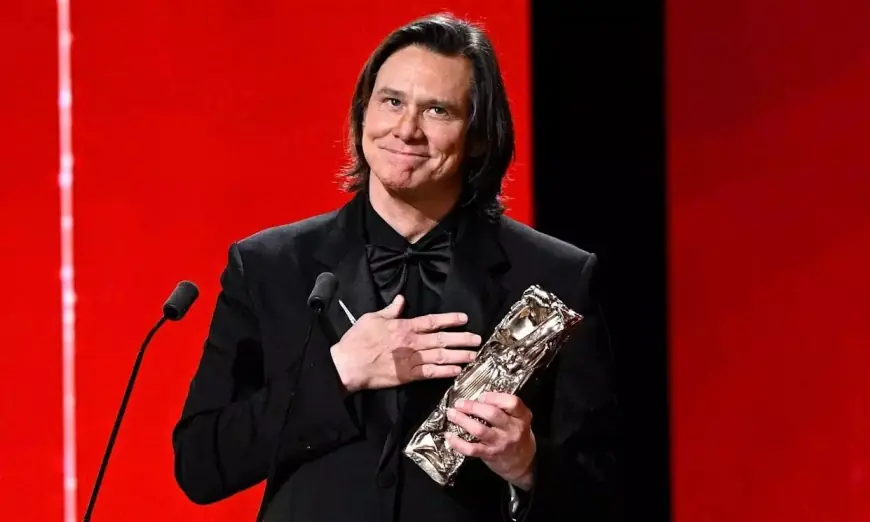
Jim Carrey made one of his most public appearances in years on Wednesday, Feb. 26, accepting a major lifetime-style career honor in Paris and delivering an emotional, mostly French-language speech that mixed gratitude, comedy, and a notably personal moment. The 64-year-old actor attended with close family and publicly acknowledged his partner, a rare detail from a performer who has kept much of his private life out of view in recent years. By late Wednesday night ET, the appearance had already reignited the two questions that follow him now more than any box-office stat: is he returning to regular acting, and what does “stepping back” actually mean for him in 2026?
Carrey didn’t announce a new film from the stage or lay out a comeback plan. But the combination of an institutional tribute, a carefully staged public presence, and the warmth of his remarks signaled something subtler: he’s not disappearing, he’s curating. That distinction matters in an entertainment economy where the line between retirement and selective work is increasingly blurry—especially for stars who can choose their moments, their projects, and their visibility.
The Paris honor puts Jim Carrey back in the spotlight on his terms
For an actor whose public persona once thrived on maximal exposure, Carrey’s recent years have been defined by distance: fewer red carpets, fewer press cycles, fewer broad commitments. His Paris appearance functioned as a reset without calling itself one. He showed up for a celebration of the work already done—physical comedy that bent the rules of mainstream filmmaking, dramatic turns that proved he could play against type, and a career-long ability to make audiences uneasy and delighted in the same scene.
That’s also why this kind of honor is strategically clean. It frames Carrey as legacy, not as a celebrity chasing relevance. It reminds the industry that he’s still a name with gravity, even if he isn’t chasing opening weekends. And it gives him a platform where the story is appreciation rather than expectation.
The speech itself underscored a key point: when Carrey does go public now, he seems determined to do it with intention. He leaned into the setting, leaned into the language, and leaned into sincerity—then punctured the mood with quick humor before it could turn sentimental. It was classic Carrey, but matured: less adrenaline, more control.
A rare glimpse of his personal life adds a new layer to the narrative
The moment that traveled fastest afterward wasn’t a joke or a career tease. It was Carrey acknowledging his partner directly and affectionately from the stage, with family present. For fans, it read as a confirmation that his quieter public period hasn’t been isolation so much as reorientation—toward relationships, select appearances, and a life that doesn’t require constant performance.
That matters because the vacuum created by a celebrity’s silence never stays empty. It fills with rumor: health speculation, cosmetic surgery talk, conspiracy threads about why someone “vanished,” and endless decoding of hair, clothing, posture, and facial expressions. In the days following the ceremony, online chatter fixated on how he looked leaving events and whether his appearance had changed. None of that is reliable in the absence of verified medical information, and much of it is simply the internet doing what it does when a familiar face reappears after a long stretch away.
What is verifiable is simpler: he attended, he spoke, he was surrounded by people who clearly matter to him, and he chose to let the world see that. In today’s celebrity ecosystem, that is a statement by itself.
Retirement, Sonic rumors, and what a “comeback” could actually look like
Carrey’s retirement talk has never sounded like a contract clause. It has sounded like a mood—and moods change. In recent interviews over the past few years, he’s suggested he feels creatively satisfied and more protective of his time. Yet he has also kept the door open, especially when a role seems genuinely fun or when the concept grabs him.
That’s why speculation about him returning to familiar franchises keeps flaring up. A franchise role is, paradoxically, a low-risk way to work: the production infrastructure is established, the character is defined, and the commitment can be bounded. It offers a predictable runway without requiring the actor to re-enter the full machinery of constant promotion. If Carrey does more acting in the near term, this kind of “contained” involvement is the most plausible shape—not a return to five projects in two years, but one carefully chosen role that fits his appetite and his schedule.
A broader comeback—new characters, new genres, awards-chasing dramas—remains possible but less certain. The Paris honor may increase offers, but Carrey’s recent pattern suggests he is less motivated by the number of scripts than by whether a script feels worth the cost of giving up peace.
What to watch next: five scenarios and the triggers that would confirm them
The next steps depend on signals that are easy to spot once they happen:
One scenario is a single high-profile role announcement within the next few months, likely tied to a known property. The trigger would be a confirmed casting deal and a production start window, not hints.
A second scenario is “selective visibility” without heavy acting: more public honors, occasional appearances, and possibly creative work outside film. The trigger would be a pattern of curated events rather than a film slate.
A third scenario is a limited return built around voice work or shorter shoots. The trigger would be projects designed to minimize time on set and avoid extended location work.
A fourth scenario is a full return, which would require something bigger than nostalgia—an auteur collaboration or a script that offers a reinvention. The trigger would be an announcement attached to a director with a clear artistic thesis and a timeline that suggests serious commitment.
A fifth scenario is a reaffirmation of stepping back, with the Paris appearance standing as a capstone rather than a runway. The trigger would be months of quiet after the publicity wave, with no production news following.
For now, the clearest takeaway is that Jim Carrey isn’t chasing the spotlight, but he isn’t fleeing it either. He’s using it sparingly—showing up where the moment has meaning, then stepping away before the world can demand the next performance. That balance, more than any single role, is what makes his 2026 arc feel newly alive.