

























Iran's Retaliatory Strikes Hit Dubai Airport, Burj Al Arab, and the US Navy's 5th Fleet Base in Bahrain as Gulf Erupts

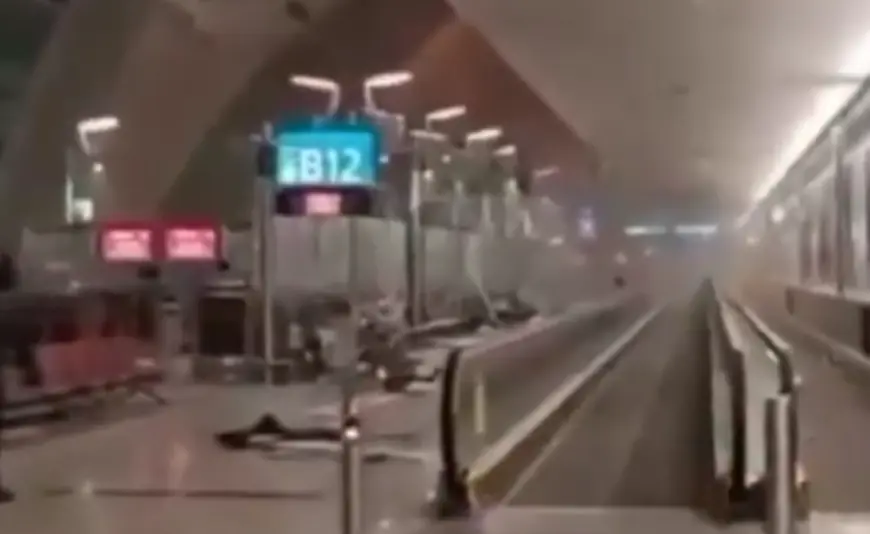
For a second consecutive day, explosions tore through Dubai, Bahrain's capital Manama, and Qatar's Doha on Sunday, March 1, as Iran pressed forward with an expanding wave of retaliatory strikes targeting US military assets and civilian landmarks across the Gulf. The attacks follow the joint US-Israeli operation that killed Iran's Supreme Leader Ayatollah Ali Khamenei on Saturday — a strike President Trump hailed as "the single greatest chance for the Iranian people to take back their country."
Dubai Under Fire: Airport Crippled, Burj Al Arab and Fairmont Palm Struck
Dramatic footage verified by news teams showed people fleeing a smoke-filled concourse at Dubai International Airport, where officials confirmed four staff members were injured. The world's busiest international aviation hub — which handled a record 95.2 million passengers in 2025 — has suspended all flight operations until further notice. Dubai Airports confirmed incidents at both Dubai International and Dubai World Central – Al Maktoum International, urging passengers not to travel to either facility.
In Dubai's Palm Jumeirah district, an explosion struck the Fairmont Hotel, leaving it in flames. Verified footage showed the moment a drone appeared to dive toward the ground before impact. Police sealed off the surrounding area as crews cleared shattered glass from the street, while part of the building's facade was blackened and visibly damaged. Iran launched 137 missiles and 209 drones at the UAE on Saturday alone, its Ministry of Defence confirmed, with fires and smoke reaching both Palm Jumeirah and the iconic Burj Al Arab hotel.
UAE air defense systems destroyed 132 of the 137 ballistic missiles, with five falling into the sea. Debris from intercepted strikes caused minor material damage to civilian properties across several areas. In Abu Dhabi, a drone targeting Zayed International Airport killed one Pakistani national and left seven others injured.
US Navy's 5th Fleet Base in Bahrain Directly Targeted, Personnel Evacuated
Iranian missiles and drones struck the headquarters of US Naval Forces Central Command in Manama, Bahrain, as retaliatory attacks that began Saturday continued into early Sunday. Within minutes of the attack warning, explosions swept across the city and plumes of smoke rose from the base as air raid sirens blared and armored vehicles moved through the streets.
Videos posted online purport to show a drone striking radar equipment inside a large structure at the 5th Fleet facility, with dark smoke billowing from the impact point. Bahrain's Defense Force said it intercepted 45 missiles and nine drones. US Naval Central Command subsequently concluded that the Juffair neighborhood — home to Naval Support Activity Bahrain — was no longer safe, ordering all service members and contractors to evacuate and relocate to hotels at government expense. The base is one of the few accompanied postings in the region, meaning hundreds of military spouses and family members also live on the island.
Bahrain's government called the strikes a "treacherous attack" and "a blatant violation of the kingdom's sovereignty and security." Footage circulating on social media showed a Shahed drone smashing into a residential tower near the 5th Fleet headquarters, setting the building ablaze. The Interior Ministry confirmed multiple residential buildings in Manama had been hit, with civil defense teams engaged in firefighting and rescue operations.
Aviation Collapse and What Comes Next for the Region
More than 1,800 flights were canceled across the Gulf, with Emirates, Qatar Airways, and Etihad — carriers that together move roughly 90,000 passengers daily — all suspending operations. At least 145 aircraft that were airborne were diverted to Athens, Istanbul, and Rome, while some turned back entirely. UAE schools shifted to distance learning from March 2 through 4, and all drone and recreational aircraft permits were suspended for one week.
Iran's parliamentary speaker declared Sunday that "you have crossed our red line and must pay the price," signaling further strikes are planned. Iran also reported closing the Strait of Hormuz to tanker traffic — the narrow passage through which roughly 20 percent of the world's seaborne oil flows. The 5th Fleet's area of operations covers nearly 2.5 million square miles of water, encompassing the Arabian Gulf, Red Sea, Gulf of Oman, and the critical chokepoints at Hormuz, Suez, and the Bab el-Mandeb Strait. Whether Iran sustains pressure on those lanes — or whether US forces counter-escalate — will determine whether this crisis tips from a regional confrontation into a full-scale war with consequences for global energy markets no Gulf state has yet prepared for.