

























Planets Aligning Tonight March 1, 2026: Last Call for the Six-Planet Parade

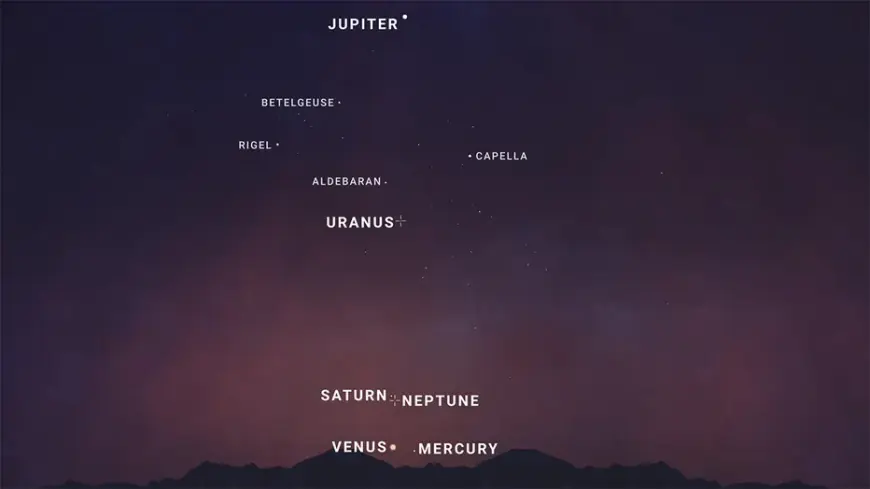
Tonight is your final prime opportunity. Astronomers and outlets including NASA, BBC, National Geographic, and EarthSky confirm March 1, 2026 as part of the peak viewing window for Northern Hemisphere observers for the six-planet planetary alignment. Step outside 30 minutes after your local sunset — the show begins right now.
What Planets Are Visible Tonight and Where to Look
Low in the west, just above the horizon, are Venus, Mercury, and Saturn. High in the east is Jupiter. Uranus and Neptune are also present, but require binoculars or a telescope. Tonight the nearly full Moon is positioned very close to Jupiter, creating one of the most visually striking pairings in the entire alignment.
| Planet | Naked Eye? | Direction | Key Clue |
|---|---|---|---|
| Venus | Yes — brightest | Low west | Brilliant steady white |
| Saturn | Yes — briefly | Low west, near Venus | Soft golden glow |
| Mercury | Difficult | Far western horizon | Faint, sets fast |
| Jupiter | Yes — easiest | High in the east | Bright, near the Moon |
| Uranus | Binoculars | Near Aries/Taurus | Faint greenish dot |
| Neptune | Telescope only | Near Saturn in Aquarius | Tiny bluish point |
What Time the Planets Are Aligning Tonight
The best window starts 30–60 minutes after local sunset. Look low in the west first for Mercury, Venus, and Saturn, then scan high to the southeast and east for Jupiter. For the US East Coast that is roughly 6:10–7:10 p.m. ET. West Coast observers should look between 6:20–7:20 p.m. PT. The Mercury and Venus part of the lineup is brief, so try to observe within the first hour after sunset.
How to See the Planetary Alignment Tonight
Astronomers advise going somewhere high-altitude and cloud-free because all the visible planets will be relatively low in the western sky. Bundle up, bring something warm, and march out into the evening.
Use a stargazing app like Star Walk 2 — open Menu, then Planets, then Planet Walk — to see which planets are above the horizon in your exact location and find them all in real time. Stellarium and SkySafari are equally effective free options. Avoid staring at your phone screen for at least five minutes before scanning the sky so your eyes can adjust to the darkness.
Jupiter will be the easiest and most impressive planet to spot. High in the southeastern sky, it shines steadily and stays visible long after the lower planets have set. Even in suburban areas with some light pollution, Jupiter stands out clearly.
After Tonight: What Happens Next With the Planetary Alignment
As March begins, Mercury and Venus will move closer to the Sun's glare and gradually slip from view, and the tight grouping of planets will begin to loosen. Jupiter and Uranus will remain visible into the spring.
Venus and Saturn will draw even closer together for a conjunction on March 7–8, creating a tight pairing worth watching for over the next week. The Full Worm Moon reaches peak phase on March 3, 2026 ET, accompanied by a total lunar eclipse — so the sky stays spectacular all week. The next large planetary alignment arrives August 12, 2026 in the morning sky.