























Knicks Vs Bucks: New York routs Milwaukee 127-98, stifles late-month surge

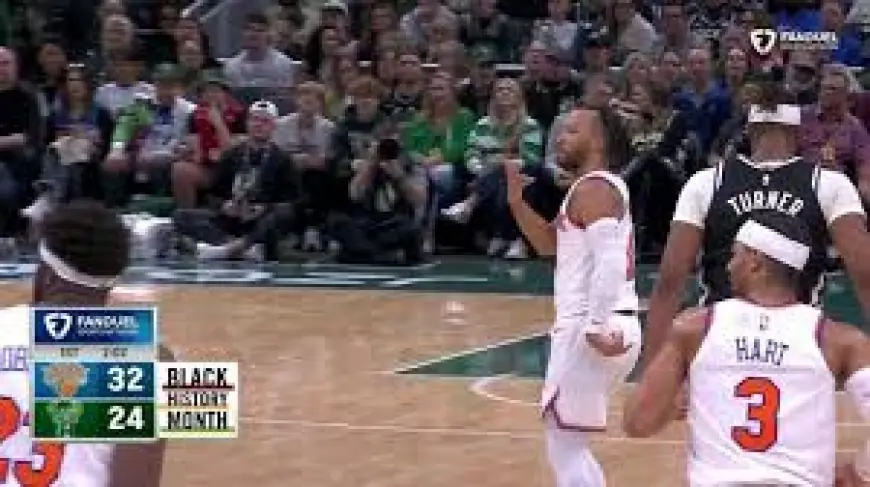
On Feb. 27, 2026 the New York Knicks defeated the Milwaukee Bucks 127-98, halting the Bucks’ bid for a third three-game winning streak of the month. The knicks vs bucks game was dominated by New York’s 21-for-41 shooting from long range and 16 turnovers by Milwaukee, a combination that turned a competitive contest into a rout.
Knicks Vs Bucks: New York’s 21-of-41 three-point barrage
New York’s 21/41 mark from beyond the arc provided the clearest cause of the margin: efficient perimeter shooting stretched the defense, forced turnovers and created open lanes. Milwaukee’s 16 turnovers compounded the damage, allowing the Knicks to convert mistakes into points and push the score to a 29-point final margin.
Rollins’ 32 minutes and second-half fade
Rollins played 32 minutes and finished with 13 points, 4 rebounds and 4 assists, but committed 5 turnovers and shot 5-for-9 from the field for a minus-30. He produced some credible looks in the first half, but was held scoreless in the second half, going 0-for-2 over that span and turning the ball over three times in the period.
KPJ and Green: playmaking, matchup troubles and career splits
KPJ logged 27 minutes and posted a quieter double-double: 11 points, 10 assists, 6 rebounds and 3 turnovers while shooting 4-for-12 and finishing minus-16. New York’s defense frequently forced him into a pass-first role; he made correct reads but could not generate scoring for himself. Green played 30 minutes, scored 7 points with 2 rebounds, knocked down 2-of-6 from three and finished minus-17. The Knicks have been a difficult matchup for Green: he is averaging 6. 8 points per game in 10 career games against New York, the fifth-fewest mark he has versus Eastern Conference opponents, and the Knicks’ wing size appears to limit his shot quality.
Turner, Kuzma and Portis lift the bench
Turner delivered a strong scoring night off the bench with 25 minutes played, 19 points, 4 rebounds and 2 assists on 4-of-7 from three, finishing minus-20. The performance looked like a bounce-back, but it came in the context of a decided blowout. Kuzma contributed 27 minutes, 17 points, 4 rebounds and 2 assists on 6-of-11 shooting overall and 4-of-7 from deep, finishing minus-16; when the matchup shifted and Kuzma was put onto Brunson late, he helped limit Brunson to two points in the second half on 1-for-4 shooting. Portis provided 17 minutes, 14 points, 2 rebounds, 2 steals and an efficient 5-for-8 from the field (2-of-3 from deep and 2-of-3 at the free-throw line), finishing minus-10, though the game report notes he had a few defensive lapses in which a shooter was left wide open.
Thomas, Sims and Jericho: missed chances on both ends
Thomas’ line read 17 minutes, 7 points, 2 rebounds, 2-for-9 shooting and 3-for-3 at the foul line, finishing minus-17. After an incredible start to his Bucks tenure, the game showed the opposite side: several forced shots and a limited defensive impact that made it difficult to justify extended minutes. Sims played 23 minutes, finished with 2 points, 4 rebounds and a 1-for-1 field goal, and was minus-21; the Bucks needed a bigger glass game from him and he failed to deliver. A separate 12-minute line—0 points, 3 rebounds, 2 assists and 0-for-2 shooting with a minus-11—appeared for another rotation player. The write-up stressed that Jericho really struggled against the taller Knicks bigs, Karl-Anthony Towns and Robinson, underscoring Milwaukee’s difficulty handling New York’s frontcourt size.
Bucks+ audio recap and immediate implications
Readers can find further discussion in a six-minute audio recap on the Bucks+ podcast, Bucks In Six Minutes. Practically, the result denies Milwaukee a third three-game streak in the month and leaves clear tasks for the coaching staff: clean up 16 turnovers, find defensive answers for New York’s wing size, and coax more reliable glass and scoring from role players. What makes this notable is how sharply the statistical mismatches—21-of-41 from three and 16 turnovers—translated into a wide margin in the final box score, highlighting execution gaps that will shape short-term adjustments.