

























Sky News: Greens’ Hannah Spencer stuns in Gorton and Denton as chargeback ‘epidemic’ and assisted dying bill stall dominate papers

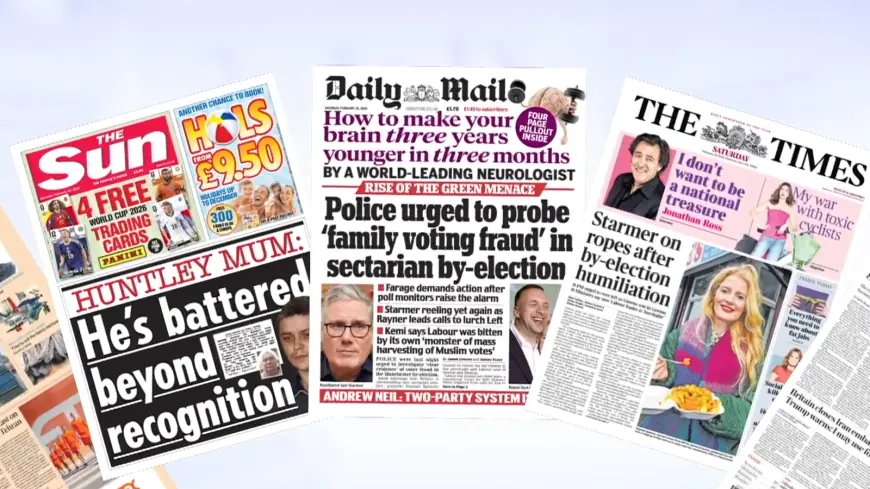
Sky News examines Saturday’s national front pages as a string of developments — the Green Party’s shock win in Gorton and Denton, a rising chargeback fraud problem hitting small businesses, and the assisted dying bill’s struggle in the House of Lords — reshapes political and economic conversations ahead of the parliamentary recess. Each story carries immediate consequences: questions for Labour leadership, possible losses for independent retailers, and a race against time for a contentious medical law.
Sky News front pages: Gorton and Denton headlines set the tone
The weekend newspapers place the Gorton and Denton by-election at the centre of their coverage. One front page shows Hannah Spencer celebrating her victory in Manchester’s Gorton and Denton; another uses the Terminator catchphrase "Hasta la vista, baby" to mark the upset. Coverage highlights a wide set of reactions: some comment pieces call the result a humiliation for Labour, others frame it as weakening the prime minister’s authority. A separate page notes the arrest of a man after the statue of Sir Winston Churchill was defaced in Westminster, and quotes Second World War veterans expressing outrage at the damage.
Hannah Spencer: Green gains, Labour pushed into third place
Hannah Spencer — described in print as a plasterer and plumber — has become the Green Party’s fifth MP after winning the Gorton and Denton by-election. The Greens finished ahead of Reform UK, with Labour relegated to third place and the party losing a previous majority of 13, 000 in the seat. The result has prompted calls from within Labour for the prime minister to move the party to the left; some Labour MPs are urging a leftward course and a rethink of policies designed to blunt Reform UK’s appeal. Angela Rayner called the outcome a "wake-up call, " while editorials and comment columns say the victory raises fresh questions about Sir Keir Starmer’s direction and leadership.
Reform UK and Nigel Farage challenge ballot conduct
Reform UK’s leader has expressed deep concern about alleged illegal "family voting" during the Gorton and Denton contest and has reported the matter to the police and the Electoral Commission. Coverage records the party leader’s upset and the referral to enforcement bodies as part of the post-election fallout, and notes the contested atmosphere around the result.
Chargebacks911 and the "epidemic" of chargeback fraud hitting small firms
A separate Money feature warns that a refund con trick is becoming an "epidemic, " with the chargeback mechanism being abused by some consumers. Research forecasts project chargeback will be used 281 million times globally this year, with as many as 70% of those claims judged fraudulent. Monica Eaton, chief executive of Chargebacks911, calls the problem severe for small businesses. Restaurateur Nima Safaei, owner of 40 Dean Street in Soho, says he lost £2, 000 last autumn to chargeback fraud and warns that persistent losses at that level would threaten his business’s survival.
Industry voices describe a spectrum of misuse: low-level "friendly fraud" such as failing to recognise a bank statement entry or a child making purchases on a parent’s device; social media encouragement of chargeback as a "life hack"; and outright organised fraud where customers keep goods after securing a refund. Adam Scarrott, director of issuing and acceptance at UK Finance, says chargeback is an important consumer protection but is being abused. One dispute involved office staff at a major airline who allegedly encouraged relatives to submit chargebacks for flight tickets while ensuring the company would not contest them internally.
Kim Leadbeater’s assisted dying bill stalled in the House of Lords
The attempt to legalise assisted dying for terminally ill people with less than six months to live looks likely to fail to clear the current parliamentary session. The bill, proposed by backbench MP Kim Leadbeater and backed by a Commons majority, did not have government sponsorship; No 10 allowed MPs a free vote. In the Lords, a small number of opponents have tabled so many amendments that there will not be time to secure a vote before the session ends in May, with less than six days left for debate.
Roy Kennedy, the Labour whip in the House of Lords, told a parliamentary committee the government would not provide more time because there are only a limited number of sitting Fridays left. Ministers could have extended the session, but that would have been seen as extraordinary. Backers of the bill — Leadbeater and Charles Falconer — have sought legal and constitutional advice on using the 1911 Parliament Act in the next session to force the legislation through unamended; the Act, revised in 1949, has been used sparingly, most notably for laws that decriminalised homosexuality and banned foxhunting.
Supporters say peers have effectively blocked the will of the Commons, while opponents argue the Commons did not scrutinise the bill sufficiently and that delaying tactics are part of due diligence. The bill’s backers say they can reintroduce the identical text in the new session to trigger the override mechanism, either by adopting the Parliament Act at the next private member’s bill ballot or by securing government time for the bill to return to the Commons. Dame Esther Rantzen accused some peers of "blatant sabotage. " Speaking to Sky News on Thursday, unclear in the provided context.
These three storylines — the by-election shock, the spread of chargeback misuse, and the assisted dying bill’s parliamentary impasse — are dominating Saturday’s coverage and pose immediate political, legal and economic consequences as parliament moves toward its recess.