

















Chief Warrant Officer 5 Eric Slover and 100-Year-Old Royce Williams Win Medals of Honor at State of the Union

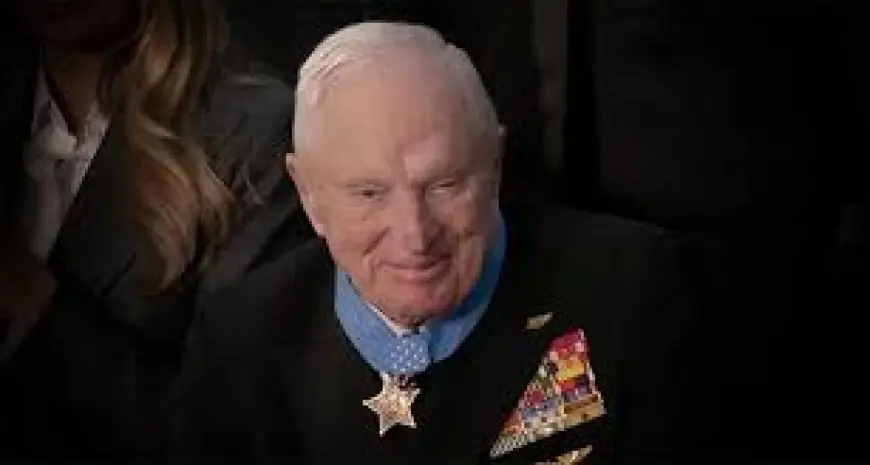
President Trump presented the Medal of Honor on Feb. 24 to retired Navy Capt. Royce Williams and to chief warrant officer 5 Eric Slover during the State of the Union, bringing decades-old actions into the public record. The awards matter now because recent legislative and declassification steps removed barriers that had kept one case secret and stalled formal recognition for years.
Chief Warrant Officer 5 Eric Slover and the Maduro raid
One of the two honors went to Chief Warrant Officer 5 Eric Slover, an Army helicopter pilot who was wounded in the raid that captured Venezuelan President Nicolás Maduro. The president credited Slover with helping to plan the operation and leading the first Chinook helicopter assault against Maduro’s heavily fortified compound, and presented him with the nation’s highest military decoration on the national stage.
The public presentation followed Slover’s battlefield injury, linking his operational role and sacrifice to the decision to bestow the Medal of Honor. The ceremony at the State of the Union converted that battlefield recognition into a formal award, making his actions part of the official historical record.
Royce Williams’s 1952 dogfight and delayed recognition
Retired Navy Capt. Royce Williams, who turned 100 this year, received his Medal of Honor for a November 1952 engagement in which he and three other Navy pilots encountered seven Soviet MiG-15s. Flying an F9F-5 Panther on Nov. 18, 1952, Williams shot down four MiG-15s over a 35-minute dogfight — an aerial feat not previously or since equaled — and later landed a plane riddled with more than 260 perforations. The aircraft was in such poor condition that crew members pushed it overboard after recovery.
Williams flew more than 220 missions across World War II, Korea and Vietnam. Despite that record, superior officers ordered him to keep the 1952 engagement secret for decades. Russia declassified the relevant information about the encounter roughly a decade ago, which allowed Williams to speak openly about the incident for the first time in generations.
Williams sat next to the first lady during the State of the Union; she placed the medal around his neck as the chamber rose in a bipartisan standing ovation that lasted several minutes. The president had telephoned Williams on Feb. 3 to inform him of the forthcoming award.
American Legion, the FY 2026 NDAA and the path to the Medal
The push to win Williams formal recognition was led in part by The American Legion, which first highlighted his achievement in a 2017 story and later passed resolutions backing the award. Operation Just Reward, a team affiliated with the Legion’s post in Encinitas, California, devoted substantial time to the campaign. Steve Lewandowski, a member of Post 416, described the day as one when Williams finally received the recognition he had long been denied.
Crucially, language in the FY 2026 National Defense Authorization Act removed statutory time limits that previously prevented the award of the Medal of Honor in cases like Williams’s. That legislative change produced a direct causal chain: the NDAA’s removal of time bars enabled the president to move forward with the decoration, and earlier declassification removed secrecy constraints — together clearing the way for a public ceremony.
What makes this notable is the convergence of legal, administrative and diplomatic developments: declassification allowed factual disclosure, veteran advocacy sustained momentum, and congressional action erased procedural hurdles, turning long-hidden military episodes into acknowledged, decorated service.
The twin presentations on Feb. 24 linked two very different wartime narratives — a Cold War aerial engagement kept secret for decades and a recent helicopter operation that resulted in wounds and public praise — under a single presidential act of recognition.