




















Expert: To Sit or Stand — Trump’s State of the Union Challenge Becomes Defining Moment

Expert analysis of the latest development: in a marathon State of the Union address on Tuesday, Feb. 24, 2026, President Donald Trump staged a dramatic on-the-spot test for members of Congress that underscored sharp divisions in the House chamber and shaped how the speech will be remembered.
Expert moment: the sit-or-stand challenge
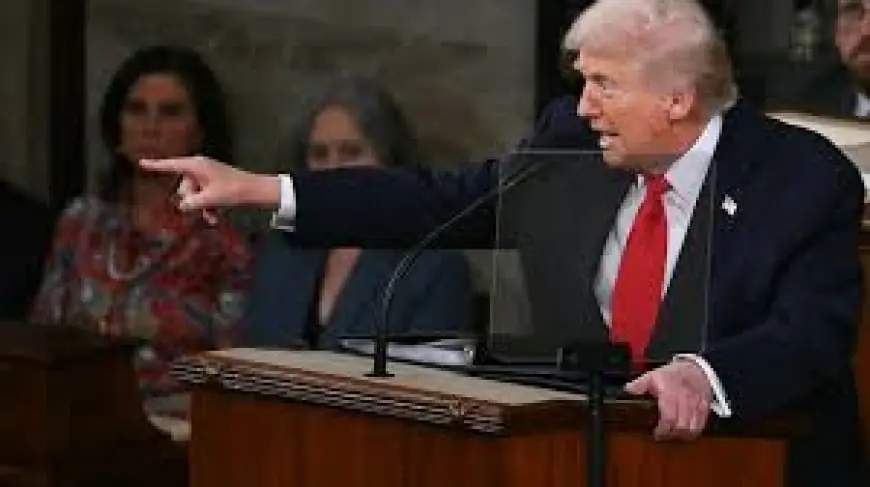
About halfway through his State of the Union address, President Trump put Democrats on the spot with an invitation: "Stand up if you agree with this statement: The first duty of the American government is to protect American citizens. Not illegal aliens. " The call for audience participation produced a visible split in the chamber, a moment widely described as political theater and one that the president’s allies sought to make the centerpiece of the night.
What happened in the House chamber on Feb. 24, 2026
The address took place to a joint session of Congress in the House chamber at the U. S. Capitol in Washington on Tuesday, Feb. 24, 2026. Republican members of Congress stood while Democrats kept their seats. Vice President JD Vance and House Speaker Mike Johnson of La. were shown applauding during the speech. The sequence of standing and sitting reinforced visible lines of partisan division in the room.
How the moment reshaped the speech
The invitation to stand may stand as the most remembered part of a L-O-N-G version of the annual presidential speech. The tactic was framed as an immediate test of lawmakers’ alignment: either stand and visibly support the president’s framing or remain seated and risk becoming a prop in his campaign pitch. Observers described the choice facing Democrats who stayed as a damned-if-you-do, damned-if-you-don’t dilemma.
How President Trump framed the night
Over the course of the marathon address, President Trump ticked through claimed victories and insisted the U. S. is "winning so much, " even as his approval slips. He also blasted Democrats as "crazy" for remaining seated rather than standing to applaud, and he said the State of the Union gives Americans a chance to see what their representatives really believe: "One of the great things about the State of the Union is how it gives Americans a chance to see clearly what their representatives really believe, " the president said, immediately before issuing the stand-or-sit challenge.
Democrats’ response and the boycott context
Some Democrats had boycotted the entire event; the phrase "the ones who hadn't already boycotted the whole affair" in coverage highlights that a subset of Democratic lawmakers chose not to attend. Those who remained faced the political calculus described above. The reaction in the chamber — Republicans standing, many Democrats sitting — provided a stark visual shorthand for partisan division.
What remains unclear in the provided context
The context supplied here ends mid-sentence: "With that, the lines of division within the chamber — and, by extension, the nati"; that fragment is unclear in the provided context and cannot be completed without additional verified detail. Beyond that fragment, the available facts establish the sequence, the setting, the key participants, and how the sit-or-stand moment functioned as a central theatrical element of the address.
Forward-looking: the sit-or-stand challenge has already been billed as a defining moment of the evening and will shape messaging and political ads in the near term. The immediate choices made by lawmakers on the House floor — standing, sitting, or absent — provided a concise visual storyline that is likely to be replayed as part of post-speech political battles. Details about broader reaction and longer-term impact remain contingent on developments beyond the material provided here.