
























S26 Ultra Debuts with Privacy Display, Snapdragon Power and Expanded AI Features

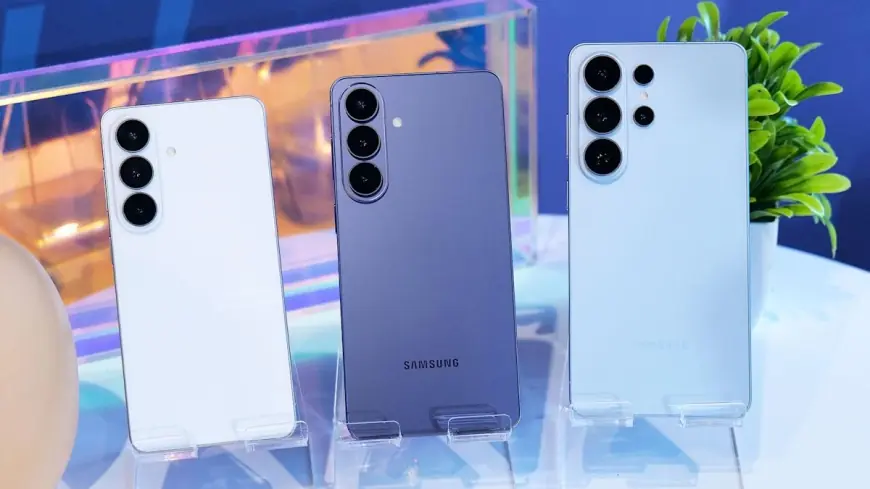
Samsung used its Unpacked event in San Francisco to unveil the Galaxy S26 lineup, and the s26 ultra emerged as the headline device with a novel Privacy Display and flagship hardware. The timing matters because preorders opened on Feb. 25 and the phones are scheduled to ship on March 11, putting the new features into consumers’ hands within weeks.
Unpacked at Palace of Fine Arts
Samsung held Unpacked on Wednesday at San Francisco’s Palace of Fine Arts and presented three new handsets: the Galaxy S26, S26+ and S26 Ultra. The company also announced Galaxy Buds 4 alongside a suite of AI updates, and offered hands-on time with all three phones at the event.
S26 Ultra Privacy Display
The S26 Ultra arrives with what Samsung describes as a first-of-its-kind Privacy Display that is intended to prevent people nearby from reading the screen from acute angles. The feature blacks out parts of the display to limit side viewing, causes a small decrease in brightness when active, and includes numerous customization options. Users can configure Privacy Display to trigger when asked for a password or PIN, when a notification arrives, or when specific apps open — for example, banking apps in public. The s26 ultra is listed as the only phone in the new lineup to include that special display.
Snapdragon 8 Elite Gen 5 chipset and regional chip choices
Samsung is sticking with Qualcomm silicon for these devices: all three Galaxy phones are powered by the Snapdragon 8 Elite Gen 5 for Galaxy chip. The company confirmed that in North America, China and Japan it will continue to use Qualcomm chips rather than the Exynos 2600, and devices purchased in those markets will run the Snapdragon part.
Pricing, preorders and color options
Prices rose for the non‑Ultra models: the Galaxy S26 starts at $900 and the S26+ at $1, 100, each $100 higher than their predecessors for variants with 256GB of storage. Samsung cited memory‑market pressure tied to a RAM shortage that has helped push prices up and said it would not reduce memory specs because that would hamper AI processing. The S26 Ultra starts at $1, 300, the same entry price as last year’s S25 Ultra. Preorders opened on Feb. 25 and the phones will begin shipping on March 11. Color choices include a cobalt violet purplish option, sky blue, black and white; silver and rose gold (described in other reports as pink gold) are online exclusives.
Camera and AI upgrades
Hardware camera modules are carried over from the prior generation, but Samsung has layered substantial software upgrades on top. New features include ProScaler image upscaling and an MDNIe chip aimed at improving color precision, an Object Aware Engine designed to better render skin tones and hair textures for selfies, and a video stabilization mode that attempts to keep the horizon level while following a moving person or pet. AI tools such as Now Brief and Auto Eraser have been reworked to be compatible with more apps, and Samsung framed these software changes as ways to extend the value of the existing sensor designs.
Design, battery, S Pen and comparisons with iPhone 17
Samsung slightly altered the phones’ silhouettes by rounding corners to bring the base models closer to the Ultra’s styling. The Galaxy S26 has a 6. 3‑inch display — slightly larger than the S25 — while the S26+ has a 6. 7‑inch screen with a higher resolution than the base model. The S26 Ultra sports a 6. 9‑inch AMOLED display at QHD+ resolution of 3120 x 1440 and a 120Hz refresh rate, with a stated 500 PPI. The Galaxy S26’s battery capacity is listed at 4, 300mAh, larger than the S25. The Ultra retains support for an S Pen that slots into the phone’s base.
Samsung moved to aluminum frames rather than the titanium used previously, a choice that keeps the phones lighter and reduces the chance of overheating but comes at the cost of some durability. The Galaxy family lacks a programmable Action button and shows a different logo on the back compared with some competitors. For context in the market, the Galaxy S26 is lighter than the iPhone 17 at 167 grams versus 177 grams; both the Galaxy S26 and the iPhone 17 use 6. 3‑inch displays but at different resolutions (Galaxy 2340 x 1080, iPhone 2622 x 1206) and pixel densities (Galaxy 411 PPI, iPhone 460 PPI), with both supporting up to 120Hz. The iPhone 17 starts at $800, while the iPhone 17 Pro Max begins at $1, 200 for 256GB. The S26 Ultra’s higher resolution and Privacy Display are among the clearest hardware differentiators Samsung highlighted.
What makes this notable is the combination of incremental hardware continuity with aggressive software and AI workarounds: Samsung has preserved sensor hardware while emphasizing software—upscaling, color processing, stabilization and privacy—to distinguish the new models in a market where raw specs are converging rapidly.