















Warriors Vs Pelicans: Dejounte Murray’s comeback shifts the game and exposes Golden State’s thin depth

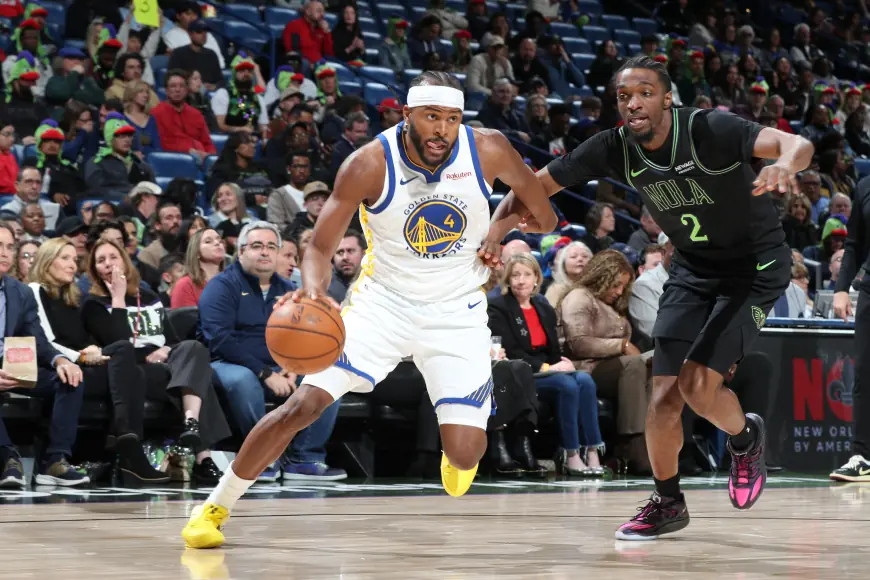
Why this matters now: warriors vs pelicans was more than a box score — Murray’s long-awaited return and a battered Golden State roster changed who had to step up and how minutes were handled. Murray arrived after more than a year on the shelf, while the Warriors were missing several regulars and still managed a second-half fight; the result landed as a narrow 113-109 loss that will affect rotation choices and player evaluations in the short term.
Immediate impact on rotations and roles in Warriors Vs Pelicans
Here’s the part that matters: Dejounte Murray returning reshuffles New Orleans’ lineup and forces the Warriors to lean even harder on their depth. Golden State played without Steph Curry, Jimmy Butler III, Kristaps Porziņģis, and Al Horford, which pushed players into oversized minutes and shifted responsibilities. The loss left evaluations centered on who can carry offensive load and who can handle extended defensive minutes.
How the contest unfolded and the context around Murray’s return
The game finished 113-109 in favor of New Orleans in what was labeled an odd matchup. It began as a very ugly first half for Golden State — the Warriors were unable to buy a bucket and briefly looked headed for a blowout — but they roared back in the second half and even took the lead before losing rhythm down the stretch and ceding control in the final moments. New Orleans was described in coverage as a very bad Pelicans team overall, yet fairly healthy for this game and notable for welcoming back Dejounte Murray after more than a year on the sidelines. Murray’s presence was a clear storyline, though an incomplete line in one report left the opponent name after “Golden S” unclear in the provided context.
Player grades and stat-driven takeaways from Golden State
- Moses Moody — 34 minutes, 24 points, 5 rebounds, 3 assists, 1 turnover, 5 fouls, 7-for-13 shooting, 4-for-10 threes, 6-for-8 free throws, 72. 6% TS, +13. Grade: A. Moody stepped up, used his jump shot threat to attack, took three shots inside the arc and drew eight free throws. Post-game note: best plus/minus on the team.
- Santos (Gui) — 39 minutes, 15 points, 12 rebounds, 4 assists, 2 steals, 3 blocks, 6 turnovers, 5 fouls, 6-for-13 shooting, 1-for-4 threes, 2-for-2 free throws, 54. 0% TS, -7. Long minutes reflected roster strain; his energy produced rebounds and defensive plays but also six turnovers and five fouls.
- Dray (Draymond) — 32 minutes, 11 points, 7 rebounds, 6 assists, 2 blocks, 1 turnover, 2 fouls, 5-for-11 shooting, 1-for-3 threes, 50. 0% TS, +8. Grade: B+. He played strong defense on Zion Williamson (who scored 26 points but needed 21 shots and five free throws to get there), offered playmaking that helped the second-half surge, and led the team in assists.
- De’Anthony Melton — 28 minutes, 28 points, 4 rebounds, 3 assists, 1 steal, 3 turnovers, 4 fouls, 8-for-21 shooting, 3-for-10 threes, 9-for-11 free throws, 54. 2% TS, +9. At times Melton appeared to be the only reliable scorer early. The original grade commentary is incomplete in the provided context.
For reference, entering the game coverage mentioned a league average true-shooting (TS) of 57. 9% when grading efficiency.
Murray’s personal arc and what his return means for New Orleans
Dejounte Murray’s comeback is framed by a difficult sequence: he was traded in June 2024 from the Atlanta Hawks to New Orleans, arriving to hopes that he could form a trio with Zion Williamson and Brandon Ingram. Before that, he had earned an All-Star nod with San Antonio in 2022 and was averaging a career high in points in Atlanta. Off the court, a string of blows compounded: his mother suffered a stroke a week before his first game of the 2024-25 season, and he flew to Seattle, where he grew up, to see her; she could barely speak and was helpless in the hospital. In the first game he broke his left hand, underwent surgery, and missed 17 games; in January 2025 he suffered a season-ending ruptured right Achilles tendon. He was originally drafted at the end of the first round by the Spurs in 2016 and was traded to Atlanta in June 2022, shortly after his All-Star breakthrough, with an intent to pair him with Trae Young. Murray described that stretch as the worst three months of his professional career on and off the floor, saying he was never able to focus on basketball. After a year-long rehab from one of the toughest injuries in sports — and despite doubt from a medical professional about his ability to bounce back — he is finally ready to play. Murray was listed as probable to return Tuesday for the Pelicans’ game against the Golden S, but the opponent detail after “Golden S” is unclear in the provided context.
Signals, stakeholders and what could confirm the next turn
The real question now is whether Murray’s presence will convert into sustained on-court stability for New Orleans and whether Golden State’s short-term standouts can translate these performances into reliable depth once regular rotation players return. Expect coaches to re-evaluate minutes, watch how free-throw and turnover numbers hold up under extended usage, and see which perimeter shooters remain dependable when Curry and other absentees come back.
It’s easy to overlook, but the personal timeline — from a trade in June 2024 to a ruptured Achilles in January 2025 and a year-long rehab — compresses a lot of narrative into one return, which explains why the matchup carried outsized emotional and roster significance for both teams.