
























Guadalupe Moreno Carrillo: Security sweep in Tapalpa centered on cabin 39 and La Loma after attempt to capture El Mencho

The name Guadalupe Moreno Carrillo appears in public discussion, but her role is unclear in the provided context. Federal authorities and the military mounted an expansive operation in Tapalpa, Jalisco, after Rubén Nemesio Oseguera Cervantes, known as El Mencho, fled his cabin and a cordon stretched more than four kilometers around the Country Club to prevent his escape.
Cabin 39 and the failed two-kilometer escape
El Mencho abandoned cabin number 39 and attempted to leave the area in a pickup truck, traveling at least two kilometers along dirt tracks and cobblestone paths that lead into a wooded zone. The move did not succeed: security forces had set a perimeter that encompassed the Country Club and expanded outward, sealing off every route where the capo could flee. The cordon exceeded four kilometers in radius, and federal troops used both ground and air assets to interdict movement.
La Loma, Los Pastores and the majority of the security circle
Residents said the bulk of El Mencho’s security detail was lodged in the cabins of La Loma, located roughly two kilometers from the Country Club. Dozens of sicarios reportedly slept in those houses and formed a nearby circle of security ready to respond. The defenders of the capo tried to slow the federal advance by setting fire to the grasslands that connect the Country Club grounds to Rancho Pinto; those properties are part of the same larger estate, separated by very rough terrain but linked by trails.
Actions by the Fiscalía General de la República and Ejército in La Loma
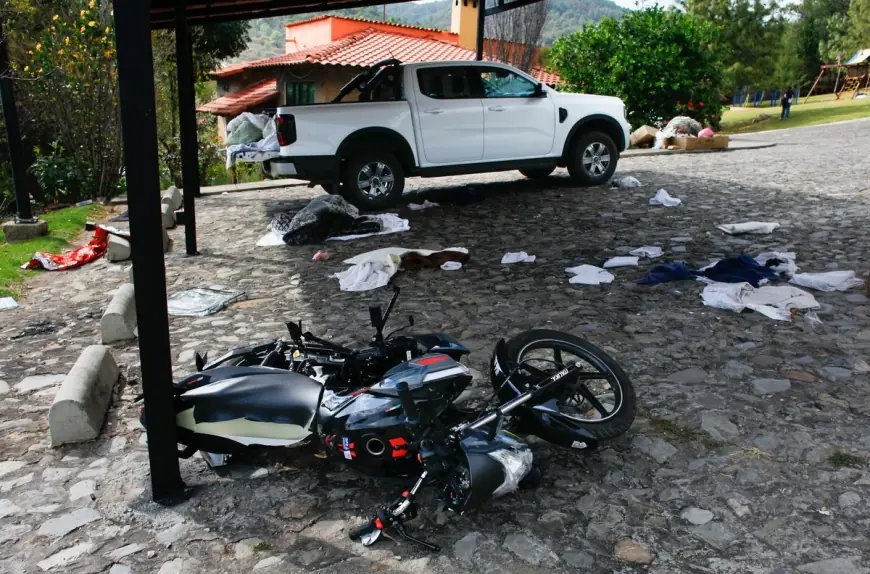
On Monday, personnel from the Fiscalía General de la República and the Ejército conducted diligences in the cabins of La Loma as part of an investigation recorded under file number FED/FEMDO/FEIDICS-JAL/0000230/2026. The cabins had been abandoned suddenly; investigators found physical traces indicating how the sicarios slept, maintained observation points and used firearms and explosives in attempts to prevent the capture of their leader. Those on-site actions followed the violent events that disrupted the rural, mountainous area the previous day.
Military deployment, helicopters and local alarm at 7 a. m.
Residents and employees of local hotels and recreation centers described alarm and fear when helicopter noise began around 7: 00 a. m., disrupting the quiet of Tapalpa, a pueblo mágico in the Jalisco highlands. That morning and the preceding Sunday, a large contingent of the Ejército and the Guardia Nacional deployed by land and air—on foot, in armored vehicles and using helicopters—to confront the forces aligned with Oseguera Cervantes. The federal sweep surrounded the Country Club and extended to the limits of the cabins of La Loma and Los Pastores.
Local landscape, tourism and the wider CJNG footprint
The Country Club sits five kilometers from Tapalpa’s town center and is noted for tile roofs and many adobe constructions painted white with a brown stripe, an appearance that has made the area attractive to visitors. Locals described a façade of tranquility—what some call pax narca—despite widespread knowledge that control in the area had been exercised by the Cártel Jalisco Nueva Generación. Witnesses said El Mencho and his people moved between Tapalpa, El Grullo, Villa Purificación and Autlán.
What makes this notable is the scale of the response inside a tourist-oriented zone: a cordon exceeding four kilometers deployed around a community of weekend visitors, followed by on-site forensic and military diligences the next day. The Agency that tracks international drug threats classifies Oseguera Cervantes’s organization as one of the most dangerous, a designation that framed the intensity of the federal and military operation in the mountains surrounding Tapalpa.
Details not present in the provided context remain unclear in the provided context.