
















Al Green’s Aisle Protest and Its Immediate Impact on House Dynamics During the State of the Union

Why this matters now: The decision by al green to stage a silent aisle protest during the president’s address didn’t only remove a single lawmaker from the chamber — it underscored widening fault lines in the House as Democrats largely sat in protest while Republicans repeatedly rose to applaud. The moment sharpened tensions, produced physical confrontations on the floor, and became an instant visual emblem of partisan escalation.
Al Green’s action and who felt the impact in the chamber
Several House Democrats visibly signaled opposition during the address: dozens of colleagues boycotted the speech and several in the chamber made their stance plain by staying seated or walking out. Green’s protest focused attention on those choices and on nearby Republican reactions — staffers and members intervened, and the chamber’s tone shifted from formal to confrontational.
What took place in the center aisle and how it unfolded
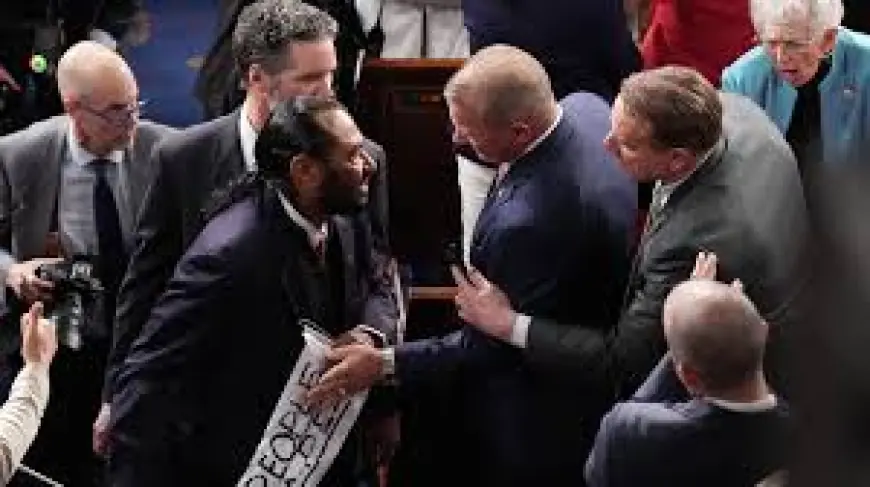
As the president began his remarks and many attendees sat, Green remained in the center aisle holding a cardboard sign that read "Black people aren’t apes!" That sign was presented as a response to a prior racist video depiction of Barack and Michelle Obama. Multiple Republican representatives attempted to grab or block the placard from cameras as a staffer escorted Green toward the door. Representative Troy Nehls engaged Green aggressively as he passed, and Senator Markwayne Mullin approached in a menacing fashion. Green left clutching both his walking stick and the protest sign, and there were acrimonious exchanges on his way out; a few Republicans chanted "USA! USA!" as he exited. His seat remained empty with a handwritten cardboard sign reading "Al Green. "
Wider Democratic responses and departures during the speech
Green was not the only lawmaker expressing dissent. Many Democrats sat solemnly while Republican colleagues stood and clapped at the end of numerous sentences from the president. Several Democrats walked out early. Senator Mark Warner of Virginia wrote on a social platform that he "couldn't sit through an hour of Trump's lies" and left as the president touted economic claims. Representative Bill Foster of Illinois said on a social platform he tallied "5 bald-faced lies" — the same as the prior year — and added, "Less than one hour into his speech, I'm out. "
Direct exchanges on policy points and shouted retorts
When the president spoke about immigration enforcement and urged funding for the Department of Homeland Security to a standing ovation from Republicans, some Democrats replied aloud from the floor. Representative Rashida Tlaib, wearing a pin that read "release the files, " yelled back about Alex Pretti, a Minneapolis nurse who was shot to death by federal agents: "They saw the videos, Mr President. " Representative Ilhan Omar shouted "You should be ashamed, " and repeatedly accused the president of having "killed Americans" as he told Democrats they should be ashamed.
Green’s history, his response after ejection, and what that signals
This removal marked the second consecutive year Green was removed from the annual event. Last year he was ordered out of the chamber by House speaker Mike Johnson after yelling responses during the president’s speech; this year’s protest was silent, though still pointed. Green has been among the president’s most prominent critics and was the first member of Congress to call for his impeachment as early as 2017. He represents a predominantly African American district and has long fought for civil rights. Outside the chamber after being escorted out, Green said the removal was of no consequence, continued holding his sign for cameras, and said nothing would prevent him from taking what he described as a righteous stand. "You have to take a stand, " he added, saying there were others who would do so as well.
What’s easy to miss is that Green maintained the visual of his protest even after ejection, which kept the moment visible to cameras and observers beyond the floor.
- Last year: Green was ordered out by House speaker Mike Johnson after yelling during the address.
- This year: Green was escorted out while holding a sign that read "Black people aren’t apes!" and clutching a walking stick.
- During the speech: multiple Democrats remained seated or left; Republicans frequently stood and applauded.
Here’s the part that matters: the episode combined symbolic protest, physical confrontation, and public rebuttals on policy and justice issues — amplifying tensions well beyond a single removal. The real question now is how these visible fractures will affect floor decorum and bipartisan cooperation going forward.
- Dozens of colleagues boycotted the address; several Democrats stayed seated in protest while Republicans cheered.
- Physical engagement: Representative Troy Nehls and Senator Markwayne Mullin confronted Green as he was escorted out.
- Visible messaging: Green’s sign referenced a racist video depiction of a former first couple and stayed in view despite attempts to block it.
- Public pushback included shouted exchanges from Representatives Rashida Tlaib and Ilhan Omar and early exits by other Democrats.
Timeline and sequence are based on the events as presented in the chamber; some reporting details beyond the chamber are unclear in the provided context.