







El Mencho’s death sparks a wave of violence and questions in Mexico

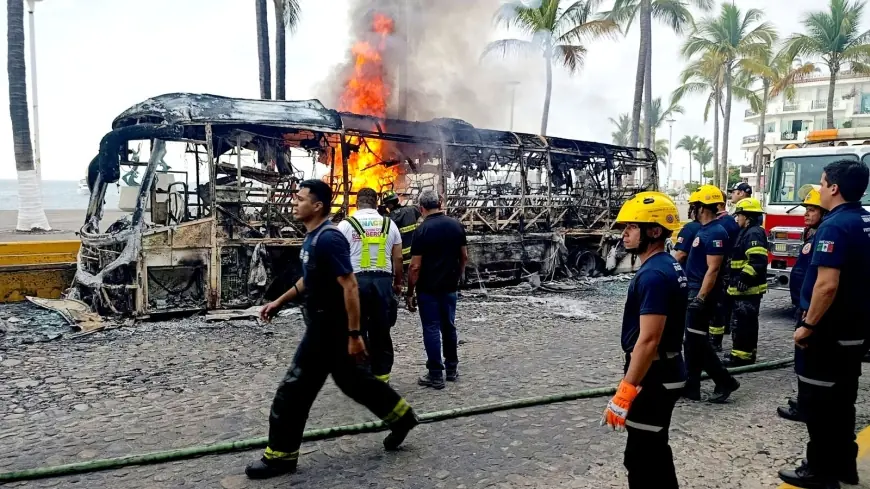
El Mencho, the Jalisco New Generation Cartel leader, was killed by Mexican special forces on Sunday, and the operation has set off a wave of unrest across mexico as authorities and international figures react. The raid removed the head of a cartel based in Jalisco that security agencies and experts have described as one of the country’s most powerful criminal organisations.
Violence spreads across Mexico after the raid
Mexican the killing prompted outbreaks of violence in the wake of the operation. A newspaper seller in Mexico City put the morning’s editions on display with the story dominating front pages. Former US Drug Enforcement Administration chief Mike Vigil said the US is "trying to take credit" for the operation but that it was carried out by Mexican forces with US intelligence support; he added the Trump administration was "trying to take credit" and that "100% of it was Mexico... and they deserve all the credit. " Vigil also said the killing would send "psychological shockwaves" through the cartel, whose members had thought their leader was "invincible. " Donald Trump wrote in a post on Truth Social that Mexico must "step up their effort on cartels and drugs. "
Details from Gen. Ricardo Trevilla Trejo on the raid
Defence minister Gen. Ricardo Trevilla Trejo gave a detailed account of the operation to the media. He said the special forces and the National Guard used six helicopters and that a fighter jet had been on standby to speed the drug lord to the Mexican capital; El Mencho died before he could be put on board. Trejo described cartel members opening fire with heavy weaponry when they realised their base was being raided and called the clash a "very violent" battle that government forces were able to fight off.
How the confrontation unfolded and its immediate toll
Trejo said El Mencho and two bodyguards fled to a wooded area with cabins, and that the drugs boss was found hiding in a bushy area. Several rocket launchers were recovered with the group but Trejo said they were not used. One helicopter was forced into an emergency landing at a military base after being hit by enemy fire. El Mencho and the two bodyguards were badly hurt in the firefight and were flown in another chopper, alongside an injured soldier, to a medical centre; the three criminals died on the way. The defence minister also said a senior Jalisco member was tracked down and killed after urging attacks on military installations and the National Guard, offering 20, 000 pesos for each soldier injured.
Casualties and material seized at the site
Gen. Trejo revised the toll of cartel members killed in the raid to eight, saying four more bodies had been found inside the property. He said grenades, ammunition and eight vehicles were discovered nearby.
Who El Mencho was and how the CJNG rose
El Mencho’s real name was Nemesio Rubén Oseguera Cervantes. He was a 59-year-old former police officer originally from Aguililla in the state of Michoacán. He had been involved in drug trafficking since the 1990s and migrated to the United States, where he was convicted in the US district court for the Northern District of California in 1994 of conspiracy to distribute heroin and served nearly three years in prison. After his release he returned to Mexico and re-engaged with Ignacio Coronel Villareal, alias "Nacho Coronel. " Following Coronel’s death, El Mencho and Erik Valencia Salazar, alias "El 85, " created the Jalisco New Generation Cartel about 2007. The group initially worked for the Sinaloa cartel but split and have for years battled for territory across Mexico. One underworld yarn says the split began when a Guadalajara narco spilled a glass of hibiscus tea over a rival, a small incident that reportedly set off betrayals, gun battles and massacres.
Cartel reach, tactics and wider threats
The CJNG, based in Jalisco, is known for displays of ultraviolence and a large, military-style arsenal. The group has carried out aggressive attacks on the military, including assaults on helicopters, and is a pioneer in launching explosives from drones and installing mines. An earlier effort to capture El Mencho ended badly in 2015 when cartel gunmen shot down an army helicopter with a rocket launcher. In 2020 the cartel carried out a brazen assassination attempt using grenades and high-powered rifles in Mexico City against the then head of the capital’s police force, who is now the federal security secretary.
Security specialist Eduardo Guerrero said in 2021 that authorities north and south of the US border considered the CJNG a national security threat, noting "they have huge amounts of money, the latest generation weapons, military-style paramilitary groups and vehicles" and that they represent "a very severe challenge to the [Mexican] government – above all in small and mid-sized cities where a detachment of 50 cartel operatives can obviously defeat any local police force. " The US Drug Enforcement Administration considers the CJNG to be as powerful as the Sinaloa cartel, with a presence in all 50 US states. The DEA says the CJNG is one of the main suppliers of cocaine to the US market and, like the Sinaloa cartel, earns billions from the production of fentanyl and methamphetamines. Sinaloa has been weakened by infighting after the loss of leaders Ismael "El Mayo" Zambada and Joaquín "El Chapo" Guzmán, who are both in US custody.
El Mencho’s public profile and unfinished notes
Unlike Joaquín "El Chapo" Guzmán, El Mencho preferred the shadows and few photographs of him exist. Since 2017, El Mencho unclear in the provided context.
What comes next is unclear in the provided context.