














I share this with my daughter: Jessie Buckley wins best actress at 2026 Baftas

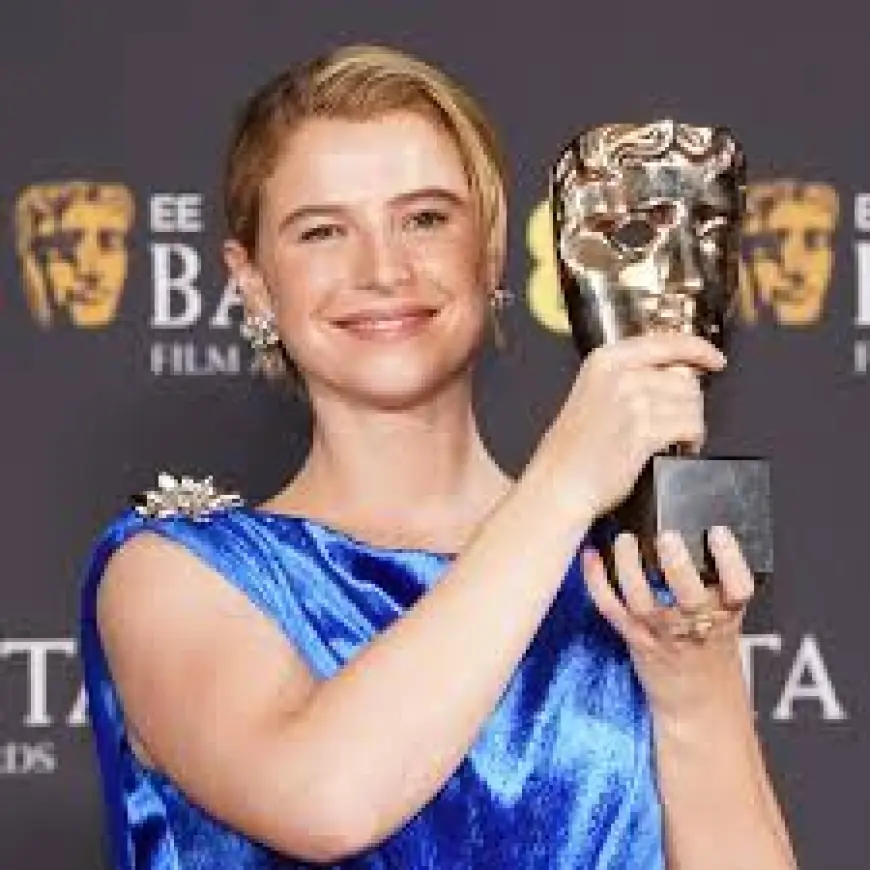
jessie buckley’s triumphant run through Oscar season continued with a best actress win at the EE British Academy of Film and Television Arts awards on Sunday night. The victory, at the Royal Festival Hall on London’s South Bank, came two days after she took the equivalent Irish Film and Television Academy award in Dublin and marked the first time an Irish performer has won the Bafta best actress prize.
Jessie Buckley’s acceptance and speech
Buckley, nominated for playing a wracked Agnes Shakespeare in Chloé Zhao’s Hamnet, accepted the prize luminous in blue after receiving the award from compatriot Cillian Murphy. “This is nuts, ” she said, then paid tribute to those who taught her craft: “This really does belong to the women past, present and future who taught me and continue to teach me how to do it differently. ”
She spoke directly about family, saying, “I share this with my daughter, who has been with me since she was six weeks old on the road with this. ” Buckley called motherhood “the best role of my life” and promised “to continue to be disobedient so you can belong to a world in all your complete wildness as a young woman. ”
Awards season and Dublin win
The Bafta success followed Buckley’s win at the Irish Film and Television Academy awards in Dublin two days earlier, underlining a sustained awards-season run. The Bafta best actress prize is the first time an Irish performer has taken that specific honour at the British Academy event.
Supporting actor upset and Oscar implications
Paul Mescal, nominated for playing William Shakespeare in Hamnet, lost out in the best supporting actor category to an absent Sean Penn, who was described in the ceremony as sinister as a messianic despot in Paul Thomas Anderson’s One Battle After Another. Stellan Skarsgård had looked the favourite in that category, and Penn’s win was noted as opening the corresponding Oscar race up considerably.
Visual effects and Avatar triumph
Richard Baneham took a second Bafta in special visual effects for Avatar: Fire and Ash. The Tallaght man thanked his director and crew from the podium, saying, “I have to say go raibh maith agat to Jim Cameron, our visionary director, ” and adding that thanks were due to the crew “in our stage and lab in New Zealand and in LA. ”
Debuts, shocks and British film honours
Element Pictures, the Oscar-winning Dublin-based production company, were listed as proud co-producers of Akinola Davies jnr’s My Father’s Shadow, which won the outstanding debut by a British writer, director or producer. Akinola Davies jnr shares that prize with his co-writer Wale Davies.
The biggest shock of the evening was Robert Aramayo, the young star of Kirk Jones’s drama I Swear, winning best actor ahead of names such as Timothée Chalamet and Leonardo DiCaprio. I Swear tells the story of John Davidson, a courageous Scottish campaigner for those with Tourette syndrome; the film was a significant hit in the UK and Ireland but has barely registered with awards bodies elsewhere. The Yorkshireman, who also won rising star, appeared stunned by the prize.
Hamnet managed to win best British film, but could not overcome One Battle After Another for overall best film. One Battle After Another took six Baftas, including best director and best adapted screenplay.
Sinners and supporting actress pick
Ryan Coogler’s Sinners triumphed in three categories: original screenplay, original score and, for British performer Wunmi Mosaku, best supporting actress. Mosaku’s victory over Carey Mulligan and Teyanna Taylor was described as a minor upset. From the podium Mosaku thanked the academy and addressed her daughter, calling her her greatest teacher and saying she was proud of her.
The ceremony left many headline narratives intact: Buckley’s continuing momentum through awards season, the unexpectedly strong showing for Robert Aramayo, and the dominance of One Battle After Another across multiple major categories.
Unclear in the provided context: the precise date of the Sunday night ceremony and the full ending of one quoted line from Mosaku, which appears truncated in the available text.