

























Ilia Malinin’s Olympic Free Skate Collapse Rocks 2026 Men’s Figure Skating Field

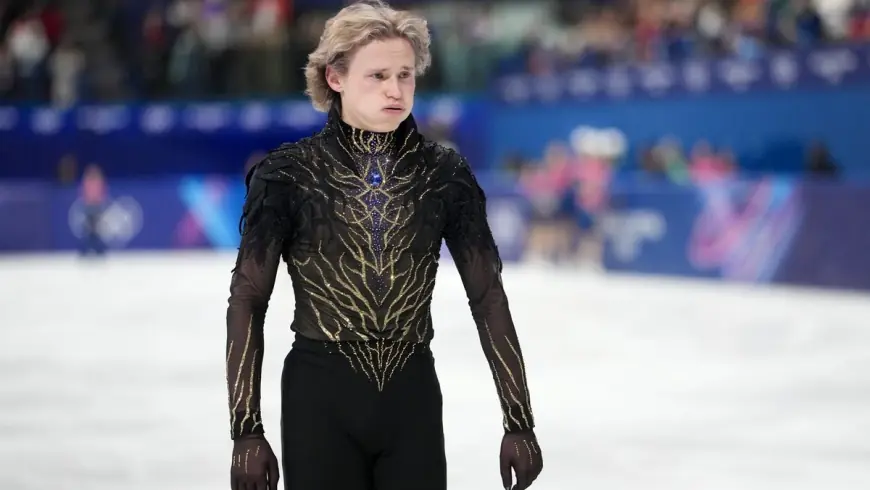
Ilia Malinin, the 21-year-old U. S. world champion and heavy favorite, suffered a dramatic breakdown in the men’s long program at the 2026 Winter Olympics, falling twice in the free skate and tumbling from the lead to an eighth-place finish. The result vaulted Mikhail Shaidorov of Kazakhstan to gold in one of the sport’s most unexpected outcomes.
Fall from favorite to eighth
Malinin entered the free skate with clear momentum after strong earlier performances and carried the label of the event’s favorite. Expectations were sky-high: he had been expected to contend for another individual Olympic gold after contributing to a team title earlier in the Games and is the only skater to have completed a quadruple axel in competition. Instead, the routine unspooled quickly. He fell twice and completed only three of seven planned quadruple jumps, finishing the event with 264. 49 points and landing outside medal contention.
The free skate unravels
The program began promisingly with a clean-looking quad flip and a near-perfect grade of execution for that element, but trouble followed. An attempted quad axel was popped into a single axel, costing both base value and crucial execution marks. A quad lutz was downgraded elsewhere, a quad loop became a double loop, and a second lutz ended with a fall. The collapse wiped away what had been a commanding short-program position and allowed challengers to close the gap.
Podium and a historic winner
Mikhail Shaidorov surged from fifth after the short to win gold with 291. 58 points, becoming his nation’s first Olympic figure skating champion and one of its rare Winter Games gold medalists. Yuma Kagiyama of Japan took silver with 280. 06 points, while Shun Sato, also of Japan, claimed bronze at 274. 90. Shaidorov’s victory was met with visible disbelief and emotion on the ice as the final standings crystallized.
Malinin’s reaction and perspective
In the hours after the event Malinin described the experience plainly: “The pressure of the Olympics really gets you, ” he said, noting that the scale of the moment compressed his usual process. He also reflected, “I blew it. That's honestly the first thing that came to my mind. I have no words, honestly. ” He had previously acknowledged feeling nerves early in warmups, around six minutes before competing, but had usually been able to settle into the routine. This time, he said, the performance sped by and he couldn’t reestablish his customary rhythm.
What this means for the sport
The outcome is a stark reminder of how Olympic pressure can upend expectations even for a skater widely seen as the generation’s best. The technical ceiling of men’s skating has been pushed by athletes pursuing ultra-difficult elements such as the quad axel, which carries a high base value and extra execution potential when landed cleanly. Yet the event also reinforced that consistency under pressure often determines medals at the highest level.
For Malinin, the Games will be remembered as a painful first Olympic individual experience but not as an endpoint. He leaves Milan-Cortina with a team gold and a newly acquired experience of competing on the sport’s biggest stage. For the broader field, Shaidorov’s breakthrough signals a fresh chapter in men’s figure skating, where opportunity can open quickly when a favorite falters and challengers seize their moment.