
























AI Uncovers the Mystery of a Roman-Era Stone

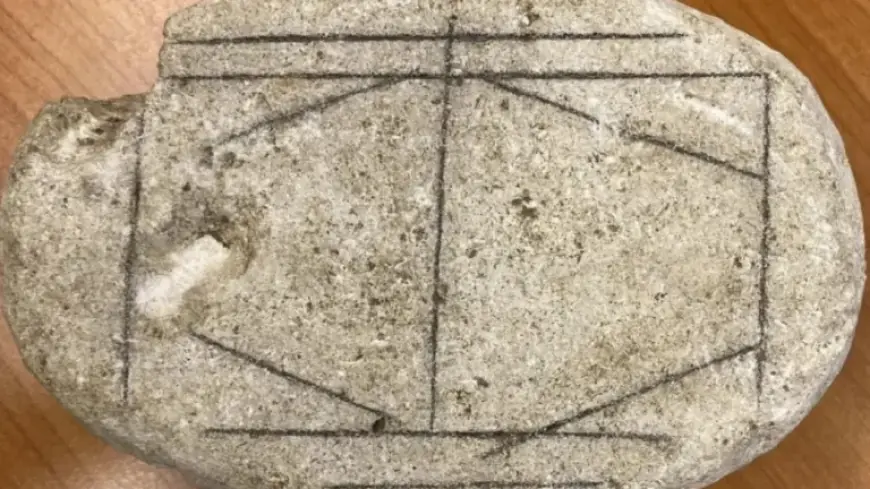
A Roman-era stone discovered in the Netherlands has intrigued researchers for years. Recent advancements in artificial intelligence have led to significant breakthroughs concerning its purpose. Scientists believe the stone served as a game board, and they have reconstructed possible rules for the game.
Discovery of the Roman-Era Stone
The artifact is a circular limestone piece characterized by diagonal and straight lines. These lines exhibit varying depths, suggesting that game pieces were moved along them. Walter Crist, an archaeologist from Leiden University and specialist in ancient games, stated, “We can see wear along the lines on the stone, exactly where you would slide a piece.”
Role of Artificial Intelligence
Researchers from Maastricht University employed an artificial intelligence program named Ludii to explore the game’s rules. They trained Ludii using the rules from around 100 ancient games from the same region as the Roman stone. This innovative approach enabled Ludii to generate numerous potential rule sets.
Game Mechanics and Variants
Ludii simulated gameplay against itself to identify enjoyable variations. It produced several game rule sets that were then compared with the physical wear patterns on the stone. Dennis Soemers, a researcher at Maastricht University, noted that the AI identified engaging rule sets for human players.
Implications and Cautions
Despite these advancements, researchers caution against definitive conclusions. Soemers remarked, “If you present Ludii with a line pattern like the one on the stone, it will always find game rules.” This highlights the uncertainty regarding whether the Romans played the game precisely as inferred by contemporary analysis.
Game Objective and Publication
- The game aims to hunt and trap the opponent’s pieces in as few moves as possible.
- Findings and suggested rules have been published in the journal Antiquity.
This remarkable investigation illustrates how artificial intelligence can engage with archaeological research, offering new insights into ancient practices and cultures.