

























Federica Brignone seizes Olympic gold in women’s super-G at Milano Cortina

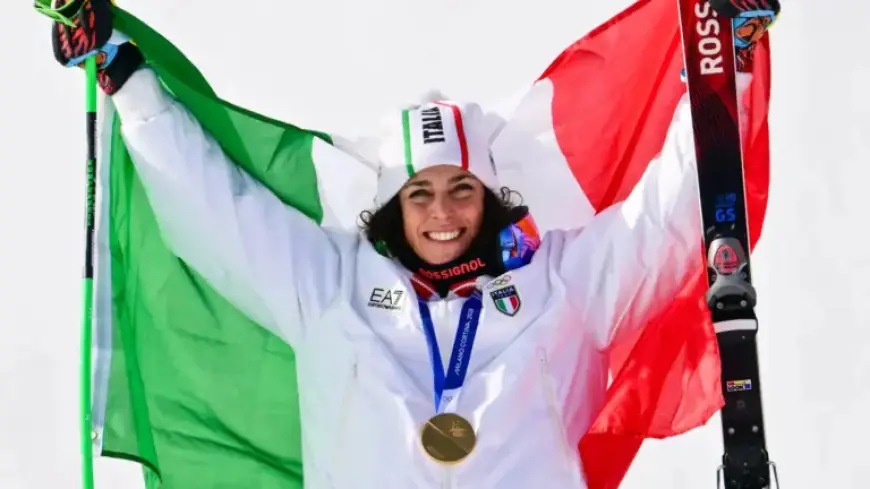
Federica Brignone delivered a commanding run to win the women’s Olympic super-G at the Milano Cortina Games, topping a field thinned by crashes and non-finishes on a bruising course. The Italian star clocked 1:23.41 to secure gold on home snow.
Brignone masters a punishing set
On a layout that demanded precision at full speed, Brignone found the balance between aggression and control, laying down a clean, fast line that held up as the benchmark through the start list. Her 1:23.41 stood firm as the day’s best, a time that rewarded risk-taking in the midsection without surrendering speed through the bottom gates.
The victory adds another signature moment to Brignone’s decorated career and came in front of an Italian crowd with no shortage of voice. In an event where tiny errors balloon into time losses, her composure under pressure proved decisive.
A day of attrition: 26 finishers, 17 DNFs
Merely getting to the finish proved an achievement. Multiple crashes and missed gates underscored how unforgiving the super-G set was, with only 26 athletes making it to the bottom and 17 registering DNFs. Line choice through key transitions separated contenders from those who were forced out, and the high attrition rate framed Brignone’s smooth execution as even more valuable.
The course asked athletes to thread speed through sections where terrain breaks disguised direction changes. Those who misread the set or pushed beyond the limit found little room to recover.
U.S. roundup: Wiles leads Americans, Cashman 15th
Jacqueline Wiles led the American contingent in 13th place with a time of 1:25.40, steadying her run amid the chaos to place inside the top 15. Keely Cashman followed closely in 15th at 1:25.61, just over two seconds off Brignone’s winning mark.
The attritional nature of the race also caught out several notable names. Breezy Johnson, the downhill gold medalist earlier at these Games, did not finish after getting thrown off line, and Mary Bocock’s challenge ended early as well.
Cashman reflects on a hard-fought finish
Completing her Olympic program in Milano Cortina, Cashman acknowledged the result wasn’t what she envisioned after promising training and a strong combined showing earlier in the week. “I had high expectations for today, and just kind of didn’t happen how I wanted it to,” she said. “But that’s ski racing.”
Cashman’s top-15 in super-G matched her 15th-place result in the team combined, capping a consistent set of performances on a global stage where the margins are razor-thin.
Home-soil triumph energizes Italy
Brignone’s gold resonated beyond the timings. Winning a speed title in Italy amplified the celebration and underscored the nation’s depth in women’s alpine skiing. The super-G reward came from a high-wire mix of tactical nous and confidence at pace, the kind of balance that turns a treacherous set into a showcase run.
For a host nation eager for defining moments, the performance arrived with perfect timing, offering a highlight in one of the sport’s most finely balanced disciplines.
Super-G spotlight: one run, no safety net
Super-G compresses the audacity of downhill and the precision of giant slalom into a single-run shootout. With no second chance and no prior training runs on the race set, competitors must commit instantly to blind terrain features and subtle rhythm changes. That format rewards athletes who can read a course quickly, adapt in real time, and maintain speed without tipping into error.
On this day in Milano Cortina, that razor’s edge favored Brignone. While others were tripped by transitions and offset gates, she kept the line tidy, the skis running, and the splits green—enough to turn a brutal test into Olympic gold.