
























Nancy Guthrie Search Reaches Day 8 With No Suspects Named as Investigators Review Multiple Ransom Communications

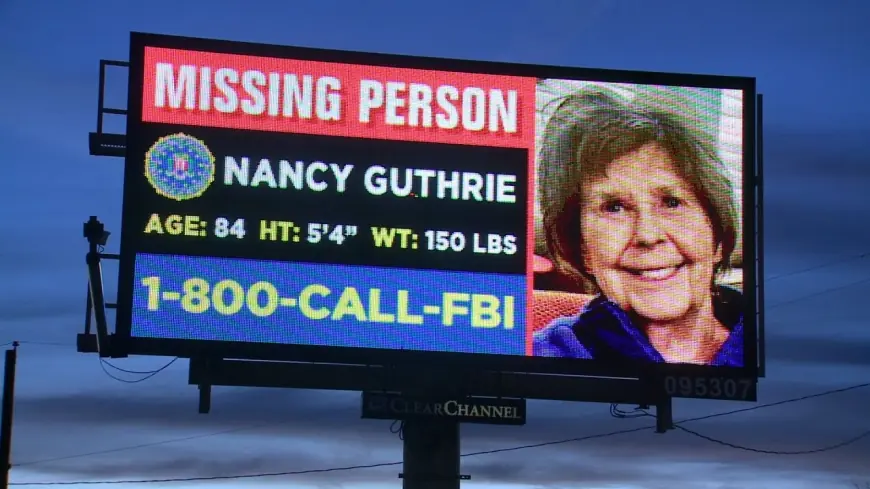
The search for Nancy Guthrie, the 84-year-old mother of television journalist Savannah Guthrie, entered day 8 on Sunday, February 8, 2026 ET with no suspects publicly named and investigators focused on a new pressure point in the case: multiple ransom-style communications that authorities say are still being evaluated for authenticity.
Law enforcement in southern Arizona has framed the investigation as urgent and active, while cautioning that the flurry of messages circulating during the search has created both leads and noise. The family has continued public appeals as authorities pursue evidence, digital traces, and tips from the public.
What happened and where the investigation stands on day 8
Nancy Guthrie was last known to be at or near her home in the Tucson area on Saturday, January 31, 2026 ET, after being dropped off by family following an evening together. She was reported missing on Sunday, February 1, 2026 ET when she did not make expected contact.
Investigators have said they are treating the disappearance as suspicious and are conducting an ongoing search that includes reviewing surveillance possibilities, canvassing neighborhoods, and pursuing any credible information about vehicles, movements, or communications linked to the case. As of day 8, authorities have not publicly identified a person of interest.
The focus on ransom communications has intensified because multiple messages have surfaced, including at least one that investigators have described as a hoax and at least one other message that remains under review.
Multiple “ransom” communications: what investigators are evaluating
Authorities have acknowledged they are evaluating more than one ransom-related communication connected to the case. The central question is not whether messages exist, but which are real, which are opportunistic, and which are designed to misdirect.
One communication has already led to an arrest of a man accused of sending false ransom-related messages to the family while the search was underway. That arrest underscores a harsh reality in high-profile missing-person cases: as public attention rises, so does the incentive for scammers to exploit the family’s fear and urgency.
Investigators have also said they are assessing a separate “new message” for authenticity. Officials have not publicly confirmed proof of life, and they have urged the public to avoid amplifying unverified claims that could interfere with investigative strategy.
The family’s posture: appeals for safe return as pressure builds
Savannah Guthrie and relatives have issued direct public pleas emphasizing one objective: safe return. Their messaging has been consistent in tone, prioritizing reunion over retribution. In cases involving potential ransom demands, families often face an excruciating balance between cooperating with investigators and signaling flexibility to whoever may be involved. Public statements can be part of that balance, but they also carry risk if they encourage copycats.
For investigators, the family’s visibility can help by generating tips. It can also complicate matters by drawing in bad actors and flooding tip lines with rumors.
What’s behind the headline
This story is moving fast because it sits at the intersection of public attention and private crisis, and because ransom communications change the incentives for almost everyone involved.
Context: Missing-person cases involving older adults are time-sensitive even under ordinary circumstances. When suspicious indicators are present, the clock feels even louder.
Incentives:
-
Investigators want controlled information flow to protect the integrity of evidence and avoid tipping off anyone responsible.
-
The family wants speed and safety, even if that means navigating uncertainty publicly.
-
Scammers and hoaxers exploit the moment because attention creates openings for fraud.
Stakeholders: The Guthrie family; local and federal law enforcement; neighbors and potential witnesses; and the broader community that can provide tips, camera footage, or sightings. Secondary stakeholders include anyone responsible for local security systems and data that could confirm timelines.
Second-order effects: A wave of fake messages can harden families and investigators against genuine contact, slowing negotiations if a real perpetrator is testing channels. It also increases public skepticism, which can reduce the quality of tips at the exact moment investigators need clarity.
What we still don’t know
Despite day 8’s escalation, major questions remain unanswered:
-
Whether any evaluated ransom communication is definitively tied to Nancy Guthrie’s disappearance
-
Whether investigators have confirmed proof of life
-
The precise, minute-by-minute timeline around the last confirmed sighting
-
Whether nearby cameras captured relevant movement that has not been publicly disclosed
-
Whether there are internal persons of interest who have not been named to protect the investigation
In cases like this, silence is not necessarily lack of progress; it can reflect a deliberate decision to avoid compromising a recovery effort.
What happens next: realistic scenarios and triggers
-
Authentication of communications
Trigger: forensic analysis of message metadata, routing, or technical fingerprints that link a message to a real actor. -
Targeted search expansions
Trigger: a credible lead that narrows geography, such as a confirmed sighting, vehicle identifier, or location-based digital trace. -
A public request for specific evidence
Trigger: investigators pinpoint a time window and ask for doorbell or security footage from a defined radius. -
Additional arrests for interference or fraud
Trigger: more hoax communications or attempted extortion tied to the case’s publicity. -
A shift in public posture from officials
Trigger: confirmation that a communication is credible, or evidence that changes the risk assessment.
As the search enters its second week, the headline is less about dramatic turns and more about the grind of verification: separating real signals from noise, protecting the investigation, and keeping the focus on the same priority investigators and family have repeated since day 1 — bringing Nancy Guthrie home safely.