





















“Doomsday Clock Advances to 85 Seconds from Midnight, Nearing Historic Catastrophe”

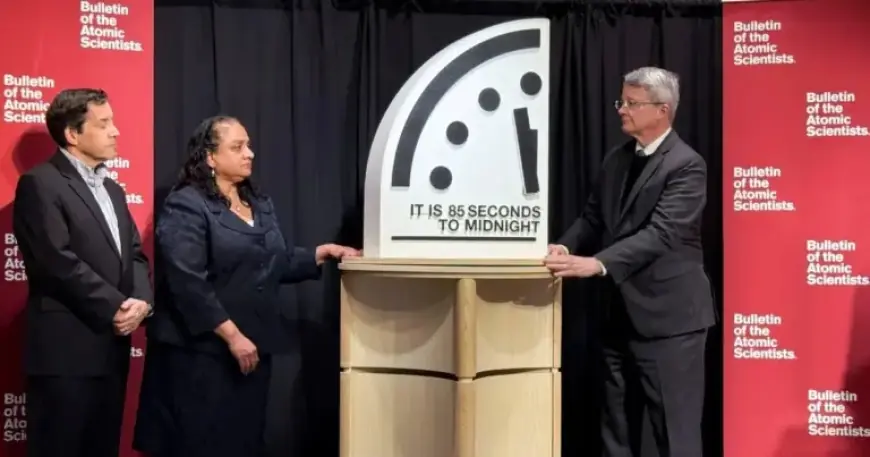
The “Doomsday Clock,” a symbol representing the proximity of humanity to extinction, has now moved to 85 seconds before midnight. This adjustment, announced on Tuesday, marks the closest point to catastrophe since the clock’s inception nearly 80 years ago.
Statement from Experts
Alexandra Bell, the president and CEO of the Bulletin of the Atomic Scientists, emphasized the inadequate progress made in addressing existential threats, particularly from nuclear weapons, climate change, and emerging technologies. She stated, “Every second counts, and we are running out of time.”
Historical Context
Last year, the clock was set at 89 seconds to midnight, which was a record low. Daniel Holz, chair of the Bulletin’s science and security board and a physics professor at the University of Chicago, highlighted the increased aggressiveness of major countries over the past year. He warned that a crucial treaty limiting U.S. and Russian nuclear arms is set to expire soon, allowing for a potential arms race.
Current Environmental Challenges
The Bulletin underscores alarming climate trends. Atmospheric carbon dioxide concentrations and global sea levels have reached unprecedented levels. Holz warned that extreme weather events like droughts and floods are becoming more frequent and severe.
- Record high atmospheric carbon dioxide levels
- Rising global sea levels
- Intensifying weather events, including droughts, fires, and floods
Emerging Threats
Holz also raised concerns about the risks posed by artificial intelligence. He identified AI as a rapidly advancing technology that could exacerbate misinformation, complicating global responses to existing threats.
Political Climate and Rights Erosion
The rise of nationalistic autocracies was another point of concern for Holz. He warned that a fragmented global political landscape could lead to collective loss, stating, “If the world splinters into an us-versus-them, zero-sum approach, it increases the likelihood that we all lose.”
Recent events in the U.S., including federal agents’ fatal shootings of citizens, have raised alarms about the erosion of constitutional rights. Holz noted that historical patterns show that unaccountable governments lead to conflict and suffering.
Call to Action
Bell believes that the issues reflected in the clock’s setting are solvable through collaboration. “Every time we’ve been able to turn back the hands of the clock, it’s been because we had scientists and experts working to find solutions and a public that was demanding action,” she said.
Clock’s Historical Adjustments
The Doomsday Clock was first revealed in 1947, shortly after atomic bombs were dropped in World War II. In its nearly eight-decade history, the clock has been adjusted over two dozen times.
| Year | Setting (seconds to midnight) | Key Reasons for Setting |
|---|---|---|
| 1991 | 17 minutes | End of Cold War, nuclear treaty |
| 2020 | 100 seconds | Cyber threats, information warfare |
| 2023 | 90 seconds | War in Ukraine, escalating tensions |
| 2024 | 89 seconds | Ongoing dangers and inaction |
| 2025 | 85 seconds | Increased existential threats |
The recent adjustment of the “Doomsday Clock” underscores the pressing need for global unity and decisive action on critical issues. The clock’s minute hand continues to tick closer to midnight, reminding us that the time for change is now.