






















4.1 Magnitude Earthquake Hits Kawartha Lakes, North of Toronto

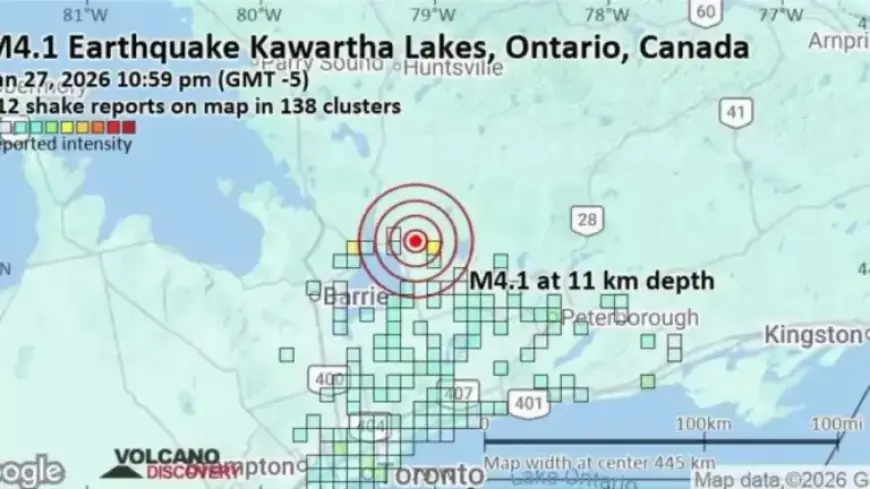
The Kawartha Lakes region, located north of Toronto, Canada, recently experienced a magnitude 4.1 earthquake. This tremor prompted numerous residents to report sensations of shaking throughout the area. The event brought attention to the geological activity in a region not typically associated with earthquakes.
Impact of the Earthquake Across Ontario
The earthquake’s tremors were felt across a wide area, with varying intensities described by residents. These reports were categorized using the Modified Mercalli Intensity (MMI) scale, which ranges from I (not felt) to X (extreme shaking).
Intensity Reports by Region
- Kawartha Lakes: Residents experienced light to moderate shaking, with MMI levels ranging from III to IV. Many noted objects rattling and walls shaking.
- Toronto: Reported weak to light shaking (MMI II to IV). Some high-rise apartment dwellers felt vibrations lasting for 5 to 10 seconds.
- Pickering: Light shaking was reported (MMI III). Some residents initially mistook the sensation for strong winds.
- Ajax: Observations of strong vibrations were noted, with descriptions likening the shaking to an elephant running through the house.
Noteworthy Experiences from Residents
Various accounts illustrate the shaking’s impact on daily life. In Lindsay, for instance, a resident initially believed their pet was causing the vibrations before realizing it was the earthquake. Reports from Brampton and Oshawa highlighted noticeable disturbances, waking many from their sleep.
Understanding the Modified Mercalli Intensity Scale
The Modified Mercalli Intensity scale helps quantify perceived shaking during an earthquake. Most reports from this incident fell within the MMI levels II to IV, indicating that while there was no significant damage, the tremors were felt widely.
Preparedness for Future seismic Activities
This recent earthquake emphasizes the need for awareness regarding geological events, even in areas like Kawartha Lakes that are not commonly associated with seismic activity. Residents are encouraged to consider preparedness measures to better respond to potential future earthquakes.