
























Atomic Scientists Reset Doomsday Clock for 2026

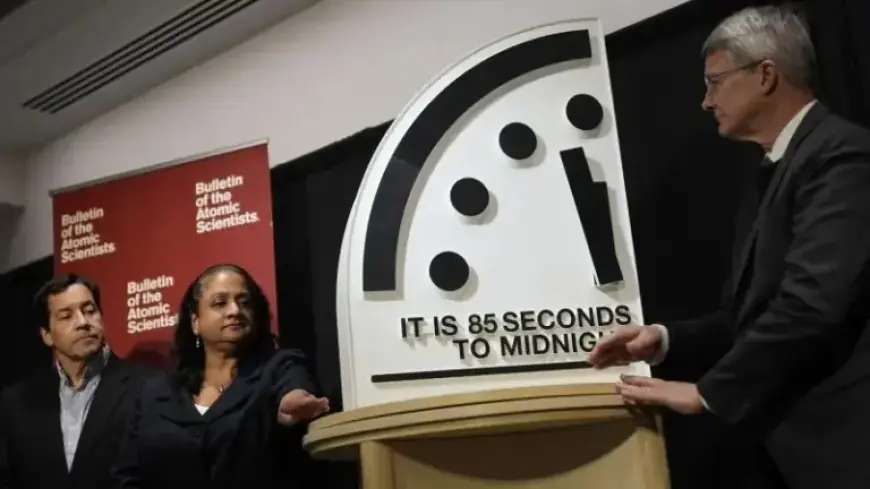
On February 13, 2026, the Bulletin of the Atomic Scientists reset the Doomsday Clock to 85 seconds to midnight. This marks the closest proximity the clock has ever been to midnight, symbolizing the imminent threat to humanity’s survival. Established in 1947, the clock serves as a dire reminder of the multiple existential risks we face today.
Overview of the Doomsday Clock
The Doomsday Clock was created as a symbolic measure of how close humanity is to catastrophic destruction. Midnight on the clock represents an uninhabitable Earth. The previous year, the clock was set at 89 seconds, which was also deemed alarmingly close.
- 85 Seconds to Midnight: The current setting reflects worsening global conditions.
- Historical Context: Since its inception, the clock has been adjusted based on perceived threats.
Reasons for the Adjustment
Bulletin President and CEO Alexandra Bell highlighted several critical factors for this year’s timing change:
- Insufficient progress in controlling nuclear risks.
- Escalating threats from climate change.
- Emerging biological dangers and advancements in disruptive technologies like artificial intelligence.
- Increased spread of misinformation and conspiracy theories contributing to existential risks.
“Humanity has not made sufficient progress on the existential risks that endanger us all,” Bell asserted.
The Current Global Landscape
Over recent years, global tensions have only intensified. Dr. Daniel Holz, chair of the science and security board, expressed concerns over nationalistic behaviors and aggressive military strategies, particularly involving nuclear-armed nations. Significant factors to consider include:
- The expiration of the last remaining nuclear weapons treaty between the United States and Russia on February 4, 2026.
- A rise in conflicts involving nuclear weapons.
- No coordinated international strategy to address the rapid development of biological threats.
Historical Background and Purpose
The Bulletin of the Atomic Scientists was founded by scientists who worked on the Manhattan Project during World War II. Initially focused on nuclear threats, the organization expanded its scope in 2007 to include climate change.
Each year, the clock’s time is decided by experts on the Bulletin’s science and security board, which counts several Nobel laureates among its members.
The Clock as a Tool for Awareness
The Doomsday Clock is not intended to quantify existential threats precisely. Instead, it stimulates vital discussions about the scientific and societal crises we face. Despite criticisms about its metaphorical nature, many experts acknowledge its value in raising awareness.
The Path Forward
The Bulletin emphasizes that moving the clock back from its troubling setting is achievable through decisive action. Historical precedents show that significant diplomatic efforts can lead to better conditions. For instance, it was set back to 17 minutes to midnight in 1991 following major disarmament treaties.
Individuals also have a crucial role to play. Public discourse can combat misinformation, urging leaders toward responsible actions. Simple lifestyle adjustments—such as reducing emissions, conserving resources, and promoting sustainability—can collectively mitigate the climate crisis.
Maria Ressa, co-founder of Rappler, resonated this urgency, stating that shared facts are essential for collective action. The fight against misinformation is pivotal in fostering a credible societal dialogue.
In conclusion, the Doomsday Clock serves as a critical alarm for humanity. It not only gauges current threats but also calls for immediate action on a global scale. Collective responsibility and informed discussions are necessary to steer humanity away from potential annihilation.