























Naomi Osaka’s icy handshake moment exposes the sport’s gray zone on “hindrance” at the Australian Open

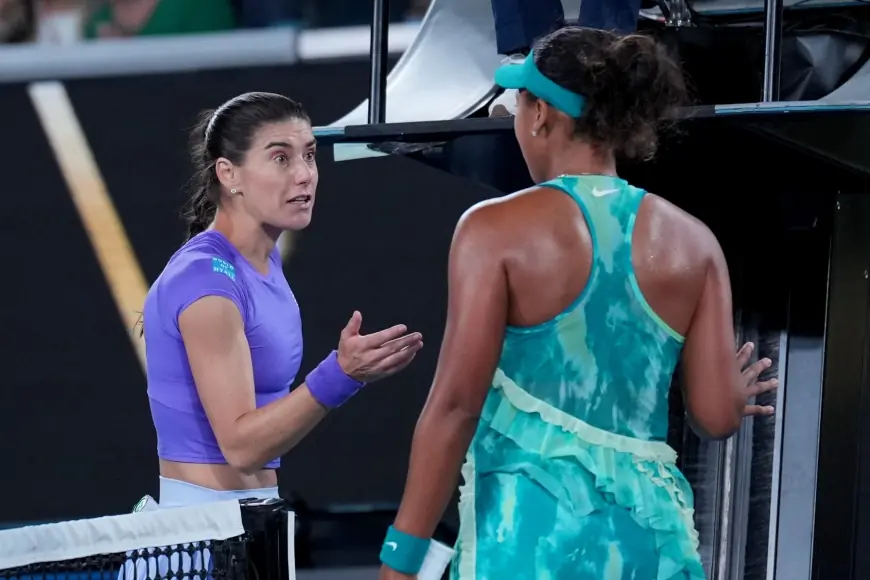
The Australian Open is supposed to be the cleanest stage tennis has—clear rules, clear etiquette, and clear winners. Naomi Osaka’s second-round win over Sorana Cîrstea showed how quickly those lines blur when a match turns tense. The dispute wasn’t about a disputed call or a medical timeout; it centered on timing, noise, and whether a player’s self-hype crosses into interference. The result is a rare mid-tournament flashpoint that now sits in the same spotlight as the draw itself.
When motivation starts sounding like disruption, everyone loses control of the narrative
Osaka didn’t need controversy to be a headline in Melbourne. She’s a multi-time major champion and one of the biggest names left in the women’s bracket. But the moment a match ends with a frosty handshake and a pointed exchange at the net, the discussion shifts from forehands to “fair play.”
Cîrstea’s frustration was specific: Osaka’s audible “come on” celebrations, she argued, came at moments that felt intrusive—most notably during the space between a first and second serve. That’s the sensitive zone in tennis etiquette: the server is trying to reset, and anything that feels like a disruption can be viewed as gamesmanship, even when it isn’t intended that way. Osaka, for her part, maintained it was self-motivation, not a tactic, and noted the chair umpire did not penalize her during play.
The tension widened beyond the two players when Novak Djokovic’s wife publicly criticized Osaka’s behavior as disrespectful, raising the question of whether the sport is enforcing its own standards consistently when crowd noise, player emotion, and the letter of the rule collide.
What happened on court: a three-set win, a cold handshake, and an apology afterward
Osaka advanced to the third round with a 6–3, 4–6, 6–2 win over Cîrstea. The match itself was competitive—Cîrstea took the second set, and Osaka responded with a decisive third. The post-match scene, though, became the headline: the handshake at the net was visibly stiff, and Cîrstea challenged Osaka about sportsmanship.
Afterward, Osaka acknowledged that some of her comments in the immediate aftermath could be taken as disrespectful and offered an apology if that’s how they landed. Cîrstea did not turn the exchange into an extended feud, emphasizing the moment was minor in the context of what she has framed as her final season on tour.
The tournament schedule now moves quickly. Osaka is slated to play Australian qualifier Maddison Inglis in the third round in the night session, a matchup that suddenly carries extra pressure—not because of tactics, but because every celebration, shout, and glance at the opponent will be interpreted through the lens of this dispute.
The wider draw context: volatility on the women’s side, milestones on the men’s side
While Osaka’s situation grabbed the oxygen, the tournament has been busy reshaping itself elsewhere.
On the women’s side, Anastasia Potapova has already supplied a jolt to the bracket, knocking out Emma Raducanu in the second round. Meanwhile, Linda Nosková entered Melbourne as a seeded player but has been eliminated, another reminder that the women’s draw is being defined by fast-moving momentum shifts rather than a single dominant storyline.
On the men’s side, Djokovic’s early rounds have carried their own historical undertone. He moved into the third round with a straight-sets win that set him up for a night-session meeting with Botic van de Zandschulp, with major milestone numbers hovering around his Australian Open legacy. That’s why the Osaka-Cîrstea dispute landing in Djokovic’s orbit—even indirectly—felt like gasoline on a small fire: it fused a rules-and-etiquette debate to one of the tournament’s most scrutinized figures.
Quick micro Q&A
Is shouting “come on” during points against the rules?
Not inherently. The line usually gets tested when the timing can be interpreted as hindrance—especially during an opponent’s serve routine.
Why didn’t an umpire warning end the issue?
If an official doesn’t view it as hindrance in the moment, play continues—and the disagreement turns into a subjective debate after the match.
Will this follow Osaka into the next round?
Yes, in the simplest way: opponents, crowds, and officials will be more alert to timing and volume, even if nothing changes in the rulebook.