Mortgage Rates Today: 30-Year Fixed Holds Near the Low-6% Range as Markets Reprice

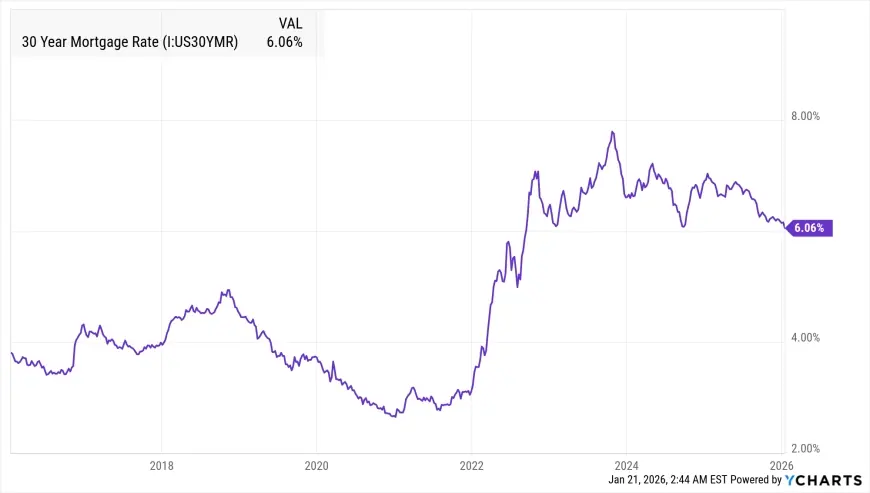
Mortgage rates today are hovering around the low-6% range for a 30-year fixed loan, after a choppy stretch where bond-market moves pushed rates up and down day to day. In practical terms, many borrowers are seeing headline 30-year fixed quotes clustered around roughly 6.1%, while refinance pricing remains higher.
Mortgage rates can change quickly because lenders update rate sheets as Treasury yields and mortgage-bond trading shift. That’s why you may see noticeably different “today” numbers depending on the tracker you check and the time of day you look.
As of Wednesday, January 21, 2026, a widely followed national average places the 30-year fixed around 6.12%, with the 30-year fixed refinance around 6.54%, and the 15-year refinance near 6.00%.
Mortgage rates today: what’s happening right now
Rates have been moving on a familiar set of drivers: expectations for interest-rate policy, inflation progress, and sudden bursts of market uncertainty that lift longer-term bond yields. When the 10-year Treasury yield pops higher, mortgage rates typically follow—sometimes within hours.
Today’s levels also reflect the reality that refinance rates often sit above purchase rates. Lenders price refis differently because the risk profile and servicing economics can change, especially when borrowers are “rate sensitive” and more likely to refinance again if rates fall further.
-
30-year fixed purchase rates are sitting near ~6.1% on national averages.
-
30-year fixed refinance rates are more commonly in the mid-6% range.
-
Daily volatility is still present, meaning “today’s rate” can be different by the afternoon.
-
Points and credits are doing more of the heavy lifting: many quotes depend on whether you pay upfront fees to buy the rate down.
-
Shopping matters more than usual because small pricing differences can translate into meaningful monthly savings.
Why “today’s mortgage rate” can look different across sites and lenders
Two borrowers shopping the same day can see different numbers even with similar credit because mortgage pricing is a bundle of moving parts:
1) Timing and market swings
Some daily trackers update continuously; others update once. If bonds sell off mid-morning, the “today” number can jump.
2) Points vs. no points
A quote at 6.125% might assume you’re paying points. Another lender might show 6.375% with a credit that reduces closing costs. Both can be “right,” just structured differently.
3) Loan details that change pricing
Down payment, loan amount, property type (condo vs. single-family), occupancy (primary vs. investment), and cash-out vs. rate-and-term refinance all shift pricing.
4) Credit score and debt-to-income bands
Mortgage pricing moves in tiers. A small score difference can move you into a new pricing bucket.
What homebuyers and refinancers should do today
If you’re buying, the immediate decision is less about predicting the perfect bottom and more about controlling risk.
For buyers:
-
Compare at least 3–5 loan estimates on the same day, with the same assumptions (points, lock length, and closing timeline).
-
Ask for a “par rate” and a “zero-point rate” so you can see whether paying points actually pays off for your time horizon.
-
Use seller concessions strategically: credits can reduce cash-to-close or fund a temporary buydown if your lender offers it.
For refinancers:
-
Run the break-even math: if closing costs take 36–48 months to recoup, make sure you’ll keep the loan long enough.
-
Watch the spread between purchase and refi pricing—if it narrows, refis can become more attractive quickly.
-
Consider a shorter lock if you can tolerate risk (shorter locks can price better), but only if your closing is genuinely on track.
Where rates have been lately and what to watch next
Even with today’s day-to-day swings, the broader trend in recent weeks has been toward improvement compared with the higher-rate periods many borrowers saw last year. Weekly benchmarks for the 30-year fixed have recently printed close to the low-6% range, reinforcing that the market has been flirting with levels that feel “manageable” again for some buyers—though affordability remains tight in many metros.
The next big tells that can move mortgage rates quickly:
-
Inflation data and rate-path expectations
-
Major policy headlines that move global bond yields
-
Treasury auctions and demand for longer-term bonds
-
Mortgage-bond market strength (which can tighten or widen spreads)
Historically, when rates ease after a high-rate stretch, homebuilders and lenders often lean harder on incentives—like buydowns and credits—to convert hesitant shoppers. That pattern tends to pick up heading into the spring selling season if rates don’t re-accelerate higher.
FAQ: Mortgage rates today
Are mortgage rates expected to drop soon?
They can, but the path is rarely straight. Rates often fall in bursts when bond yields drop, then rebound on strong economic data or renewed uncertainty.
Should I lock my rate today?
If you’re within a few weeks of closing and the payment works for your budget, locking can protect you from sudden spikes. If you have time and flexibility, some borrowers prefer a float strategy with a clear “lock trigger.”
Why is my offered rate higher than the national average?
National averages don’t reflect your points/credits, lock length, property type, or credit tier. Your personalized rate is the only number that matters for budgeting.
Mortgage rates today are giving buyers a window in the low-6% zone, but the market is still jumpy enough that shopping and lock strategy can matter as much as the headline number. Over the next few sessions, the biggest signal is whether bond yields keep calming down—if they do, lenders often compete more aggressively on pricing; if they don’t, expect the “today” rate to keep changing from one morning to the next.