
















Unraveling the Intricate Transformations in M.C. Escher’s Artworks


Self-similar images are a fascinating aspect of visual art, often characterized by repeated patterns at varying scales. This phenomenon, known as the Droste effect, has been vividly explored in M.C. Escher’s 1956 drawing, Prentententoonstelling, or “picture gallery.” In this piece, Escher ingeniously integrates a self-similar image as both the foreground and background, resulting in a mesmerizing loop.
Understanding M.C. Escher’s Transformations
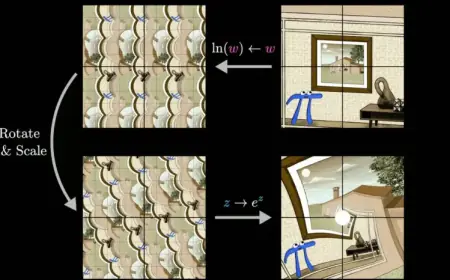
A recent video by 3Blue1Brown delves into the mathematical transformations behind Escher’s artwork. This analysis is based on earlier research conducted by B. de Smit and H. W. Lenstra Jr., who published a pivotal paper in 2003. Their work elucidated the complexities of Escher’s designs and examined the enigma surrounding the center of his piece.
The Mystery of the Center
In Prentententoonstelling, Escher created a transformation grid made up of square rectangles that could replicate images without alteration. However, the center of this grid remains an empty void, marked only by Escher’s signature. This design choice has sparked intrigue and speculation among art and mathematics enthusiasts regarding its potential completion.
Mathematical Foundations
The researchers proposed that filling the central void could be achieved by interpreting the artwork as drawn on an elliptic curve within a field of complex numbers. Initially, the transformation appears straightforward, with just four rectangles positioned at varying zoom levels. The challenge lies in effectively connecting these rectangles to form a cohesive image.
Automation and Innovation
This innovative approach can be automated using demonstrated complex methods, ultimately allowing the central area to be filled in. The results produce a captivating Droste effect, showcasing the intricate mathematical beauty in Escher’s works. Notably, Escher achieved this complexity without any formal mathematical training, underscoring his unique talent and vision.
- M.C. Escher’s drawing: Prentententoonstelling (1956)
- Key researchers: B. de Smit, H. W. Lenstra Jr.
- Pivotal paper published in 2003
- Focus on elliptic curves and complex numbers
In conclusion, M.C. Escher’s artwork continues to intrigue both artists and mathematicians alike. His ability to intertwine visual artistry with complex mathematical principles remains a topic of study and admiration at Filmogaz.com.