

























River Overflows, Engulfing Its Banks

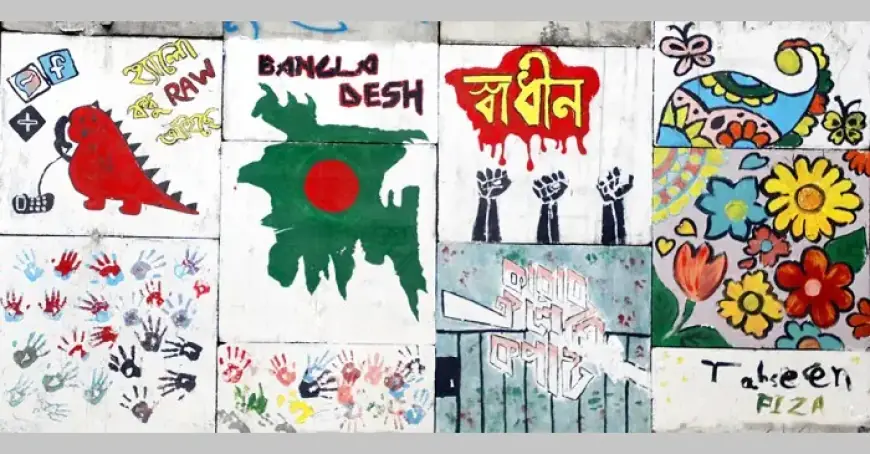
A graffito painted on a Dhaka wall became a potent symbol during the July uprising. It captured the anger and hope on the streets.
From liberation to one-party rule
Bangladesh won independence after the 1971 Liberation War. The victory followed mass suffering and political exclusion under Pakistan.
By 1975, Sheikh Mujib had dissolved multiparty democracy. He created BAKSAL, a one-party system, and concentrated power.
Sheikh Mujib was assassinated in August 1975, along with most of his family. The killings opened the way for military rule.
Military rule and managed democracy
Generals governed Bangladesh from 1975 until 1990. Their rule combined repression with displays of electoral legitimacy.
General Ziaur Rahman rose to power in the late 1970s. He held referendums and elections that critics called managed.
General Ershad ruled for nine years. He allowed parties and some press freedom, but elections and institutions were tightly controlled.
Ershad fell in 1990 after a mass movement. After that, power alternated between Sheikh Hasina and Khaleda Zia.
The 2024 uprising and interim government
In summer 2024 students mobilised against a job quota system. The protests broadened into a challenge to long-standing political practices.
About 1,400 people were killed during the unrest. The violence and loss hardened calls for systemic change.
Muhammad Yunus led an interim government after the uprising. His administration presided over negotiations for constitutional reform.
The July National Charter
Negotiations in 2025 involved more than two dozen political parties. The effort sought to translate protest demands into institutional reform.
- The charter proposed prime ministerial term limits.
- It called for an independent judiciary and a bicameral parliament.
- It proposed a neutral caretaker system for elections and guaranteed civil liberties.
The National Consensus Commission and 24 parties signed the charter in October 2025. The document aimed to bind future governments to reform.
Electoral verdicts and promises
In 2026 voters gave the BNP a two-thirds parliamentary majority. A referendum held with the election approved the July Charter by over 60 percent.
The BNP had signed the charter and campaigned on implementing it. Its 2026 manifesto explicitly pledged to deliver the agreed reforms.
Oath controversy and stalled reform
At the new parliament’s oath-taking, MPs faced two pledges. One was to uphold the Constitution; the other was to respect the July Charter.
BNP MPs took the constitutional oath but refused the charter pledge. Only MPs taking both oaths qualify to serve on the Reform Council.
More than two-thirds of lawmakers declined the second oath. The refusal effectively hollowed out the charter’s reform architecture.
The BNP argued the charter lacked constitutional force and that the party had not been elected to the council. Critics called this reasoning insufficient.
Public reaction and accusations
Student groups and reform organisations denounced the parliamentary choice. Some called it a betrayal of the blood spilled in July.
The National Citizen Party and Students Against Discrimination warned that the charter’s handling broke public trust. The anger was visible on the streets.
Patterns and prospects
The sequence recalls earlier cycles of hope and disappointment. Each episode has eroded civic trust incrementally.
Like a river that overflows, engulfing its banks, accumulated sediment chokes the channels of public confidence. The metaphor fits recent events.
Yet the public refusal to accept betrayal has reappeared repeatedly in Bangladesh’s history. The political argument remains unresolved.
Dr Habib Zafarullah contributed analysis. He is an adjunct professor at the University of New England and a former professor at the University of Dhaka.
This report is published on Filmogaz.com.